Consiglia

The sun was melting into the skyline when Consiglia decided she needed some air.

Though hot and stifling – almost as suffocating out of doors as in – she needed to move, or surely she’d go mad.

Each day had been growing hotter.

And hotter.

One could feel the trapped heat rising from the narrow streets.

Even the patches of shade, which usually offered instant relief, had succumb to the relentless sun.

It was as if the small town where she was born, the tiny, tired home where most of her family had lived and died, and the familiar streets she had rarely left, were smoldering.

Seething.

And each day the temperatures rose, his tolerance for her grew shorter.

And meaner.

Meaner even than she had gotten used to after thirty years at his side.

Under his foot.

In his control.

At least, she convinced herself yet again, he had never hit her.

The absurdity of this thing she repeatedly told herself to be grateful for, made her shake her head and grimace, as she slipped out the door and onto the ancient cobblestone street.

Not even nightfall was offering much relief from the heat and although this was the height of the tourist season, and a time of year when life was usually buzzing joyously around the main piazza, this night was unusually quiet, with only a scattering of people at the piazza’s two cafes.

For this, Consiglia truly was grateful.

She didn’t want to see anyone she knew – she had known her entire life.

Even the thought of a moment’s eye contact with a stranger made her panic (being certain it would cause her to burst into tears out of sheer jealousy that they were from anywhere but there), so she slid along the dark walls of attached homes and darted down the nearest street.

The same excuse pounded against her thoughts again and again: At least he has never hit me.

So mocking and repetitious were the words, she put her hands to her ears to try to block out her own thundering thoughts, finally screaming, “ENOUGH!”, then scanning the road for someone who might have heard. 

No one heard.

But oh, his brutality, she nearly laughed aloud, is generously dished out by other means.

Bitter, cruel words inflicting wounds much deeper than any cut to the flesh.

Each slicing to the soul.

To the self.

Leaving scars that never heal and a human being now halved, and half believing.

The all too familiar neighborhoods of the small town soon gave way to old stone walls and burgeoning farm fields where the meager winds, unfettered by buildings and asphalt, were liberated, and the air felt a little fresher.

Freer.

As she longed to feel.

She picked up her pace as dark thoughts and nasty words became the only inhabitants around her.

Consiglia had no direction in mind, but it didn’t matter in the least, as long as it was further away from him – from the yelling and the belittling and the normalcy it had all become; as chronic as cooking three meals a day, hanging out the laundry, sweeping the stairs… hiding the hurt.

She finally stopped below of wall of Jasmine in full bloom and took a long, deep breath. The overwhelming sweetness of its fragrance made her happily dizzy, so she sat beneath its thick, trailing vines, at the side of the dark, desolate road and wept, like she had never wept before.

Her body convulsed.

Her throat released a moaning so low, loud and guttural that it frightened her. But there would be no stopping it until, like the cries of a dying animal, all its life had been released.

This would take some time.

When, at last, the moans had subsided to quiet whimpers, she lay down with her head in the dirt and dead leaves, closed her swollen, stinging eyes and rested there until her breath returned to normal and her mind turned to tomorrow.

She knew she could stand no more like today… or yesterday, last month, or last year…

Consiglia had had enough.

Slowly, she picked herself up, brushed the petals and dirt from her hair and her clothing and in that moment, felt as if she was brushing away all that had been and all that she had allowed her life to become.

She began walking again, taking the first, slow steps in the direction of town and then stopped… and taking a long, slow breath, turned in the opposite direction.

Having no idea of what she would do, or where she was going, she smiled and picked up her pace knowing only that there would be no going back.

Midday Ave

Holy Mary, full of grace, the Lord is with Thee.
Blessed art thou among women,
and blessed is the fruit of thy womb, Jesus.
Holy Mary, Mother of God, pray for us sinners,
now and in the hour of our death.
Amen.
~ Ave Maria prayer

As dependable as the midday church bells chiming, the radio goes on in the kitchen across the way.

The program begins with a clarinet solo of Franz Schubert’s famous song (originally titled, “Ellens Gesang III, or Ellen’s Third Song”), but now most commonly known as “Ave Maria”.

The clarinet is slow, steady, and rather sad; and after a few refrains, is joined by a quiet chorus of female voices – also slow, steady and rather sad – who bring us to the beginning of the program.

I can only assume the soft-spoken moderator – or holy host – is a nun (or at least sounds like what I can only hope a nun sounds like).

Blessed art thou among women.

And even though my Italian is not at a level of complete comprehension, I am able to understand that the gist of the daily docket is an advise format, sort of like the Catholics’ “Dear Abby”.

Folks from all over Italy write in for counsel on their personal and familial problems and she guides them with sisterly advise (mostly rosaries and prayers) to finding peace and resolve.

Pray for us sinners.

Everything about the radio program is done in an almost hushed tone and even though I don’t understand much of it – nor subscribe to any of it – the sounds soothe me as I sit near the window, reading or writing.

Until, like clockwork, the family next door gathers around the radio and kitchen table for their midday meal. From what I can construct from the voices (and whom I have seen coming and going), the clan consists of a husband, wife, brother, and hard-of-hearing, aged mother.

As the meal begins, the programme, as well as the food, seems to garner their attentions and keeps conversations to a minimum; while the radio host doles out a series of rather benign pieces of advise to her listeners and correspondents, such as “Listen to your brother.”

Blessed art though among women?

Inevitably, however, as the meal ends and plates are cleared and clatter in the sink, dialogues begin.

At first, they are usually brief exchanges, punctuated by occasional laughter or exaggerated superlatives (as Italians are apt to offer), yet what starts as innocuous and inoffensive soon – and inescapably (or so it appears) – escalates into something altogether ungodly.

The Lord is with Thee?

Already strong voices are now raised to such pitches as to shake dust from old crevices, and reverberate off the closely constructed neighborhood walls, blasting through the serene, midday pausa, like firecrackers in a church.

Heated.

Mean.

Unloving exchanges.

Usually ending in several, “Va fancullo!”, and a slamming door.

Such hurtful words being discharged daily to supposed loved ones.

Full of grace.

At first, I found their noontime routine shocking – probably more because of the sheer volume and close proximity (not having neighbors so near at hand for decades) – than the occurrence, itself.

Soon after, I found its precise regularity rather comical, especially due to its simultaneousness with the programme of peaceful prayer they are so committed to tuning into everyday.

Now and in our hour of death.

Nowadays, I still find it darkly amusing, but also incredibly disturbing that their terrible treatment of one other has become such a hardwired part of their lives that they are numb to its effect on each other, as well as all those living near them who have involuntarily become part of it.

So habitual have these brief but bitter battles become that almost as regularly, the brother (usually the nastiest, as well as the door slammer) returns to the fold a short time later, whistling a happy tune.

Even I have more or less numbed to it.

Pray for us sinners?

Can calmly set my inner clock to it.

Even knowing such exchanges have to cut deep.

And never have time to heal when each day they are reopened.

Re-spoken.

Reheard.

Just as repeatedly as the prayers on the radio.

Listened to no longer.

Now and in our hour of death.

And so tomorrow, at noon, the church bells will chime once more.

The radio will be turned on.

And the family will gather round the table.

To repeat the ritual.

Amen.

Queen of Spuds

She looked in the mirror and noticed a large pustule on the right side of her nose.

It hadn’t been there when she climbed into bed the night before, nor had there been the usual signs of its arrival.

Redness.

Irritation.

Swelling.

Nothing to warn her something was going to pop up.

But there it was, larger than a marble – and just as shiny – begging her to mess with it.

Relieve her face of its unsightly appearance.

Leaning into the bathroom mirror, she placed both index fingers on either side of the mass and with determination… squeezed.

Hard.

What issued forth did so with unexpected ease, but more surprising was the enormous amount of pus – if one could call it that – which oozed forth.

A pastry bag filled with mashed potatoes was the image she couldn’t shake, as an hellacious amount of creamy, white, semisolid goo continued to issue forth until she felt faint by the sight and sheer volume of it, and had to stagger out of the bathroom to steady herself by sitting on the edge of her bed.

“What the fuck was that?!”, she cried aloud.

For the first time in her life, she felt near hysterics.

“Calm yourself, woman. There is a simple explanation for what you saw – or think you saw.”

Closing her eyes, she lay back on the bed, hoping the last of the pus had erupted and that she would return to the mirror after a few deep, cleansing breaths, to find a small, raw, unsightly crevass – and nothing more – where the strange pustule had been.

“Just your average, everyday zit,” she laughed unconvincingly.

Steadying her breath, she opened her eyes and watched the ceiling fan above her spinning.

Normal.

She turned her head right to see her nightstand, piled high with books, and the alarm clock, which read 7:17 a.m.

Normal.

Turning her head left, toward the bathroom door, which was wide open, she could see a portion of the mirror where she couldn’t be sure whether she had just experienced the creepiest moment of her life, or quite possibly stood half-asleep, having not completely stirred herself awake from an outrageous nightmare.

Everything there appeared normal, so slowly raising herself, she sat up and was just about to stand when she looked down.

What she was seeing just wasn’t possible.

Her body shook violently, as she grabbed for her glasses on the nightstand, which only brought the grotesque site clearer into focus.

Her feet resembled nothing of the sort, but instead were clumps of earth with winding roots, tubers and stems – what she could only describe as a potato plant where her feet should have been.

She reached out, but stopped.

Instead, she attempted to wiggle her toes hoping the action would – as when your foot falls asleep – create a tingling sensation and wake her from this strange scene.

She watched the soil shift a bit as she set her entire being to the task, but she felt no tingle and her toes and feet remained indiscernible.

Shocked to silence, she stumbled to the bathroom, and sitting at the edge of the tub, began clawing at the clumps of dirt and tubers and leaves, but to no avail.

In fact, each time she did seemed to stimulate further growth.

An inner voice shrieked, “For god’s sake, then don’t use water!”

Grabbing a pair of hair scissors from the bathroom drawer, she looked down.

She was desperate to start cutting at the roots and runners.

To stab through the clumps of dirt.

To find her feet.

But the fear of cutting off her toes stopped her cold.

With the scissors still clenched in her right hand, she looked to her face just visible above the sink in the lower part of the mirror and, raising her left hand, she SLAPPED her left cheek as hard as she could.

“WAKE THE FUCK UP, ANNE! THIS ISN’T REALLY HAPPENING!”

But the sting on her cheek, and the red welt now rising on the side of her face, were telling an entirely different reality.

Sheer panic dug the scissors into the roots and soil below, but the more she stabbed and cut, the more the plant grew and wound further up her legs.

She dropped the scissors and feverishly began pulling at the expanding, sinuous roots, stolons and stems with her hands, now feeling their movement under her skin, climbing up her torso like a hundred, small snakes.

She pulled and pulled and pulled at the never ending plant, like a magician pulling the infinite handkerchief from his pocket – the sudden image of which sent her into frenetic bursts of laughter and tears.

“Somebody… help me,” she whimpered, still pulling at the potato plant now winding its way in and out and up her body as if this was now made of nothing but soft, accommodating earth in which to propagate.

By the time she reached the front door, it had wound around her neck, choking her pleas for help as she stumbled outside and into the front yard.

The dirt and the potatoes, the tangled roots and leafy stems, had become too much weight to bear and with a final gasp of “Why?”, which filled her mouth with earth, forward she fell with a heavy, earthen thump onto a patch of ground she had recently readied for a small vegetable garden

She didn’t know how much time had passed after her collapse – for time meant nothing now – before she heard footsteps through the dark and silence that entombed her.

Though muffled and distant at first, the voices were familiar, being those of her two best friends who had come by to borrow a picnic table for the barbecue they had all planned for that evening.

She struggled to move.

To speak.

To scream.

But as she did, she felt the roots wrap tighter.

Not getting a response to their knocking, her friends turned to leave, but not before spotting the enormous, fecund plant growing out of the garden patch, bearing so many potatoes they were bursting from the ground.

They looked to each other and smiled.

“She won’t mind if we take a few for the barbecue,” she heard one say.

“Of course not,” answered the other. “After all, she’ll be there to enjoy them.”

“Besides…” one of best friends continued, as she yanked at the large tubers erupting from the soil, “look how many there are!”

“Did you hear that?” she asked, holding a triumphant clump of potatoes clinging to a tangle of roots and dirt.

“Hear what?” the other replied.

“I swore I heard a scream,” she said uneasily.

“I didn’t hear a thing,” said the other as she turned and walked away. “I bet Anne will be really pleased that her potatoes will be a main part of dinner tonight.”

“I hope so,” said the potato-laden friend, who rose from the garden patch, but not before hearing a low, smothered whimper rising from the soil.

“It must be the heat,” she laughed to herself, leaving a trail of dirt, and a flicker of doubt, behind her.

This House

This house

now weighs heavy on my heart

where once was light

we nurtured from the dark;

where when we moved ourselves

within these walls,

neighbors turned to friends

and friends turned all.

Where varied folk

met on this dusty road

and found a kinship

worth a weight in gold.

But years have passed

and seeds have scattered

and once things did,

but now don’t matter.

Cause when the world

was forced to shift,

what was once,

no longer fit.

And as the view

began to change

and i unchained

the new within,

these walls –

this world –

became a cage

guarded by a new found rage

of my own making.

And it started me thinking.

Now new worlds lie in wait.

My love and I

can feel the weight

lifting

and roots

shifting.

And this,

our beautiful home,

our past,

lovingly

and finally,

releasing.

Dad

The doctor’s last count was seven.

Each stroke leaving in its wake

a little less Dad.

Less motivation.

Less vision.

Less presence.

Then he lost his license.

So Dad just sat.

Eventually losing sight

of all that made him tick.

Gave him purpose.

He was good at.

I watched the frustration

when things weren’t clicking

in his once playful eyes,

in his quick and clever mind,

and quietly mourned

the lengthening shadow

that would smother such strong light;

turning weaknesses upon himself,

and others.

The shadow strengthened,

as the once powerful figure

could no longer focus.

Spent the days crying.

The nights wandering.

His underpants,

soiling.

Conversations were now repetitions,

driven by a series of questions

he’d ask again and again

and again.

Always about family,

living and dead.

No steering away

from this endless thread.

But it’s all that remained

as he struggled for thoughts.

For words.

For himself.

The bygone body, swaggering and bold,

began to weaken,

and wither,

and fold

from all those years of sitting.

Doing hours and hours of nothing.

While cherished faces,

and times and places,

steadily stepped into the dark.

Rare became the instants

during my brief, long-distance visits,

when I saw that certain twinkle in his eyes.

When he was pleased,

about to be silly –

or incredibly Dad.

But then

alas

it would pass

and entered this man, instead.

The only thing constant

was his wheezy, cartoon laughter

which he easily summoned

to the great relief of everyone

hovering uncomfortably in his small, sad room

scattered with pictures of loved ones –

now mostly strangers.

Rarest was hearing the voice of his past,

which sang in my ear

when he used my pet name.

Summoned forth in fugitive instants.

Clear and compelling.

Making me unexpectedly ache,

and anxious

to hear Dad speak again.

But Dad never did.

Yet in that flash,

in his strong, familiar voice,

he was my beacon,

my banker

my mentor,

my tormentor,

My father.

And everything felt right.

Then it didn’t.

And I cursed myself

for not plucking from the ether

that all-too-brief moment

to stuff deep within my pockets.

and help me remember

his long and strong hugs

of immeasurable comfort.

His powerful presence.

His stubborn dreaming.

His cocky, foolish, bridge-burning scheming.

The maestro of his successes

and Master of his failures.

But grateful for the moments

we spoke about nothing

and I apologized for everything.

Though he wouldn’t remember anything.

But love is in the giving.

In the times he heard,

I love you.

So, I told him different stories

about faraway lives,

and in between the questions

and his uncontrolled emotions,

I‘d try to fill the ether

with soon forgotten memories.

With love and laughter.

And strong hugs

of immeasurable comfort.

The Train

Staring at the corner of his small, shaded, shared room which smells of disinfectant, death and old wool, all that’s left of Jake’s life stands on the shelf before him: dusty, unframed photos (faded images of lost faces, youth and health) on a teetering pile of once comforting books, earmarked and yellowed, barely held together by their cracked and broken bindings.

Lifting them from their place would reveal a thick outline of their long neglect.

The books are now just painful reminders of his last stroke and the words are un-consoling strangers among the unclear images that come, and mostly go, of what’s come and all but gone in Jake’s long, lonely life of merely living long.

Yet there’s something on that meager shelf the old man will treasure forever.

It came to him one summer from his only uncle, Joe, a large, quiet man with the strength of a bull, who worked his whole life in the northern logging camps bringing down trees and building other men’s wealth.

Their meeting was brief (but the moment still strong) in a desperate childhood filled with hunger and want.

He’d come down from the highland forests the summer Jake turned six.

The air was stifling – thick – as was Joe’s large frame filling the door of the derelict cabin where the boy and his mom scratched out their living mending shirts, washing laundry, running errands.

Whatever work to be found up and down the great, green mountain.

The unexpected visit surprised Jake’s mom, who hadn’t seen her brother since they were young; sent off as soon as they could earn a living on their own.

She embraced the waist of the burly, bearded man, who returned the hug with one, massive, tree-trunk-of-an-arm, then turning to his only nephew with a wide, toothy grin, Joe revealed his hidden arm where two objects lay in his giant, calloused palm.

With fingers big as branches, using bits of paper, bark and wire, the woodsman had turned simple scraps he’d found around the camp into a logging train, with a smokestack engine coupled to a car fully loaded with tiny, timbered logs tied up with string.

“Ain’t much.”

But it was absolutely everything.

Sitting at the large, well-worn work table together, Jake’s uncle and mother searched for words to close the gap of so many years; while the boy rested his chin against his sinewy, tanned arms crossed atop the hard-scrubbed pine.

Staring eye-level at the train.

Hesitant to touch it for fear it would, like a fidgety spirit, fade away.

Or worse – break in his young, but hardened hands.

Just studying it – knowing it was his – was more than enough for the boy.

The brief visit would be the first and last time he would see his Uncle Joe, whose large, lumberjack’s frame had barely left the shadow of the shack before the grind of what would be Jake’s life had begun again.

Having that train in his sight each day – the one made just for him a lifetime away – made even the strangest places left behind and those ahead, endurable.

And Jake feel fairly human.

The Girl in the Red Velvet Hat

I saw a girl in a red velvet hat with feathers to one side.
Meeting her eyes, I smiled.
She grinned, but shyly turned her gaze.
So I studied her young silhouette
and thought of long past days.
Of ladies in fabulous hats and fitted suits,
with cigarettes and smart comebacks
for men in Fedoras, white shirts and ties
who secretly longed for the sassy, young ladies
in red, velvet hats with feathers to one side.

The Gift Inside

The tuk-tuk spins around the corner of the centuries-old church, just missing a mother standing in the middle of the busy road, trying to get her miserable-looking teenagers to stand within spitting distance of each other, their father, and the stain-glassed building they walked three tension-laced miles to see.

Maria doesn’t flinch.

Her long, brown hair sails behind her as the little, red tuk-tuk jerks momentarily left, then hugs the turn and hums up the narrow street to a shady spot below a gnarly, old tree growing through a courtyard wall.

Daily spirited by the desire to pay off the money she borrowed to buy the three-wheeler she’d been driving for someone else long enough, Maria is out looking for fares each morning as soon as the day’s first voices rise to her third floor window from the narrow streets, cramped with crumbling, pastel-colored buildings.

And in a couple of hours, eager tourists.

“Such a hard worker,” the old ladies on the streets call to her each morning from different stoops and stories, where they hang their gossip and their laundry, and look to the cloudy skies with defiance.

“Such a lovely girl,” they laugh and shout down the narrow streets, good and loud, so Maria (already around the block) can still hear, “but too much putt-puttering and not any kissing!”

Setting off a chain reaction of neighboring howls coming from behind damp sheets and dangling undergarments.

Even the young men from the neighborhood stop what they were doing to watch her pass, as she doggedly criss-crosses the city in her shiny, red tuk-tuk.

And if they catch her eye and she smiles their way…

But Maria just sees her city.

And curious faces – of all shapes and sizes – in her tuk-tuk’s rear view mirror, swaying and smiling at each twist and turn, as she putt-putters up and down the city’s rolling hills; laying bare the love of her birthplace, with its pocked and weathered walls and bustling river banks.

The city’s recent reawakening fills Maria with such joy that she wears her smile like her old, lace-up sneakers – daily and for the same reason – from the moment she uncovers her bright red partner, until the deep dark of a new day drags weary sightseers indoors to rest their blistered feet, and Maria up the stairs.

Each exhausted, but eager for the morning.

Quieting in the wake of the high season, the young guide with the easy smile, decides to linger longer than usual in the shade of the churchyard tree and the stillness of the dead end.

Taking a rag from below her seat, she circles her tuk-tuk.

Inspecting.

Polishing.

Proud of it – and herself.

But the tuk-tuk already sparkles in the filtered light of the autumn tree. So, she puts the rag beneath her seat and reaches into a striped, canvas bag next to it, lifting out an oval box with thick metal molding, pointed and curved, and crownlike.

Sitting with her feet on the dashboard and the box on her knees, Maria carefully examines it – the cold of its molding and warmth of its wood; its tiny lock, with its tiny key hanging from a string tied to the handle.

Which, as she’d promised on the day she received it, still hadn’t been used in the lock.

Nuno, the young man Maria knew from the bodega around the corner from where she parked the tuk-tuk, surprised her with it one day, coming out from behind the wide, low wooden counter.

She had never seen the dark-haired, dark-eyed, somber young man anywhere but behind the cash register, and he hadn’t spoken a word to her in two years, just a smile-less nod each day he handed her change.

His dark eyes looking straight into hers, but his face still and unrevealing, he walked straight at her with what looked like a small treasure chest in his hands.

The box she now held in her hands.

He thrust the it toward Maria with great urgency, causing her to stumble back and nearly topple a tower of tourist magnets. With barely a moment to right herself, Nuno was unapologetically upon her, with the box still clutched in his outstretched arms.

“I made this for you,” his words tumbled out.

Maria had just found her balance, when his words made her knees give way.

Bracing herself, she searched for something to say.

“That’s very sweet, Nuno, but I couldn’t take such a treasure from you.”

As she said it, the young clerk’s face dropped, as did his arms holding the handmade gift.

Maria lunged forward to save it from hitting the old, stone floor – catching the box by its thick, wire handle, finally leaning against the well-worn counter, finding her only comfort in its steadfast timbers.

“I’m so sorry, Nuno,” she smiled as she held the box up and began to admire its strength, warmth, uniqueness. “It is a lovely box, but why would you make me such a thing?”

“The gift is not the box,” he said, surprising Maria again. “The gift is inside.”

Maria turned the handsome, oval box.

If it held something inside, she said smiling and embarrassed as she gently shook it near her ear, it felt rather light.

“You’re teasing me,” she giggled, feeling her cheeks turned red.

“I promise,” Nuno insisted with such gravity that Maria’s heart jumped, “I am doing no such thing.”

Setting the gift on the counter, Maria reached for the key and slipped it into the tiny lock, but before she turned it, she found Nuno’s hand gently, but firmly, on top of hers.

“Please promise me you won’t open it… not yet.”

Maria removed her hands from his and looking into the eyes of the serious, young shopkeeper (even though the promise and its many unanswered questions made her uneasy), she accepted the gift.

Picking the box back up, she briefly hugged it to her chest with the promise, and thanked him.

“You’ll let me know when it’s time?” she smiled, as she turned toward the stain-glassed shop door, glowing red and blue in the waning sun.

“You’ll know,” replied Nuno, meeting her eyes for a moment, then disappearing to the back of the shop, behind the large wall of warped shelves, thick with as many layers of paint as the generations who piled them high with boxes of goods not paid for with promises.

Lost in thoughts of this very recent event, Maria didn’t notice the elderly American couple until they were at her side, holding hands and umbrellas, with tired feet and hopeful smiles below ever darkening skies.

Putting Nuno’s gift into its bag and grabbing her plastic-coated maps, the tuk-tuk is soon trailing behind the city tram, rattling along well-trodden tracks, passing wondrous, worn buildings covered in ceramics, still bold and bright and remarkable.

Uneasy thoughts of Nuno and his gift are replaced with the familiar smells and sights of her beloved city, its bustling centers filled with buses and tour guides and taxis, and tourists wanting to see it all in two and a half days.

Its ancient walls built upon ancient layers, held upright and together by scaffolding, hope and netting.

Like the graffiti cast over the city.

Powerful and profoundly beautiful.

Angry, ugly and rueful.

Telltale scars of its 20th century life.

Yet her city survives.

Battered, but proud.

Heart beating strong.

Maria senses it around every corner, in the stacks of salted cod on the shelves and fresh meats hanging from the windows; in the terraced, cobbled steps heavy with the scent of citrus trees; where residents sip dark amber wine and listen for the Fado singers to begin.

She hears it in the sounds of children laughing and screaming from the school’s rooftop garden and sees it in the dark, narrow shops piled high with dusty, unwanted goods; where crumpled, old shopkeepers (long past keeping shop), hover at the entrance, searching more for conversation than customers.

Parked in front of one of these old stores, Maria waits while the American couple explores the ruins of a Roman arena. Her thoughts again wander back to the box, to Nuno, and her promise – all of which had begun to weigh on her.

People in the neighborhood had even taken notice.

“She hasn’t smiled since she got that box from Nuno,” they’d whisper down the alleys as she slowly puttered past, wearing a distracted look like a pair of sunglasses.

“What has he done to our happy girl,” they’d moan like the start of a sad folk song. “He must let her see what’s in the box before it drives her mad.”

And that’s just how Maria was beginning to feel.

Each time she lifted it from its canvas bag to examine it and question it – which she did again and again and again – the box felt heavier.

And the heavier it got, the more compelled she was to carry it with her.

Before long, Maria could be seen toting the burden down the long, narrow stairs and alleys, straining and frowning, but keeping her promise of keeping it locked, until one day the box became almost too heavy for even her faithful, old, three-wheeled friend to carry up and down the hills of her treasured city.

She could take it no longer, and leaving the onerous box and the American couple in the tuk-tuk, she stomps toward Nuno’s shop, practicing aloud all of the questions that had been troubling her nights and her days.

Nuno sees her enter the shop out of the corner of his eye as he helps a young boy count his change to buy the very last pastry of the day. Only when the boy is out the door with a mouthful of custard and the tart half-eaten, does the young storeowner look toward Maria and nod.

“You must come and take your gift back,” she says loudly and abruptly.

The young man stands frozen and silent behind the counter.

“Please, Nuno,” she begs with tears already falling from her tired eyes, “It does not belong to me.”

The young man stares at her until she begins to question her decision.

Without a word, Nuno walks out of the store, passing so close to Maria she can smell his disappointment.

But not looking at her.

Maria follows him out onto the cobbled street, jogging to keep up with his long, determined strides.

Approaching the shiny, red tuk-tuk, riding even lower with the weight of its mysterious gift, Nuno searches for the familiar canvas bag and reaches inside, hesitating far too long before lifting the box out.

His head sunk low.

“Inside is my everything,” he groans and shakes, as he strains to lift his cumbersome gift.

Maria wants to reach out, but she can already feel the lightness the further away Nuno and the locked box get.

It’s days before she can drive past Nuno’s shop and is shocked to see the shudders on its windows and a sale sign hanging from the stained glass door.

Maria brings the tuk-tuk to a sudden stop in front of the shop and jumps out, looking both ways for nosy neighbors before peaking through a small pane of clear glass on the door.

Everything is gone.

The once, well-tended floors are now littered with newspaper and the shelves are barren and beaten. Maria’s eyes quickly find the only thing that remains – the box – sitting in the middle of the low, wooden counter at the back of the shop.

Maria’s insides twinge.

The box is closed, but the lock has been opened and is still latched, though its tiny key is no where to be seen.

She leans her head heavily against the door and sighs.

Reaching for the handle, but stops herself as soon as her fingers touch the cold brass.Stuffing her hands in the pockets of her jeans, Maria turns away from the shop with a sad smile, climbs into her shiny, red tuk-tuk, and put-putters away.

The Wind and the Owl

When the central highland winds howl through the valley and rattle the windows of our house on the hill, shaking and bending the juniper and pinion trees I see beyond the shuddering panes, my body and mind still brace for the only thing that comes of such blustery warnings to the Midwestern me.

The menacing advance of a fearsome storm.

Intense and unforgiving.

I feel my body – tense and taut – bracing for the worst with each swollen

Pacing through the house.

Anxious for it to stop.

Or me to move.

So my dogs and I head out for our walk, prepared for a fight against tempests and cold and I’m ever surprised to find the winds far more kind than I imagined.

Mellowed by the sun’s abiding strength.

Layers are shed at the start of our walk and the warm, constant breezes now push me, Frank and Nellie to the chapparal below, where I know the sweeping winds will blow much gentler music across the tall grass. And at my back, urge me forward toward to the far fence line where the pronghorn often graze.

But downwind today, well warned of our arrival, they’re likely to have scattered; prompting me to turn against the wind and start a circuitous loop back home.

Toward the scrub oak and junipers.

Shelter and shade.

And the shadowy scent of Mountain Lilac blossoming profusely in the wake of generous winter rains.

The gentle fragrance of this rugged bush, appears and disappears with the shifting winds, lifting my spirits with each sweet return, as I wander up and down the hills with my two, most joyful companions.

The world in their noses turned into the breezes.

Close to home, I see a Great Horned Owl take to the air just a few feet ahead.

I hear one, grand flap of his wings. And then nothing.

A familiar shadow among the neighborhood trees, I track his flight and see him perch again in a pine, up the hill and up ahead, and I follow with glee.

Silently.

Deliberately.

From tree to tree.

Hidden among the dark, green boughs of an old, domed Juniper, heavy with pollen, the owl waits. But just as we near, off he goes, higher up the hill and closer to home, past the scattered remains of a long dead tree which lay like a skeleton, gray and sunbleached, exactly where it fell.

Pursuing him again to yet another tree, it’s as if the owl is hunting me. For, there, in a clearing of branches, the great hunter sits.

Quietly watching us move up the hill.

Allowing me the perfect view of this very perfect predator.

Staring still, my eyes meet his, until he decides we’ve come close enough.

And that is that.

He spreads his wings and disappears, without a sound, among the pinion near the old pit mine.

I try to reconnect at a fourth tree ahead, but instead, meet a noisy grackle balanced at the top of the tree where I hoped the Great Horned Owl would be. But he has already continued on his way, up the hill, over a fenceline, and out of my sight.

Certain we’re not out of his, I scan the trees on the hill in vain.

Unleashing the dogs, Nellie’s off in a dash in her fruitless pursuit of chasing small reptile.

Zigging and zagging, but never succeeding.

I think she’s just teasing.

My call for her cuts through the wind and the white-noised silence.

Unsettling me.

Until the music of the wild winds in the scrub oaks and the pines, in the final footsteps home, help me find my peace and place again.

The Water Jug

There once sat a giant water jug in the corner of the plaza

of a tiny, wind-beaten, anywhere town.

The brown and green mottled jar

well over two meters in height

had been there for as long as anyone could remember;

and no matter the day, time, year, or generation,

the jug was always filled with water,

ever fresh and cool within its thick, clay walls.

A clean, wooden sipping ladle, soft to hold and handle,

tied to a braided rope of gem-colored ribbons,

always hung about the shiny brass spigot

found one-third the way up the vessel, at a height for all to reach.

Below this, sat a large stone trough,

which caught each precious drop,

and where all the town’s creatures came to sit and sip.

No one ever dared lay claim to be the one who filled the giant jar,

for all knew that to keep it thus, meant miles of travel

and toting to and from the nearest well.

“Such a blessing, indeed,” they would remark to each other as they drew from the tap,

“to have such a friend – or friends – as these!”

Some curious folk tried, here and there, to lift the jug

to see if its source was, perhaps, not a person, but a spring, or pipe.

But the jug wouldn’t budge.

And, once more, attentions would turn elsewhere –

away from the shiny, earthen jar that watered their gardens and helped make their broth;

cleansed and nourished them.

Its mysterious origin would fever the imaginations of the town’s newcomers,

but soon they too, would, without much thought,

take from its bounty as one takes a breath.

The years passed.

The town got bigger.

And the jug continued to give… as best it could.

No one noticed when the braided silk ribbon holding the ladle frayed and finally fell,

splitting the old, weatherbeaten, wood scoop in two.

The faded, unravelling rope blew away with the winds,

and the ladle pieces were soon buried in the dirt kicked up by another,

and another, and another at the spigot.

So it should come as no surprise that no one noticed the first crack –

a hairline near the top, by the lid (now missing its knob).

Or the second, at its base in the back.

And how could anyone have known

without ever lifting the high, heavy lid – long devoid of its handle –

that the jug was now only able to half-way fill?

More years passed and more people came to settle near

and depend upon the water jug in the corner of the old plaza,

not paying much mind that the spigot was getting harder to turn

and the water came in troubled spurts.

Because came it did,.

So, on they went with their lives.

While the cracks in the vessel grew long, and dark, and moist.

One afternoon, an elder from the town

(a sweet and gentle fellow with a crooked grin and wicked humor),

sat upon the old stone trough, scratching a scraggly, stray dog behind its ears,

filling his modest kettle,

when he felt a drop on his head.

He looked hopefully to the sky, but saw not a cloud,

when down came another.

Wiping the tear-sized drip from his eye, he stood atop the trough for a closer look

and there he discovered the crack,

now beginning to seep.

His old heart raced, as he began a thorough examination of the giant earthen jug,

soon discovering,

much to his own surprise,

not only dangerous weaknesses everywhere;

but its sad state of neglect.

“What has happened to thee, Old Friend?” sighed the elder

as he grabbed his kettle and turned toward home,

laden with dark thoughts of how the town would fare without it.

Early the next morning, as the sky began to brag,

the old man was already at the water jug with his bucket, trowel, and cement.

After mixing a small batch, he began the patchwork at the bottom,

and worked his way up.

At first, no one in the town took much notice,

but the old man didn’t mind. He was enjoying the work.

He felt useful, helpful – important for the first time in years.

But his work came to a halt as he struggled for some time

to reach some of the biggest cracks at the top of the great jug.

“May I?” a tall lady with bright blue hair finally asked,

setting down her cats, and picking up the trowel.

Before long, other folk began to gather at the water jug in the corner of the old town plaza,

bringing brushes and brass polish, flower pots and benches

– even a new knob for its lid.

It was when the lid was lifted for repair by two of the town’s strongest,

that the water was discovered to be a scant distance from dropping below the spigot,

instantly turning the spontaneous, happy gathering into a very different moment.

Folks began pointing fingers at each other for taking more than their share.

Everyone finding blame everywhere but home.

All the while,

the elder, who sat carving on the giant, bent trunk of an enormous Cottonwood tree,

remained silent…

until he wasn’t anymore.

“It seems to me,” he said a little louder each time,

until by the forth, fed up, he filled his old lungs and croaked

“IT SEEMS TO ME!…”

Someone in the crowd finally noticed and a slow hush came over the townsfolk.

“It seems to me,” repeated the elder, as he very slowly and deliberately closed his knife,

took up the newly carved ladle, shoved it in his pocket, and shuffled toward the jar,

“that each and every one of us has benefitted from what this precious jug has given.”

Nary a sole could disagree, but what could they do?

What control had they over its mysterious bounty?

“Each of us has to give,” said the old man sternly, “for this vessel needs filling.

Give what you can, if only a drop.

Give what you must, for the cracking to stop.

Give what you will for the water to rise.

For the jug to replenish.

For the jar to provide.”

But the townsfolk felt they had done quite enough

with the mending and flowers, and paint, and stuff,

so off they went, back to their shops and their homes and their lives,

having convinced themselves that the jug would continue to supply their needs.

The next morning, the town’s Postmaster went to the jar

to soak her stamp sponge

and turned the handle of the spigot to find not a single…

droplet…

dropped.

She turned the handle harder.

Still nothing.

She got down on her hands and knees

and crouching under the old, brass faucet, stuck her long, thin finger up the pipe

with the hopes of dislodging the obvious offender.

The scene couldn’t help but attract attention from the folks going about their business in the plaza,

and in just a few minutes a small crowd was once again gathered at the giant water jug.

The Postmaster rose with what dignity she could,

and without bothering to wipe the dirt from her hands or knees,

said to the many familiar faces before her, “It has nothing left to give.”

The crowd refused to believe her

and grabbing the nearest ladder, the two same strongest, once again climbed to its top,

removed its lid,

and looked within.

There was water.

The crowd collectively exhaled.

“But only at the very bottom of the jug!” heralded the powerful duo from above.

Panic began simmering.

The greedy began plotting.

And the air became electrified with fear.

Now the elder,

who had been calmly watching the scene from the very same spot as the day before,

shuffled toward the center of the crowd, which quieted quickly.

“Give what you can, if only a drop,”

he repeated from the day before.

“Give what you must, for the cracking to stop.

Give what you will, for the water to rise.

For the jug to replenish.

For the jar to provide.”

“Go to your homes and go to your hearts,”

he said looking into each and every set of eyes that would meet his gaze.

“Fill your cups, your buckets, your glasses, your tubs.

For it’s time to give back to this watering jug.”

The crowd hesitated at first,

scratching their heads,

milling about,

kicking at the dirt and the dust,

causing a small group nearby to begin coughing.

Seeing his mother having more and more trouble breathing, a young man ran to the jug,

and with no thought but of that very moment,

cupped his hand and turned the spigot.

The crowd moved toward the jar with a great thirst.

But,

as the Postmaster had stated previously,

the water jug had nothing left to give.

Coughing gave way to sighs amid silence.

“Give what you can,”

whispered the elder as he wandered through the crowd,

placing his hands gently upon the shoulders of his friends, neighbors and kin,

“if only a drop.

Give what you must, for the cracking to stop.

Give what you will, for the water to rise.

For the jug to replenish.

For the jar to provide.”

And with that the crowd scattered about,

then slowly filtering back

– some with only thimblefuls –

others with great, overflowing basins and bowls.

While still others disappeared from the town completely.

One by one,

each offering was poured into the old, patched jug,

eventually filling it to its brim.

With the heavy lid placed back on top, the remaining townsfolk watched silently

as the elder pulled from his pocket the beautiful new ladle he had carved.

Stepping to the shiny, brass spigot, the old man’s crooked fingers turned the handle with ease.

and he filled the large, wooden scoop with water.

Turning to the crowd with a grand and crooked grin,

he took a refreshing gulp

the passed it to the person closest him,

and on it went.

As the ladle, soft to handle and hold,

was passed to young and old,

rich and poor,

newcomers and natives,

it continued to fill with cool, clear water

for the next and the next and the next.

Until all in the town had sipped from it and then,

without a word,

quietly returned to their homes.

Now one would have thought the story ended here.

That the townspeople had learned their lesson

and the water jug would be tended to from then on.

But folks, like the elder, passed away,

or moved on,

and newcomers settled in around the great, brown and green mottled water jug

in the corner of the old plaza,

having never heard the cautionary tale.

And those who were there,

as most tend to do,

forgot.

So the cracks reappeared

and the water level dropped.

Until one kind soul felt a teardrop on their head,

and looked up.

Winged Chatter

I try to find a new way to wander across the rolling hills of scrub and pine and stretches of grass, each time the dogs and I go walking; and so every day, I get to see familiar things in a different sort of way.

Sometimes this leads to new treasures like old, sun-bleached bones for my growing bone collection, a newly dug den with earth so freshly excavated it’s still moist and brown; or an ancient juniper at the top of a ridge, rounded like a giant, perfect mushroom cap, where generations of cattle resting and rubbing in its shade, helped give it its flat-bottomed, fairyland shape.

But mostly, it’s not knowing where the dogs and I are going, except out.

To explore this small patch of hilly land near our home where Mingus Mountain rises behind Chino Valley to the east, Table Top Mesa and Granite Mountain command the views to the south and scattered homes along long, dirt roads in the near distance remind us we’re never alone.

As does the jackrabbit springing from shrub to shrub, with its skyscraper ears that quickly disappear; or a flock of quails lifting noisily from an impenetrable cluster of apache plume in near perpetual bloom at the side of the wash.

Which, like my path, is always changing.

Crumbling.

Reshaping.

Exposing many tunnels dug feet below the surface (which look like sunken eyes, sunk deep in deep, dark sockets); and hardened roots of Pinyon pines clutch eroding walls, refusing to fall, to succumb to the changes.

Clinging green on so few of its branches.

Yet clinging.

And fruiting and feeding the creatures who live here.

Here in the washes and brushes and hollowed out trees. In the boulders and burrows and fields, where me and the dogs keep wandering, because every day it keeps changing.

Each bloom, each moon, each orbital click.

While the dogs keep on sniffing and sniffing and sniffing, and finding their own unique way, which these days is through a grassy stretch of fleeting monsoon green that tickles my knees and their noses.

The Light of Day

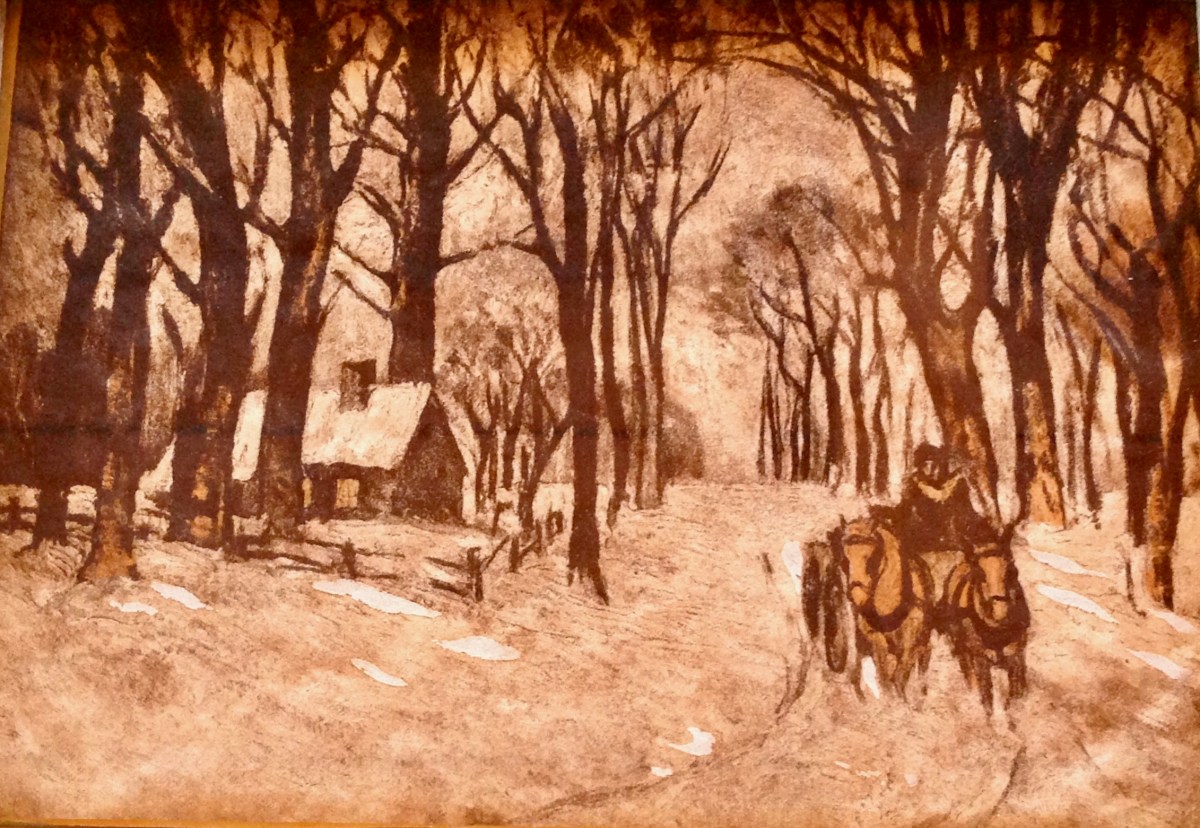
The following short story was inspired by the hauntingly beautiful winter scene pictured. I found this small, 4 x 6, unsigned, pen and ink on paper at a barn sale in Wisconsin many years ago. It remains one of my very favorite pieces. 

Katie keeps the meager fire burning in the small cottage at the edge of the woods, watching her mother twist and turn. Hearing her quietly moan.

Looking around the cabin, she’s desperate for something to do – some way to be useful. But all’s been done in the last two days since the contractions began. So all there is to do is be there when her mother calls, and wait.

Motionless at the kitchen window, she watches the rising sun slowly define the intricate silhouettes of the barren trees behind the barn.

What will the new light bring?

But she’s exhausted and the light is dim. Wiping away the frost and the fog with the apron she’s been wringing in her small hands, Katie watches her father through the kitchen window as he prepares the wagon to fetch the midwife from town. Hitching the horses in the pale light of the lantern, she marvels at his ease and compassion. Patting each of theirs rumps and their necks, and rubbing their broad, long noses, he gently rouses his team to their unexpected task.

Clouds of breath rise from their nostrils and disappear into the cold and still of the mid-winter’s morning as he moves swiftly around the massive beasts, laying the harness as he has hunderds of times before. With bridles slung over each shoulder, he warms both metal bits beneath his thick coat before putting it in their mouths; and for his daily thoughtfulness, each horse lowers his high, heavy head toward him when he holds out their bridle.

Katie smiles.

Until another moan comes from behind and she’s at the side of the bed before the contraction ends and her mom can see again. Gently wiping her brow with the apron, she squeezes tight when her mother grabs hold of her hand and clutches it to her chest.

Smiling again when her mother turns toward her.

Opening her eyes to her daughter, no pain can blur the struggle she sees in her young heart and old hands. She wants to hold her, to hug her tight and tell her everything will be well, but another bolt of pain seizes her thoughts and intents, and she releases her daughter’s hand, clutching the bedsheets instead.

Twice the dawn has come and gone and still the little one is all turned around and stubborn to leave. But I’m stubborn too, she repeats as she squeezes. And the midwife will be here soon.

Pacing the room, Katie hears a horse whinny and looks through the glass and the ice to see the foggy figure of her father climb to his seat, lift his collar against the cold, and call to his team. Running out the door to the edge of the yard, she watches her father disappear into the expanding light.

The horses’ hooves and wagon wheels crush the thin, icy layer that’s formed on top of yesterday’s heavy, wet snowfall, and the sounds of the departing wagon cut through the silence, the winter and the morning, like a tear in the universe.

His universe.

His happy home.

“Click-click,” he urges his horses, while urging himself to peace; to steady his breathing and steady their pace.

All will be fine. She’s a strong woman. Far stronger than me.

“And what would she say of this mood beyond hope?” he calls to his team, resting his eyes on the road up ahead, as the dim and grey of the dawning, winter day becomes brighter and whiter with the strengthening light.

Within Close Range: Mark

With full plates and mouths full, 

we vie for Dad’s attention. 

Except for Mark, the youngest,. 

who’s quietly making faces 

at the different conversations. 

Having barely touched his plate, 

Mark asks to be excused. 

It’s a radical move. 

As was Dad saying yes.

Something’s soon stirring

in the boys’ room above.

Then all eyes are drawn 

through the dining room window, 

overlooking the bluff,

to the darkening sky, 

where an airplane is crossing. 

Which wouldn’t be much,

if the thing wasn’t smoldering. 

Hearts jump. 

Mom shrieks. 

Until the tiny model plane on fire, 

hung up on its wire,

stops in mid-air.

Strung from the window 

to a large, old oak on the lawn. 

the tiny, model fighter jet

was soon gone.

All those hours he spent building it.

Admiring it.

High-wiring it. 

Just went up in flames.

As Mark quietly returns to the table.

All eyes have turned to Dad, 

who seems, 

at first, 

not to know how to react. 

But then we see it:

an almost imperceptible grin. 

Mark’s scrunched shoulders soften.

“Nice job,” laughs Jim, 

“Twisted, but effective.”

I can see Mark is pleased. 

He’s impressed a tough crowd. 

Dare I say it? 

Made us proud. 

Except for Mom, 

who’s still holding her heart.

Within Close Range: Ice Cream and Convertibles

Within Close Range: Ice Cream and Convertibles

“Who wants ice cream?” 

comes the call from below.

Just behind Dad, I’m first to the car. 

quickly taking possession of the coveted front seat 

when Mom chooses a quiet hour’s retreat.

Off we go,

past the last of the day’s golfers 

crossing the final, shadowed fairway.

Rolling along at country club speed, 

I look to the trees heavy with green 

and suck in the waning day,

the moist lake air, 

and the strong, sweet aroma of fresh cut grass 

and wild, roadside onions.

Once we have passed

the crustiest of the upper class, 

Dad presses on the gas 

and summer is now whizzing past 

with me behind a veil of windblown hair. 

It’s a straight shot to ice cream, 

twenty minutes to 31 flavors 

in an old, brick, corner building.

Following the train tracks all the way to town, 

passing The Lantern 

and the best burgers in town; 

passing Market Square 

where in the late summer twilight, 

half the town is milling about the fountain.

Behind the brightly illuminated windows, 

the ice cream shop is crowded. 

which means more time  

to peak between the people 

at the colorful, ice-cold delights:

Rocky Road

Mint Chocolate Chip 

Bubble Gum 

Too many for me to choose from 

and greedy for more,

I’m allowed to order the Banana Royale 

with hot fudge and chopped nuts, 

topped with whipped cream 

a bright red Maraschino cherry

and a raised eyebrow from Dad. 

Loath to re-admit offspring 

with fast melting ice cream 

into his always pristine car, 

Dad leads us all toward Market Square 

where we admire the stores from a drippy distance. 

Scanning the dimmed display cabinets 

and shiny glass countertops 

of Marshall Field’s Department store 

makes me think about the deliciousness of Frango Mints, 

and the distinctiveness of the peculiar, old lady 

from the first floor makeup department, 

who looks as if she’s been there forever. 

She fascinates me. 

Always dressed in black, 

which perfectly matches her jet-black bob, 

accentuated with a precisely penciled-in, 

black as pitch, 

widow’s peak.

A steadfast fancy from her flapper days? 

Her happy days?

Past the old rec center and the stationary store, 

I pause at the window of Kiddle’s 

to dig at the fudge from the bottom of my bowl

and marvel at the bicycles and basketballs, 

the helmets, t-shirts, bats and rackets 

covering every inch of wall from its old, wooden floor 

to its elaborate, tin ceiling.

From here, I set my sights on Market Square Bakery. 

On the same old, dusty display cakes 

sitting in the same, old dusty display windows. 

Knowing well what glorious, sugary delights 

will soon be baking on the other side of the “Closed” sign, 

making Mom’s after-school errands bearable. 

Constatntly scanning the sidewalks 

and the square’s grassy center 

for a friend among the small crowds 

gathered around the fountain and benches, 

relishing the cool of the evening. 

Delighted by the sight of any familiar face 

and the feeling of community.

Intimacy.  

So I make my Banana Royale last. 

Savoring every moment in every bite 

as we round the square and pass a real estate office 

where lighted photos of formidable houses 

make window-shoppers dream…

big.

As the last of the ice cream disappears, 

and the last corner of the square is near, 

I know we’re almost back at the car, 

but not until we pass my very favorite spot –  

Pasquesi’s, now dark and quiet.

Inside, there’s a bell on its door 

that signals Mr. P. to look up from the back 

of his simple, splendid, tiny purple lunch counter, 

as he offers up the best and sloppiest of Sloppy Joe’s, 

the cheesiest of cheese dogs, 

and the warmest of smiles. 

Greeting all as if long lost friends 

finally coming home. 

Always making me feel that I belong.

Back at the car 

and forced to relinquish the front seat 

to a sibling demanding their turn, 

I lower myself from the cool, night air 

and, in the quiet of an ice cream coma, 

count the streetlights passing above, 

until the stars and the dark replace them, 

the crickets’ song grows strong, 

and my eyes grow heavy.

Within Close Range: Good Friends and Bad Decisions

Good Friends and Bad Decisions

Meeting Betsy after dinner at Nonnie and Papa’s. 

But not before swiping booze from their cabinet. 

Having just been dumped, 

she is determined to drown her sorrows. 

As her best friend, 

I’m determined to be right by her side. 

Swig for swig.

Bad Decision Number One.

The entryway sideboard is where they keep liquor. 

I’d come across the contents years ago 

while searching for sweets Nonnie always tucks away

in little, glass dishes 

and old, plastic boxes,

in closets, pockets, drawers 

and in cabinets throughout the apartment. 

The non-candy contents of this cupboard meant nothing to me.

Until now.

Taking a moment before dinner 

to slip into the entry, 

I squat in front of the cabinet

and quietly open the door. 

My knees crackle 

and I cringe, 

as if the telltale sound could possibly be heard above the TV.

I see bottles of all shapes and sizes. 

Some look old, dusty, 

half-drunk 

and wholly forgotten; 

while others, 

still in their special holiday wrapping, 

look ready for a party 

they’d never be invited to.

In front all of these, an unopened quart of Jack Daniels. 

THIS is the bottle I’ve decided to get drunk with 

for the very first time.

Bad Decision Number Two.

I’m antsy, anxious and on edge about the heist all through dinner, 

causing Nonnie and Papa to give each other sideway glances. 

But I worry myself over nothing. 

With Nonnie is washing up in the kitchen 

and Papa already snoring in his recliner, 

I say my good-byes, 

slip the bottle into my purse, 

and slide out the door; 

wondering how soon – 

if ever – 

the missing bottle will be discovered.

In minutes, Betsy’s in the car with Jack and me, 

and we’re heading to Janet Kerf’s party, 

already in full swing. 

Shuffling through the crowded, parentless house, 

to the backyard 

and the back of a garden shed, 

we crack the seal.

Bad Decision Number Three.

Timid first sips burn our throats, 

but quickly warm our insides 

against the evening’s autumn chill. 

The more we pass the bottle to each other, 

the less we care about the burning, 

the cold, 

or the dangerous level of alcohol we’re consuming.

Blurred Decision Number Four.

Betsy’s Ex, 

who we knew to be there, 

becomes the slurred focus.

Blurred Decision Number Five.

Emboldened by my best friend’s broken heart 

and half a quart of Tennessee’s finest, 

I wobble my way through the backyard, 

the kitchen 

and into the Kerf’s living room 

where I proclaim to a packed house,

and at the top of my notoriously powerful lungs

that Kelly Walsh is an asshole.

Bold Decision Number Six.

Loud enough to be heard over the music 

AND din of teenage voices. 

All heads within earshot – 

including Betsy’s Ex – 

turn my way. 

Having never met, 

I don’t really know the ex, 

so I couldn’t really say whether or not 

he is,

in fact, 

an asshole. 

But my best friend – 

and Jack Daniels – 

say he is.

The swaying crowd is more momentarily confused 

than concerned 

as I abruptly stumble from the house 

and back to my very drunk friend 

before anyone has a chance to question 

my center-of-the-party proclamation.

With the ex-boyfriend properly cursed, 

Jack Daniels completely consumed 

and friends really concerned, 

I’m led to a phone

where someone helps me dial home and Chris answers. 

I babble and burble and beg for her help, 

then wait to be poured into the back of Mom’s car.

Early the next morning, 

after having spent most of the evening vomiting,

Betsy and I are woken with unwelcome reminder 

to drive a carful of friends to a football game.

Bad Decision Num-

oh, screw it.

Within Close Range: Whiplash Willie

Barely able to see over the dashboard of the ample sedan, toes stretching to reach the pedals, Nonnie is an Italian force on four wheels navigating the gridlock of suburban Chicago.

Her style is unique – driving with more emotion than convention, 

more conversation than paying attention – usually resulting in last-minute lane changes and unpredictable turns, and me sliding (pre-seatbelt laws) from one side of the Cadillac’s bountiful back seat to the other.

When the story she’s spinning is a doozy and Nonnie gets roused – which it usually is, and she usually does – up goes her pitch and its volume, and down goes her tiny, bunion-ed foot on the gas pedal, causing the great, lumbering beast of a car (and all its passengers) to lurch forward. 

To compensate for accelerating while accentuating, Nonnie then braces herself against the massive steering wheel and brakes, tossing her progeny back against the pristine upholstery. 

Repeating this action with each grand inflection. 

It’s how she got the family nickname, Whiplash Willie.

It’s why – when I see her begin an earful of a tale to whomever called “Dibs on the front seat!” first – I know what’s coming…

We all do.

Buckling up, I pray my grandmother’s story is short. 

And my neck remains strong.

Within Close Range: The Checkered Beacon

At the corner of Sheridan Road and Sheridan Place, right across from East Elementary and Lake Bluff Junior High School sits Artesian Park, two blocks of village green where every Fourth of July the grassy field turns to festival and carnival and fun and every winter, the sunken baseball diamond is flooded to make an ice-skating rink.

As soon as the temperature dips and the rink freezes solid, villagers swarm to the park, packing the small patch of ice with skaters of all ages, sizes and skills; with races of speed and games of Crack-the-Whip, hockey sticks slapping and half-hearted “Hamill Camels” spinning.

Huge smiles crowding pink cheeks.

The park’s field house is also opened, where a giant crackling fire in a giant stone hearth, hot drinks, long rubber mats and long, wooden benches, welcome skaters looking for secure footing and a temporary reprieve from the nippy wonders of winter.

Such happiness in hot cocoa and crackling fires.

In being a part of village life, instead of apart from it.

Layered, bundled, skated and packed into the station wagon, anxious to get to the rink and our friends, we watch Dad re-shovel the shoveled path by the garage. 

When Mom finally steps through the back door, all heads swivel toward the flash of candy apple red which has newly invaded the icy, grey scenery.

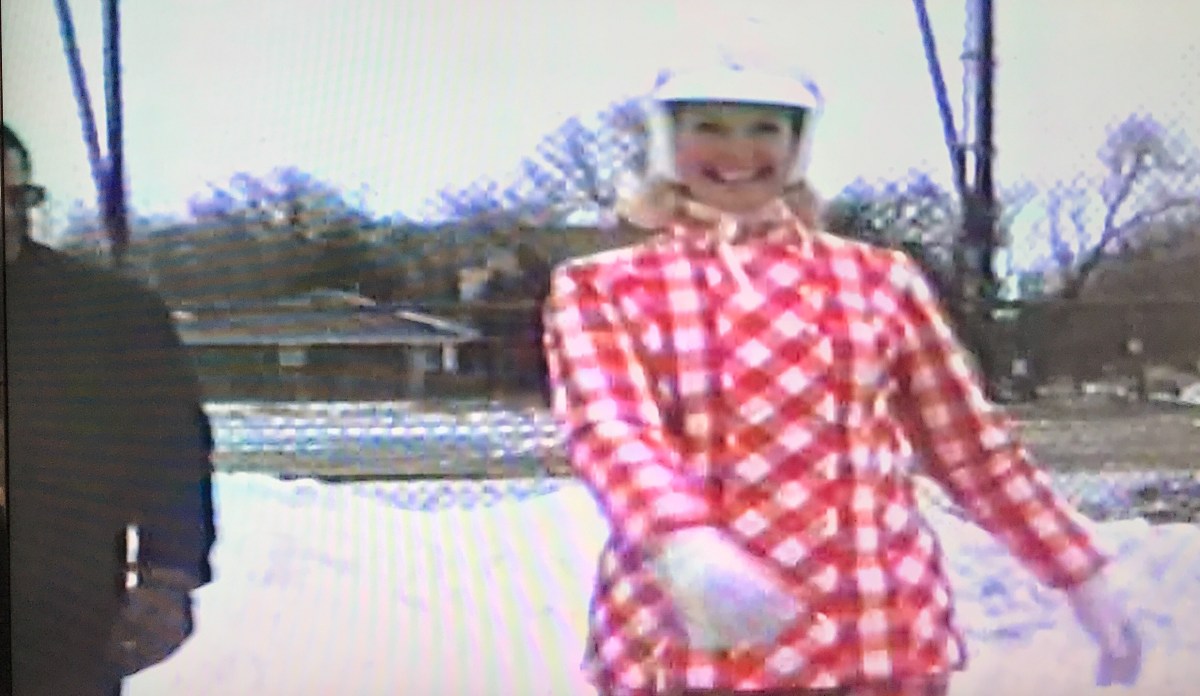
There stands Mom in an outfit the likes of which Lake Bluff villagers have never – nor will likely ever see again – a red and white checkered snow suit, with its belted jacket and matching knickers (Yes, that’s right, I said knickers.), red cable knit stockings, white knit gloves, and a matching, white knit, helmet-shaped cap with ear flaps and a large, snowball-sized pom-pom on top.

It’s something to be seen… and near impossible to miss.

She’s something to be seen. 

But that’s usually Mom: statuesque, blonde, beautiful, incomparable. 

Ever the model. 

Not afraid to be individual, and always, always fashionable.

Even when that fashion might be questionable…

… at least from the viewpoint of her five, young impressionables.

But Mom is glowing. 

Excited for the family outing. 

Eager to put her weatherproof, yet fashion savvy snow suit to the test.

But Mom is GLOWING

Like a giant, checkered barber pole.

And everyone from Dad (whose briefly raised eyebrows are a dead giveaway) to Mark (who strains his tiny, bundled body to turn and stare wide-eyed at the walking tablecloth) are stunned silent by the new outfit that speaks volumes.

As Dad winds the wagon toward town, whispers around the rear seats are exchanged. It’s agreed that the best course of action is evasive – a rapid, rear door exit will surely guarantee reaching the rink quickly and losing ourselves in the nameless, motherless crowd in moments.

As luck would have it, a parking space – one actually big enough to accommodate our Grand Safari station wagon – opens up right in front and above the bustling rink. There’s no more delaying the inevitable fashion statement that’s about to be thrust upon the unsuspecting citizens of Lake Bluff. 

As soon as Dad docks the wagon and shifts into park, Jim and Chris leap from the center seat and never look back. 

In the very rear of the wagon, however,  Mia and I are at the mercy of Dad who needs to open our escape hatch from the outside (a major miscalculation on our part), and who is leisurely lacing his own skates; while Mom struggles to wriggle a wiggly four-year-old into a pair of hand-me-down, oversized skates.

Dad finally releases us, and leaving Mia to fend for herself, I make fast, teetering tracks to the ice, losing myself in a swarm of bladed, unbounded activity. 

From the anonymity of the crowd below I watch, – mortified – as Mom’s checkered ensemble appears around the rear of our wagon, moving very, very slowly over ice and snow toward the rink. 

Giving everyone within a three mile radius ample time to take it all in.

Radiating red against the endless, ashen clouds.

Unembarrassed. 

Unaffected. 

Unbelievable.

Forcing me deeper into the throng of villagers, into the sea of somber, Midwestern winter gear. Commonsensical clothes in practical colors blending together like the dark waters of a deep, churning lake.

Unsteadying me. 

Disorienting me.

Drowning me in denim and down; in unfamiliar faces and forms, swirling and twirling and lawless.

I feel panic rise and tears swell and wish everyone would just… STOP!

Until a beautiful beacon appears.

A sudden flash of something dazzlingly bright shining through the drab-colored chaos. 

The most wonderful sight I’ve ever seen. 

Giving instant comfort. 

Guiding me home.

To the arms of Mom. 

To the warmth of her hug. 

Wrapped tight in all her red and white checkered glory.

Within Close Range: The Pressure of Writing

She moves up and down the rows of desks 

filled with tiny, crouched figures 

hovering over lined paper 

and clutching #2 pencils. 

Filling the aisle with her middle-age width 

and Avon perfume, 

I feel the warmth of her body and breath 

as she leans over me 

and sighs.

We’ve been here before.

I’m just not getting this pencil-holding thing.

I thought I was doing it right. 

The letters on my paper look pretty much like everyone’s. 

Pretty much.

But every time she stops at my desk, 

she firmly cups her hand over mine and squeezes  

hard

until she forces my tiny, anxious fingers 

to curl around the long, yellow pencil 

with the well-worn, pink eraser.

“A firm grasp is the key to proper penmanship, my dear,” she says, 

trying to sound patient 

about my substandard pencil etiquette.

Not wanting to disappoint her

again

I clench that pencil 

as if my very breathing depends upon it, 

until my fingers cramp from it, 

and the lead of the pencil 

presses so hard against the paper 

that the letters bulge through the opposite side.

When she asks us to turn our papers over 

and sit quietly until everyone finishes, 

I close my eyes 

and feel each raised letter with my fingertips. 

Wondering whether any one else 

has to press that hard 

work that hard 

to squeeze out the letters 

and words, 

and sentences, 

so very anxious to burst forth.

Within Close Range: The Straight-Away

The Straight-away is the longest lineal stretch of road in Shoreacres, where speed bumps do little to dissuade teenage boys in first cars from pressing down on gas pedals.

At the end of this tempting strip of asphalt, with the sun rising at my back, throwing orange and pink and unreasonable beauty into the gloomy school day scene, is the bus stop.

It is here, from autumn to early summer, I watch for the giant, yellow monster to come into view as it makes the turn at the top of the Straight-Away. 

Praying often that I missed it, or it won’t appear, and Mom has to drive me to school. 

Offering a morning’s reprieve from school bus bullies.

And a chance to gobble up freshly made donuts from the truck stop along the way.

Within Close Range: The Car Ride

Much of my early views of Florida are seen above a sea of car upholstery, through rolled up windows, where the only things visible are the tops of Palm trees and passing trucks, condos and clouds, and Nonnie and Papa’s heads hovering over a wide expanse of leather stretched across the latest Cadillac’s cavernous front seat.

Here, conversations are muffled, and occasionally in broken Italian, so young ears can’t possibly understand; and elevator music versions of Rock ’n Roll songs play softly; where Papa’s cautious, half-mile-to-execute lane changes regularly cause the turn signal to remain blinking. 

It must be an audio-visual black hole (I think to myself), oblivious as he is to both the flashing green light and the constant clicking for miles on end.

The sound of it lulls me into a stupor, until Nonnie finally notices the signal of perpetual motion and snaps at Papa to turn it off. 

A few miles pass and all is peaceful, until the car begins to fill with a terrible smell.

I turn to my cousin, John, who’s holding the backseat’s cigarette lighter, with an indecipherable look on his face, as the smell of flaming follicles slowly wafts through the well-sealed compartment.

“What’s burning?!” Nonnie shrieks, “Something’s burning! Jimmy, something’s on fire!”

Papa pitches the lumbering Caddy to an empty parking lot at the side of the road, unrolls the windows, and orders everyone out of the car. 

John’s dubious deed is soon discovered.

Papa gives his grandson “the eye”; while Nonnie stands there mumbling and grumbling and shaking her head.

After one last inspection to ensure nothing else has been set on fire and throwing John one, last incredulous look, Papa orders everyone back in the car before signaling his return to the road, where, for the final miles to the restaurant, I lose myself in the smell of burnt hair and the click of the sedan’s left blinker.

Within Close Range: The Upstairs Universe

The adult-free upstairs is our universe, our private world of fun and games and funny voices, where Jim’s rolled up socks turn into stink bombs of such infamy that as soon as you see him take off a shoe, you run… 

as fast as your stockinged feet along a polished wood floor can take you.

It’s also where fuzzy, red carpeting turns to molten lava and chairs and tables become bridges, and the sofa, an island where captives and carpet monsters fight to the death in battle after battle.

In the universe upstairs, sloped-ceiling closets and dark crawlspaces (too-small-for-adults places) become hideaways where we can bring pillows and posters, flashlights and stuffed animals, and write secrets and swear words on the 2 x 4s and plaster board.

And listen to Mom in the kitchen below, until the heater switches on and the great metal shafts fill with air and fill our ears with rumbling.

At the very top of the back steps, behind a tiny door (not more than three feet square), Jim has spent the entire day building a spaceship. Fabricated from old outlets and switches, and a roll of duct tape.

With Mark as his co-pilot and imagination as his rocket fuel, he rallies us to climb into his crawlspace capsule. 

I sit back in the darkness, surrounded by boxes of memories –  Mom’s heirloomed wedding dress at my elbow and Christmas decorations at my back – anxious for the countdown.

Excited for blast off.

For leaving the earth far behind.

Calling to his co-pilot to flick switches labelled with a big, black magic marker, then moving his hands up and down his own duct-taped controls, I hear the sputters and rumbles of Jim’s vocal-powered rockets.

Hugging my big, Pooh Bear, I watch our fearless pilot, in the beam of a dangling flashlight, lean back and call to his unlikely crew through the cup of his hand:

“Hang on! Here we go! Ten… Nine… Eight…”

Jim’s rumbles begin to rise.

“Seven… Six… Five… Four…”

I feel the crawlspace shake and rattle.

“Three… Two… One… BLAST OFF!”

I squeeze that silly, old bear and close my eyes to see the fast-approaching cosmos…

And there I float in the infinite black. 

In the infinite stars. 

Until Jim shouts, “Meteors!” and all hell breaks loose in our top-of-the-stairs cockpit.

The hallway light suddenly cuts through the cracks and the dark – and the meteors – and the call of dinner brings us back to earth.

Within Close Range: The Being in Basements

Some are reached by steep, wooden steps,

only at the end of which,

is a switch,

and salvation from the dark;

where cold, cement floors sting bare feet

and we search for cousins playing hide and seek

beneath an old, pine table,

and in cupboards stuffed with moth balls and old lives.

Down other stairs, parents send rapidly sprouting offshoots

(and their weedy accomplices)

to remain mostly out of sight, sound and smell.

New worlds explored in sunless rooms of cinderblock;

where mismatched 13-year-olds kiss, and later tell,

and budding musicians, mid black lights and bong hits,

learn to shake and rattle the house;

while in the dark and in a lawn chair, I learn to hang out.

Some sunken spaces are like snapshots

kept on a shelf in an old shoebox.

Still lives of vinyl bars and swivel stools

and down-turned glasses on dusty shelves, long unused.

Moth-eaten scenes of what might have been.

A gathering place for friends and kin

where woes of the week were drowned deep in cocktails

and lost in card games – or a top twenty song – to which most sang along,

as the stereo spun its new-fangled, stereophonic sound. 

Curious but comfortless, being long-deserted and people-less.

Apart from the ghosts in the room.

My favorite sunken places are worn, but happy spaces

in which my favorite female faces

grow leaps and bounds beside me,

unconstrained and nearly unimpeded by upstairs edicts.

Sharing cigarettes, dance moves, inside jokes

and cases of beer bought just over the border;

making evenings fuzzy, and hangovers a new, underworld reality. 

Playing pool, the juke box, the fool;

while trying to play it cool

when faced with firsts and friends far more in the know

about nearly everything that happens down below.

Within Close Range: Bullies

Because our home’s so far away, 

I’m the first picked up by the bus each day

and the very first stop after school –

which makes every student on our route  

sit forty minutes more each afternoon

and me, an unwelcome sight.

Full of hormones and hate, 

those in last few rows of the long, yellow bus 

moan and groan 

as soon as I climb on,

making me nervously skitter to the nearest seat

where I crouch 

and hide 

and wait.

The hardcore insults come later

and louder

cloaked in the anonymity of the rumbling and motion 

of our rolling prison.

Deaf to what he hears, 

the bus driver just stares ahead

and goes where he’s told. 

United by the same neighborhood, 

in the opposite direction,

they snarl and nip at the back of my neck –

piercing my thin skin. 

It’s us versus them, 

in every nasty word. 

But the “them” they think I am 

is absolutely absurd.

When their rabid, backseat words 

have more than their usual bite, 

I step from the bus 

and race to the woods, 

searching for a way to shake the hurt 

in the thick, dim patches of unpeopled forest. 

I disappear among the ember-colored leaves 

which cap the many trees

before the heavy freeze 

steals the color from the land.

And there, I simply am.

Where I step to the sound of my breathing,

the movement of the clouds, 

and to the busy hush of forest life about, 

reminding me to go about my own;

and to heal my wounds

with the comforts of home.

Within Close Range: Florida Days – the teen years

Driving from the airport

to a new winter retreat – 

a 20 story high-rise in Pompano Beach –

it’s clear things aren’t as they have been.

Gone are the Mid-Century neighborhoods 

with small, tidy bungalows 

and pastel-colored apartment complexes. 

Gone are the small, neat streets 

crammed with big, American cars 

and the quiet, inland canals 

with their 90 degree curves.

Modern high-rises now loom along the coast, 

casting long shadows over these old ghosts.

Smothered by “The Strip”, 

a popular stretch of beach –

and the only way to their new place,-

Nonna and Papa are forced to face

nubile, bikini-clad, beer drinking youth 

balanced precariously between child and adult

unkempt, 

half-naked 

all god-forsaken. 

But Gina and I crave this uncharted world, 

which we’re slowly cruising past 

in the back seat of a tightly sealed Cadillac, 

filled with the sounds of Perry Como 

and the smell of Jean Nate.

The closer we get to Nonna and Papa’s, 

the older the demographics begin to slant,

until beers and bikinis are soon replaced 

by beer bellies and Platex bras.

The upside to the new zip code 

is a bigger abode – 

and a separate door to the outside world –

or at least to a corridor,

and an unused stairwell.

To Marlboro Lights 

and poorly rolled joints, 

and late night escapades with girls from New York.

Gone are our grandparents’ halcyon days 

of minding their ways.

These are the carefree days of youth. 

Of baby oil and B-52s.

Getting stoned in the sauna. 

Drinking beers on the beach.

Somehow convincing Nonna 

to hand us the keys.

Of cranking up the radio

and rolling down the windows

to inhale the salty air

and the sweet smell 

of being newly licensed. 

Of boys on the beach noticing us 

and Nonna – 

from high above –

noticing them, noticing us.

These are the Florida days 

of pushing boundaries, 

especially ones so poorly guarded.

Well past our very strict curfew.

Nonna is waiting and bleak.

She’s worked herself into such a state,

she’s lifted off her bunioned feet.

She cross-examines, 

reprimands, 

and threatens to send us home; 

then leads us in to Papa 

in the unlit living room, 

Leaden and pacing. 

My heart is breaking.

When all is said – 

which isn’t much – 

he turns his back 

and sends us to bed. 

The first thing we see in the morning

taped prominently to the fridge

is a newspaper clip with a giant headline, 

“Girls Found Charred on Beach”,

and Nonna, 

with her back to us.

Sighing and tsk-ing, 

but not saying anything.

Until behind closed bedroom doors, 

on an all-day call with her sister, Rose,

we can hear her tell of all her woes; 

heralded, at times, in a pitch so high, 

dogs throughout the high-rise begin to cry.

This leads to quieter Florida days, 

of shorter visits 

and solo stays.

Now more observer than the observed; 

studying Nonna and Papa 

in their Florida world.

In their well-aged routine of marital malaise.

Wondering if I know what a happy marriage is?

Hours of watching old ladies by the pool; 

with their sun hats and cigarettes 

and bad romance books;

their games of Canasta, 

and over-tanned skin… 

wondering if any 

were ever really young?

When Papa leaves to tend to the store, 

it’s hours of Gin Rummy, 

and little more.

Alone with Nonna, 

playing round after round 

on the windy, high-rise balcony, 

sixteen floors from the ground.

Where 8-track cassettes 

of Liberace and Lawrence Welk 

teach me tolerance, 

and the importance of a wickedly good game face.

Happy to see the rainy skies. 

Happy to stay indoors 

and in our nightgowns.

The condo is especially quiet. 

No washing machine 

or television 

reminding us of other things. 

Other lives.

No dinner out 

or big meal in.

We barely move. 

Rarely talk.

Occasionally, Nonna disappears, 

returning with something powdery and sweet

or cheesy and crusty

and hot from the oven.

Such deliciously quiet moments 

of simply doing nothing.

Oh these my Florida days.

Within Close Range: Within Close Range

It’s early spring and still outnumbered are the days of thawing, when the sun shines through the nearly impermeable grey just long enough to make the corral thick and pliable for the heavily-coated ponies to imprint the half-frozen peaks of ice and manure.  

With little inclination to be out of doors, Mia, Mark, Jim and I, along with cousins Mary, Gina and Bill, are all hanging out in the kid’s room upstairs, twitching and giggling and getting riled by Jim, the regular instigator of such behavior. 

But this time, instead of hanging around to help control the chaos, Jim leaves, leaving his younger siblings and cousins to deal with the consequences – the most important of which is that Mark is wound-up and dangerously near the one thing in the room Jim should have taken with him: his Benjamin Air Rifle.

Jim got the rifle for Christmas and had been target practicing with it that morning. Dad doesn’t like the idea of the eight-pump, .177 caliber pellet gun, but Mom’s Missouri farm roots makes her believe that it’s every boy’s initiation into manhood.

In Jim’s defense, he never shoots at living things – mostly targets, trees and tin cans. 

However, he does get an enormous amount of satisfaction turning its site on siblings for the sheer satisfaction of watching faces contort; which is likely where Mark got the idea.

Picking up the air rifle, he aims it across the room at Gina, sitting on the sofa. 

Each of us demands he put the weapon down, but Mark already has that look in his eyes which tells us he’s stopped listening, and before anyone can say another word, Mark presses the trigger and discharges what he thinks is air through an empty chamber.

Gina, already curled into a defensive ball, is hit. 

The lead pellet rips through her jeans and grazes the skin on the back of her left thigh, already bruising when we gather around to inspect the wound.

Everyone – including Mark – is stunned and silent.

Gina’s eyes grow wide and wild.

“You little fucker! You shot me!”

We all look to Mark for an explanation, but he’s off – like his shot – out of the room, down the back stairs, and out the door.

Having returned to the scene at the sound of Gina’s scream, it takes mere moments for Jim to form an angry mob to go in search of the lone shooter, now taking refuge somewhere in the damp, barren woods surrounding our house. 

We follow the leader around the backyard and back woods, looking for a spark of tell-tale color among the sullen, gray tree trunks. 

Then something turns… Jim’s allegiance. 

In an instant, we’re all in his sights and half-heartedly running for our lives. 

Finding a safe spot from his line of vision, I’m watching from the barn stalls when Jim spots Mark weaving through the trees and across the frozen patches of slippery leaves in the back circle by the cottage. 

He’s trying to make a break for the large stretch of trees just across the driveway. From there, it’s certain he can outmaneuver Jim through the woods to safety. 

The problem is the twenty foot stretch of open pavement.

But spring is in the air and Mark is feeling a little wild.

We all are.

Jim gives the rifle an extra pump and takes aim at the small figure now bounding across the asphalt. 

In one very lucky shot… he hits his target, and like a plastic carnival duck floating atop a painted carnival pond, Mark is knocked flat. 

Jim insists it was meant to be a “warning” shot.

As all games are officially over at the first sign of blood, Mark limps toward the house where he pulls down his sock to reveal the day’s second wound on the back of his ankle. 

Mom’s soon on the scene, ordering Mark into the kitchen (with everyone following close behind).

She cleans and examines the wound and declares the pellet must have skimmed the surface of his skin (just like Gina’s had, but we felt best not to mention).

Satisfied with Mom’s answer, the hunter and all those hunted walk – and limp – away.

—————-

Forty years later, having just had x-rays taken for an orthopedic shoe insert, Mark’s doctor enters the room and hangs the film on the light box, and with a strange look on his face, points to a light spot behind Mark’s left ankle.

“This is a metal object,” he says, “… and it looks like a bullet.”

Both Mark and the doctor stare at the very clear, small, rounded object appearing on the screen. 

“No, that can’t be right,” Mark insists. “There must be a glitch on your x-ray machine.”

But the doctor assures Mark that the object is no glitch.

“Do you happen to know how it got there?” the doctor asks, now looking a little sideways at his patient.

Mark stares at the small metal object imbedded in his achilles tendon and suddenly it all comes flooding back to him. 

Before leaving the parking lot of the doctor’s office, he sent this image out to remind us all of a childhood within close range. 

Within Close Range: Wisdom Teeth, or The Heart of Darkness

I’m still lying back in the dentist’s chair when I open my eyes. 

It’s hard to lift my heavy lids, even harder trying to wake from a syrupy haze.

The first clear thing I see are my wisdom teeth – all four – on a pad of cotton laying on my miserably undeveloped chest. 

A smiling nurse takes hold of my forearm and gently guides me off the reclining chair and onto my feet. 

Legs buckling, a second nurse appears, and with each as a crutch, we wind our way through doorways, down hallways and into the waiting room. 

To Mom. 

The sight of her makes me smile, which makes it hurt, and makes me cry out; making patients sitting patiently jump in their waiting room seats and glare at me. 

Stare at me. 

Aghast.

Seeing exactly what they don’t want to see.

I couldn’t care less. I just want to sit. 

But Mom and the nurse keep me moving forward toward the exit door.

__________

Nothing looks sweeter than the car where, for the first time in years, Mom has to buckle me in. Her steely, blue eyes filled with fuss and concern, and a little horror. 

But the haze hasn’t lifted and I’m happily floating in it… and out the car window, toward the warm, autumn sun.

And Mom’s taking me home.

With a heavy hand, I lower the window and turn to face the breezes. I smell hot pavement and mid-day traffic and hear the sounds of a motorbike approaching from behind. 

As the biker passes, his helmeted head looks my way, so I smile in response, leaning heavily against the car door. 

He swerves – suddenly – and passes, quickly. 

Seeing such a severe reaction makes me fumble for the visor’s mirror, where I find a reflection like B-Science-Fiction: swollen cheeks, a misshapen face, and by the looks of the dry and wet tracks trailing down both sides of my chin, I’ve been drooling. 

A lot. 

My lips are also cracked and bloody – as if stranded for weeks in the desert – and it appears as if they’ve been pulled apart by some horrible dental device which has left indentations, still visible on my face.

I’m the goddamn monster’s bride. 

But the care is lost in thoughts of home and Mom and Dad’s blue, velvet sofa, with dogs at my feet, a box of tissue at my side, and a channel changer near at hand – which is where Mom leaves me with a kiss on the forehead and errands on her mind – one of which includes filling a prescription for pain medicine for when the strong stuff wears off.

Propped up with pillows, covered with a quilt and a Labrador, the cloud is beginning to clear from my brain, and although my jaws are sore, I’m relishing a day away from school.

The clock in the living room chimes the eleventh hour and I have nothing but a whole day of sleeping and watching television ahead.

Piece of cake.

____________

It’s been two hours since Mom left. The meds have warn off, the haze has lifted, and everything is very, very clear. 

The pain – which began as a dull ache in my jaws has turned into something hot and angry. 

And my mood, gruesome. 

Dark thoughts come to mind on the crest of each unmedicated, tear-filled minute. 

“Where is she?” I moan as our Labrador, Heather, lets me squeeze tighter.

But the throbbing grows stronger and the darkness grows darker, and my groans are too much even for Heather, who squirms from my grasp and slinks away, tail between her legs.

—————

The chimes of the clock remind me that Mom’s been gone for three hours and it feels as if my head will explode.

I now consider my mother, my captor and my tormentor.

And the blue velvet sofa, my prison of pain, where I dig my way deeper into its darkness and despair.

—————

In the fourth hour since Mom abandoned me, Jim and Mark approach my body beneath the blanket. Jim attempts a taunt, but when I slither from the covers and hiss, “Where’ssssss Mom?”, my gloom and sullen glare frightens even him. 

He gently, but firmly, grabs Mark’s shoulder and they retreat from the brooding scene… 

Misery will be my only acceptable companion this afternoon. 

And we’re inseparable.

Wretched and contemptible.

—————

The damned clock mocks me again, making it the fifth hour since our return and still no sign of Mom.

Shrouded in the pain and the darkness, still hidden beneath the blankets, my breath, my mood, and the TV, are disagreeable and inconsolable, and my thoughts, matricidal.

“How could she have forgotten about me?” I hiss into the drool-drenched pillow, unable to think of anything beyond the pain and this painful disappointment. 

————

As the seventh hour tolls and the sky grows dim, the sound of Mom’s approaching footsteps – which should signal the end of my suffering – instead fills me with rage. 

Seething in my blanketed underworld, hurtful words I’ve practiced for hours stand ready at the tip of my tongue. 

I can hear the crinkle of the white, paper bag from the pharmacy and Mom whispering, “Annie”. 

Both sounds try to pull me from the darkness, but I remain hidden.

“Where have you been!?” is all that squeaks out. 

I don’t really listen to her answer. 

I just take the bitter pill and turn over.

Within Close Range: Dinner at the Celanos’

Dinner means waiting.

It means setting the table 

with placemats and napkins,

and neatly set silver, 

pitchers of water 

and plates for your salad; 

and waiting and waiting,

as smells from the kitchen, 

from sizzling pans and simmering pots, 

waft through the house 

like intoxicating fog.

Making it hard to concentrate 

on anything but the the clock,

and the driveway, 

where we turn our attentions 

every few minutes, 

hoping for headlights.

Stomachs gurgling.

Tempers shortening.

Dad finally showing 

and ever so slowly…

shedding his suit. 

Un-harried. 

Unhurried 

to get the meal going. 

Though children are moaning. 

Haven’t eaten in minutes. 

But dinner begins 

when Dad’s ready to sit.

And no sooner.

Within Close Range: Curfew

Every mile or so, 

I glance to the clock. 

Hoping time will stop.

Or that it’s not really five o’clock.

The final mile along the road, 

I roll down the windows to air out the smell. 

The woodland creatures are beginning to shift,

so once in the driveway, I turn the lights off

and roll slowly along, with the engine hushed.

Safe inside, it’s straight to the fridge.

Grabbing cold pasta, I start up to bed.

But a light from the den stops me instead.

And before I can step a tip to a toe,

Dad rumbles from the den, 

strong and low.

And I have nowhere else to go.

Perched on his favorite, swivel chair, 

he’s flanked by portraits of ungrateful heirs.

Grumbling at the empty driveway 

and disappearing night,

he’s been swiveling there for hours 

without a child in sight.

Staring at my bloodshot eyes, 

he asks if I know the hour,

and things aren’t looking good 

for this early morning flower.

“What could you be doing 

until five in the morning?”

All at once, the truth pours forth 

without a single warning.

I tell Dad how the day was spent 

cooking with some friends, 

then going to a drive-in 

for a zombie marathon;

about the beautiful night 

and the shoreline fire, 

the remarkable moonlight 

as we waded in the water.

Baffled by my sudden truths, 

Dad takes a moment to recompute.

“I’m just waiting for your sister.”

(as the final plot twister)

were the next 

and last 

words from his mouth.

Equally confounded, 

I leave the scene ungrounded.

Looking from an upstairs window, 

just above where Dad keeps vigil,

I see the dawn beginning to dance, 

and know, poor Mia, 

doesn’t stand 

chance.

Withing Close Range: Annie, Annie, are you all right?

Everyone is anxious to be outside when spring comes to the Midwest.

And even though patches of mud-colored snow and ice still mar the school grounds, all I can see is sun and green because I’m sporting a new pair of white, Calvin Klein jeans, and red leather, Dr. Scholl’s sandals. 

Making half-hearted attempts to throw a Frisbee to each other during lunch break, Jean, Megan and I are just happy to be breathing fresh air daily denied us in the newly constructed prison we call high school.  

This semester, we’re in health class together being taught the basics of CPR. To help us, we have “Annie”, a training manikin in a spiffy red track suit, who inspires far more sexual asides than careers in the health care industry. 

The first thing we’re taught when approaching the polyester-clad casualty is to ask:

“Annie, Annie, are you all right?”, while gentle shaking her shoulders; and if this fails to get the proper response – which it inevitably did – then it was time for cardiopulmonary resuscitation.

I think. 

I haven’t really been paying attention. 

None of us have.

So things don’t bode well when chasing the disk in my new, wooden, single-strap, Dr. School’s sandals, they hydroplane on the slippery, spring surface, sending me skimming across the old ice and new grass, into a cold, muddy puddle.

Slamming me hard against the half-frozen earth.            

Searching for the wind knocked out of me, I bolt upright to see Jean and Megan racing my way. First to arrive is Megan who kneels by my side, and vigorously shaking me asks:

“Annie, Annie, are you all right?!” 

Then falls into a fit of laughter. 

Jean isn’t laughing. 

Grabbing me from behind with the strength of an Amazon, she lifts me off the ground and thrusts with all her might at my abdomen.

I don’t know whether to laugh, vomit, or pass out, but manage to signal, “That’s NOT it!”, begging for Jean to release her hold.

Exhausted and humiliated, I slip to the ground – grateful to be alive but wishing I was dead.

Arm in arm, in the full day’s sun, my friends and I walk across the sparse spring lawn, revealing my grassy, mud-stained ass and “big girl” undies – now exposed – thanks to that lethal combination of white pants and puddles.

When Mrs. Waldeck, the School nurse, looks up from her desk, 

it’s hard to tell whether her expression is anger, aggravation, or pity. 

It certainly isn’t surprise.

Mumbling something about pinochle as a proper past time and a big bonfire for burning all clogs and sandals, she leads me to the back room where I can wash up; then offers the unsatisfactory suggestion that I slip on my gym shorts for the remainder of the day.

My face says it all, so she hands me the phone and suggests I call home.

Mom, as is the norm, is nowhere to be found.

Apparently, the day’s humiliation is far from over.

And this Annie is feeling anything but all right.

Within Close Range: The Double Date

Home from college,

my dance card empty,

Jean has ignored me

and arranged a double date. 

Making my way toward the kitchen

to re-hydrate my bone-dry jitters,

I pass Dad in the den. 

He’s sitting in the swivel chair, 

with his back to the windows, 

pretending he’s reading. 

He’s also pretending not to see me. 

Isn’t happy about this evening.

With boys ever at the heels of Mia and Chris, 

he takes frequent comfort in my constant datelessness. 

But really, is the The Garden Journal so utterly absorbing

that my noisy, high-heeled entrance, he’s utterly ignoring?

Not Dad.

(Can’t suppress eye roll.)

And what about Mom? 

Still hovering in the kitchen, 

without a purpose in sight. 

Both acting as this was my very first date. 

Not exactly soothing.

Just need to keep moving.

A difficult task in absurdly high heels

which already feel like burning coals.

Through my water glass, 

I watch Dad rotate right

to face the new, oncoming lights 

bouncing off the dimly lit walls.

A swivel slowly left, 

he’s watching Jean and our dates.

The doorbell’s ringing, 

but Dad’s not budging.

Instead, he’s whirled right back around 

that book might as well be upside down.

(Can’t suppress eye roll.)

I take a deep breath and open the door.

Jean’s smile is enormous. 

I look to the floor –

I know she’s trying.

But there’s something she’s hiding –

like my date being just about as happy as I am.

Reaching out a limp, wet hand

What’s this poor guy’s name again?

I hear swiveling. 

Dad’s up and coming.

Then… passing,

without so much as a greeting.

(Eye roll mentally happening.)

And why is he stopping,

pretending to search for something?

Empty-handed, he’s returning.

I can almost hear the growling.

Keeping his fixed glare –

swiveling like the chair –

on both the boys,

until he quietly disappears.

I push my companions out the door,

hoping the night will hide my humiliation 

and breath new life into this double date situation.

But I’m not counting on it,

and neither is Dad,

who’s peeking through the curtains, 

shaking his head 

as he calls to the kitchen,

“She won’t be marrying THAT one.”

(Can’t suppress eye roll.)

Within Close Range: Clogs

Lake Forest High School’s West Campus

is a giant, brick and cinder block monstrosity, 

designed with all the charm and comforts 

of a state penitentiary. 

Sterile, 

uninviting, 

uninspiring, 

practically windowless, colorless, 

and completely humorless. 

Its warden roams the cinder block dungeons 

in his plaid polyester sports coat, 

smelling of cigarettes and body odor; 

wielding his insignificant power 

with more brawn than brain.

I’ve done everything I can to steer clear.

But best laid plans…

Still mocking an outdated documentary 

on health, hygiene, and the hazards of smoking;

featuring mildly graphic surgery footage, 

phony teens in dungarees, 

and from a hole cut in his larynx,

a smiling man blowing smoke rings,

I start down the stairs to my next class

but never see past the very first step

because the clog on my right foot has chosen to go ahead – 

getting only as far as the arch, instead –

landing my half-clogged foot on the step’s metal edge.

I plunge toward a staircase-ful of surprised friends

and new enemies, 

twisting and hurtling through the innocent 

and unsuspecting.

Coming down hard on my back.

With the grim, fluorescent lighting above 

and the cold, cement floor below,

I am returned to the moment 

by the moans of the stunned and wounded 

getting to their feet.

I attempt to do the same, 

but am gently pushed back to the cold concrete.

“You can’t move.”

“I’m fine,” I sigh in response, 

attempting to sit up again.

“No,” says our teacher,

as she pushes me back to the ground 

(a little more firmly this time).

“I mean, I can’t let you move until the principal gets here.”

“I’M FINE!” explodes off the cinder block walls. 

Faces grimace.

The class is soon sent on their way,

while like a one-shoed idiot, there I lay…

waiting…

imagining how the news of my nose dive

is already spreading.

Sprinting unnecessarily up the flight of stairs; 

a figure is soon looming over me on the landing –

an oppressive cloud of Aqua Velva and brown plaid.

And now I’m truly wishing I was dead.

Finally ensuring my captors 

there’ll be no need for an ambulance, 

to lawyer up,

or even help me up,

I hobble away,

bruised and humiliated.

Less than two weeks later,

fate becomes a hater – 

as I tumble down another set of steps.

People are beginning to wonder. 

Including the school nurse,

who meets me at the office door, 

shaking her head. 

Scrutinizing my footwear.

She hates clogs. 

Thinks they should all be put in a big pile 

and burned.

Just wait til she catches sight of my new Dr. Scholl’s.

Within Close Range: At the Edge of the Bluff

It’s an early spring day in the heartland.

Anemic, damp and miserable.

Clumps of stubborn snow and ice, 

grey and grimy, 

still dot the sidewalks and lawns.

Faces look pale and anxious for sun.

After the usual sermon of incense and absolution,

followed by stacks of pancakes and sausages, 

we know something is up 

when Dad drives past our neighborhood, 

further and further from home.

Passing unfamiliar faces and unfamiliar towns,

until backseat boredom is about to grow horns.

Passing another tiny town, 

and a solid white, storybook farm,

Dad finally slows and signals a turn.

“Shoreacres Country Club, Members Only”, 

reads the uninviting sign.

Swallowed by the dark of the woods,

the wide, low wagon drifts silently down the road, 

flanked by a small, trickling brook, 

winding past towering trees 

and long stretches of green. 

Everything is covered in a fine, frigid gloom, 

including another set of pretty, white buildings,  

silent and still on this dreary afternoon.

As we drive by a faded, old, green water tower, 

headless and frightening in the fog, 

our destination is finally divulged: 

a new home.  

I sink further into the wagon’s rear seat, 

where the unfriendly neighborhood disappears 

and I can see nothing but the thick, dark clouds. 

The silence is broken only by the sound of gravel 

crunching beneath the wheels of the wagon, 

now weighted with disappointment.

We twist down a long driveway and stop.

So inching my way back up, 

I survey the house. 

It’s dark and sullen.

Like the day. 

And my mood. 

Dad says, “We’ll just take a peek.”

But even I know what that means.

So, like prisoners into an exercise yard, 

we file from the car, 

and stand in an unhappy cluster in front of the house –

which isn’t yellow – 

like ours.

Which has no sign of neighbors, 

a school, 

the Good Humor Man,

or a new treehouse –

like ours.

We’re coaxed to a long row of windows 

which look through the cold, empty rooms, 

and beyond,

where lies a huge expanse of lawn.

And water, as far as the eye can see.

Racing to the rear of the house, 

we stand the edge of the bluff, 

looking out over the grand, Great Lake

right there at our toes.

We can see the silhouette of Chicago, 40 miles south.

Excitement for this strange, new place now erupts.

This place will become significant for all of us:

A decades-long breeder of unsupervised fun.

First beers. 

First cigarettes

And, of course, first bongs.

Secret rendezvous for teenage loves.

Outbuildings will be havens for fainthearted runaways

who soon long for home just a few feet away.

Follies of youth.

Such glorious days.

Until this world begins to erode.

To implode.

And all begin to scatter.

But, oh, what fertile earth it was

living life in the woods 

at the edge of the bluff.

Within Close Range: Starting to Drown

I struggle when Mom tries to put on my water wings, promising that if she lets me go in without them, I’ll be super careful – stay shallow.

Eventually, she gives in and along the pool’s edge I shimmy until my toes no longer touch the smooth, white bottom and Mom is no longer hovering.

Holding tight to the edge with one hand, I dip below the surface and open my eyes in the clear, blue where I can see the bigger kids dunking and diving in every direction.

Wingless.

Fearless.

Floating and free.

The center of it all is now the place I most want to be, so feeling the rough, concrete surface of the pool deck pressing into the fingertips of one hand, I stretch the other toward the forbidden zone.

The fun.

My future.

And I let go, stretching my nostrils skyward and doggy-paddling furiously toward the deepest waters.

I set my sights on Chris, who’s in the center of the pool talking to Dad, standing at the edge of the shallow end, but half way to her suntanned back, my arms and legs suddenly betray me and before I know it, down I go, pool water filling my nose and mouth.

I scramble for the sun and the air.

For a voice. 

For Chris.

But each time I break the surface, my pleas are instantly drowned and I’m still out of reach of that suntanned back. 

In the instant before I go under again, I can hear Dad’s voice, but I can’t see him and he can’t see me because Chris is directly in line between us.

And with all the commotion… 

Someone please see me.  

But no one does and, once more, I sink.

This time, the thought of not reaching air again – or even worse, reaching it and losing it again – terrifies me. 

I claw for the murky surface, now light years away, but desperate thoughts weigh heavily on my tired legs.

And I want to stop trying.

Arms abruptly pull me to the surface, then to the side of the pool, where another strong and sure pair guides me to the warmth of the concrete deck, where I vomit up pool water and begin to cry.

Within Close Range: Betsy’s Dad’s Den

Each time I light the candle gifted me, a rich, earthy fragrance brings forward hazy memories.

Vague images which come briefly into view and then vanish amid so many forgotten days.

I light the candle again, and back they come.

Out of focus, but strong.

With the faint but familiar fragrance still in the air, still teasing my will-menopause-ever-end addled mind, I reach turn over the candle, hoping the label will reveal something – anything – that might re-animate these mislaid memories.

And there is my answer. 

Pipe Tobacco.

Mr. Gould’s den suddenly comes into focus.

Tucked in the corner of the Gould’s grey-green, two chimney, Colonial, which sits a short block from the edge of Lake Michigan. 

You can find it by heading straight east down Scranton Avenue, the main street of Lake Bluff’s hardly-a-downtown-business-district.

The old house sits in a quiet spot amid tree-filled lots and winding ravines and looks as if it had been there almost as long as the trees which tower over it. 

Stepping into the Gould’s house is like stepping from Mr. Peabody’s Way Back Machine. 

Everything – from its old plaster and uneven, wood floors, to its cozy nooks and small, sunlit rooms filled with old things – incites my imagination. 

And oh, the kitchen – old bricks and beams – always smelling of fresh-baked bread. 

At least in my head.

Betsy cuts thick slices off a golden brown loaf cooling on the tall counter and we sink our teeth into the still warm, chewy insides that hint of honey and butter and leave our fingers powdered with flour.

And my stomach hungry for more. 

With the final crusts stuffed into our mouths, we climb the steep, narrow, crooked flight of stairs to Betsy’s room, straight ahead. 

Two rooms, really. One being her bedroom, the other, a small, summer sleeping porch with northwest walls of old, paned windows; where generations of restless sleepers sought lake breezes during the dependably hot and humid Midwest summer nights. 

Cots and cotton nightgowns. 

Late summer sun and the strident thrum of crickets. 

Another time still haunts the corners of this room.

Ghosts hidden beneath the piles of fabric, patterns, and sewing stuff cluttering the small, bright space at the corner of the Gould’s old, grey-green, two-chimney Colonial near the lake.

We spread out across Betsy’s high bed and talk dreamily about our four favorite men: John, Paul, George and Ringo. Spinning their albums until daylight leaves and my ride home appears at the front door.

The rest of the upstairs is a mystery to me, being two-thirds occupied by teen brothers, whose rare appearances and even rarer visits to Betsy’s room usually last briefly and annoy her thoroughly. 

They simply scare the shit out of me.

On occasion, when Betsy seeks out her dad during my visits, we wander back down the creaky, old stairs, through the dark front entry hall (which no one ever seems to enter through) to the one and only place I ever recall seeing Betsy’s Dad.

His den.

With a timid rap on the solid, old door, we hear his gentle voice give permission to enter this space.

His special place.

His sanctuary.

And it is here, as the door opens and I enter behind my best friend, that the smell of sweet and spicy, earthy and smoky, becomes a part of me. 

As does the sight of Mr. Gould behind his desk. 

Smoking his pipe. 

Sweatered like the perfect professor. 

Ever engaging his hands and his mind.

Creating. 

Drawing. 

Building dreams.

And ships in bottles.

Magnificent, masted vessels of extraordinary detail. Masterfully and meticulously constructed and painted within ridiculously constrained confines. 

When finished, each ship joins the miniature armada that floats on a sea of books on wooden shelves, near paneled walls, and paned windows with mustard drapes; above a glass-topped coffee table filled with shells and sticky sand from spilled milks.

Each night (Betsy tells me), without fail, her dad closes those long, mustard-colored curtains overlooking Scranton Avenue and sits at his desk to busy his hands and block out the world. 

Yet each and every time a car drives past, she finds it most mysterious that he draws the drapes back – just enough to watch the car pass – and then closes them again, and returns to his task.

And his deliciously fragrant pipe.

And his secret snacks – Pepsi and Fritos – hidden beneath his desk.

And there he stays, hour after hour, day after day, year after year, making beautiful things for make-believe worlds. 

I would have liked to sit in there for hours exploring the books, the shelves, the bottles, and the mind of a quiet, creative man. 

All of which are out of reach.

Yet now reach out. 

Calling me back to the old, grey-green, two-chimney, Colonial on Scranton Avenue.

To Betsy’s dad’s den.

To his ships and his pipes.

And the sweet aroma.

To fresh baked bread.

And lazy afternoons.

With best friends.

Within Close Range: Chief – in three parts

Part One:

Chief is an ornery Appaloosa, 

short and fat, 

with black spots on the rump of his dirty, white coat. 

And the devil in his eyes. 

Of little training and no past consequences,

he’s a 9th birthday present from Dad – 

whose childhood pets were porcelain cats – 

and mostly Mom, 

a self-proclaimed Missouri farm girl,

with a steely, stubborn confidence over competence.

From the other side of the pasture fence, 

she urges me to remount:

“Make him know who’s boss!”

I struggle to my feet 

and limp toward the obvious answer

now grazing on prairie grass and wildflowers.

In between greedy mouthfuls, 

Chief raises his wild, blue eyes, 

beneath poorly cut bangs –

which I do myself. 

(No wonder he’s ornery.)

He’s quietly watching my pained approach 

and just as I get within a few feet, 

with a flick of his tail, he’s off – 

bucking and snorting as he goes.

Mom’s words are unrecognizable 

from the far end of the field.

But the tone is clear. 

So I move toward my spotted nemesis,

expecting him to bolt at any moment.

But this time, he lets me mount.

It’s all too easy, a voice inside warns.

But Mom’s is louder.

Barely settled in the saddle, 

Chief lifts his head and pins his fuzzy ears

flat against his thick skull.

Grabbing the reins and the horn, 

I know what’s coming.

Somehow still in the saddle at the canter, 

annoys my little, four-hoofed devil, 

who swerves from his path toward a cluster of pines.

Two, in particular,

which stand a pony’s width apart. 

I close my eyes and hold on tight.

Like yarn through an embroidery needle,

Chief threads us between the pines.

Scraped from their stirrups, 

my little legs bounce off of the pony’s big rear-end 

as we leave the trees for pasture 

and gallop toward Mom;

who’s still lobbing impractical words over the fence.

I feel my grasp on the saddle-horn weaken,

as my resolve that I’ll soon be tasting earth, 

grows.

And I let go.

Part Two:

Mom thinks a pal might keep Chief calmer. 

So early one spring, in comes Billy Gold: 

a blue ribboned, well-trained, Palomino,

which we trailered behind the wagon 

from his Missouri home.

Chief dislikes the new arrival immediately.

I think he’s dreamy

with his white/blonde mane and ginger coat, 

still winter thick and warm to the touch. 

Feeding him a carrot,

his hot breath and fuzzy lips 

tickle the palm of my cold, red hand.

Mark and Mia remain on the fence.

Watching.

Still unsure of whether Billy Gold –

like Chief –

is sinister.

In my thickly lined hood, 

tied tight against the cold, lake winds, 

I don’t understand their warnings

until far too late. 

Chief’s powerful teeth clamp down.

The pain in my butt is searing.

I’m howling.

Billy Gold bolts.

But Chief just stands there.

A nose length’s away.

Staring.

As I hop around the half-frozen earth,

swearing.

And rubbing the area already swelling.

My siblings’ shocked silence explodes into laughter, 

followed by a closely contested race to the house 

to see who’ll be the first to blather. 

Meanwhile, a purple-red welt, 

banded by marks of Chief’s big, front teeth, 

grows and throbs with each step toward the house

where Mom greets me with an ice pack 

and an ungoverned smile. 

Part Three:

When Chief isn’t trying to shed us,

or eat us,

he’s on the lam.

Devilishly clever.

Expected and regular.

The phone rings. 

Mom cringes.

Apologizes. 

Then sounds the alarm.

Steering the station wagon straight toward town.  

We found him in a graveyard once, 

On a foggy morning, one fall. 

Striking terror in the old caretaker 

who thought he’d seen it all.

Until galloping across the graves, 

he saw a ghostly, pony-sized sight,

with bad bangs, 

bouncing in the soupy light.

Pursued closely by a tall, beautiful, blonde 

in flowing, full length, lime-green chiffon. 

His hands still trembling 

when we waved from the road,

as we slowly crept toward home 

with our pony in tow.

But much of the time, Chief’s antics are close

and off I dash with grain and a rope; 

tracking my pony’s sod-ripping route 

through the blue-blood, buttoned-up neighborhood, 

across disapproving neighbors’ pristine lawns. 

From behind their glass houses, 

shaking heads frown.

One rainy, spring day, while chasing the brat,

he stops his mad bucking 

and turns in his tracks

to face me.

He pins his ears, which puts me on guard.

Then that damn pony starts to charge!

I am quite sure that we’re going to collide

When a voice – 

loud and fed up – 

calls from inside.

I drop the bucket of grain.

I drop the pony’s halter.

I gather all my courage.

My universe is itching to alter.

Setting my feet and standing my ground, 

I watch him close the gap.

And just as he’s an arm’s length away…

I give him a great, big

SLAP

at the tip of his long, white snout.

Suddenly, all Chief’s piss and vinegar

done

run

OUT! 

With a half-hearted snort, 

he lowers his poorly banged head, 

turning his devilish focus 

on the grain bucket instead.

And with noses aligned, 

we linger toward home, 

understanding more of each other 

than we had ever known.

Within Close Range: Candied Abandon

Something scrumptious 

always simmering 

in an old enamel pot. 

Looks to have cooked a million meals 

one hopes will never stop.

But as delectable to me 

as these savory delights,

Nonna and Papa’s home 

is a sweet-tooth paradise.

A candy-coated, chocolate-covered, 

fantasyland,

with countless confectionaries 

ever at hand.

Coffee candy, toffee bits.

Circus peanuts, caramel nips. 

Cookie tins with crescents 

that melt on my tongue,

leaving powdered-sugar fingerprints 

wherever I’ve gone.

In nightstands, TV stands, 

and cabinets, wall-to-wall;

in boxes, and pockets, 

and purses in the hall.

I scan all the shelves 

for a glimmer of color

through crystal candy dishes 

in a glass-front cupboard.

On a mirrored table 

beside the velvety green couch,

I find a lidded coffer 

that has gone untouched.

Chasing my greedy reflection 

over the mirrored table top,

I see no misgivings, 

as I reach for the box.

Those would come later, 

when at the dinner table,

Nonna presses me to eat, 

but I simply unable.

Which is simply

not

done.

Within Close Range: Flying

I dream of flying.

Lifting off the edge of the bluff

and rising quickly 

toward the fat, lazy clouds

hovering over the great, grey lake.

Circling the nearby harbor

where scattered sailboats bob, 

I swoop and dive

like the swallows nearby,

but seek out more familiar forms

hidden back among the trees,

just far enough 

from the crumbling bluff

to put Dad’s mind at ease.

To the glowing kitchen window

and the figure of Mom 

in her pink, plaid apron.

Ever regal.

Ever busy

in her blue and yellow kitchen.

I hover there,

in the cool lake air,

listening to the happy clinks and clanks

of pots and plates.

And try to imagine what’s cooking

by what’s wafting through the windows.

Until a strong breeze 

lifts the aroma 

and me

back over the lake.

Past the sunken, old pier

where giant carp spawn 

year after year.

Past the rocky harbor walls

standing hard against the waves.

Until the house 

and the cottage 

and the beach 

disappear,

and I begin to really soar

over endless stretches 

of dark and deep.

Unhappy to find my bed

and solid ground beneath me 

when I wake.

Within Close Range: Florida Days – the early years

It’s a small, but airy, two bedroom 

built at the corner of an inland canal; 

brightly decorated in yellows, greens, blues and whites, 

and perpetually shaded from the Sunshine State.

A peculiar land of tropical scents 

and strikingly unfamiliar sights. 

Far removed from the only place I know at night,

home.

Put to bed too early, 

I lie in the sitting room-turned-my-room, 

tossing and turning on the lumpy sofa-bed

for what seems like hours and hours on end.

Listening intensely to the sounds of apartment living

made especially audible by the glass-vented door

opening onto the curved building’s exterior hall.

My slatted portals to an unknown world. 

To the sounds of the apartment people 

returning from the pool, 

the shops, 

the grocers, 

dinner out.

Of doorbells ringing 

and little feet skipping, 

hugs and kisses 

and friendly greetings; 

of moist, briny winds 

carrying the scents 

of jasmine and orange blossoms,

and parking lot asphalt.

The smell of ladies’ perfumes 

as they stroll past my door.

The echo of laughter in the nearby stairwell 

and their happy words

which disappear 

with the sudden click of a heavy car door.

Murmurs from the living room TV 

add to this strange symphony,

with familiar sounds 

and flickering lights 

that seep through the bottom of the door, 

casting short, cryptic shadows 

on the thickly carpeted, 

recently vacuumed floor.

Comforting is the knowledge 

that Papa is in the room next door. 

Feet up, 

arms folded high across his belly, 

and a large RC Cola at his side. 

Grinning at Clem Kadiddlehopper, 

or growling at the Chicago Bears.

When Papa finally turns the television off,

I lie in the still and unfamiliar dark.  

The inland water’s slow, buoyant motion, 

lulls me into a deep and scented slumber.

until the morning,

when I linger on the lumpy mattress 

and listen to the apartment people 

begin their days. 

Wooed by the sounds of others stirring,

I stretch toward kitchen utensils clanking

and the smells of breakfast cooking 

on the other side of the wall.

Oh these, my Florida days.

Of sand slipping away beneath my tiny feet,

and seashell hunts as the sun dips low; 

of Nonna’s curled and bunioned toes 

and skinny, seagull legs 

dipping into the foamy waves, 

but never past her knees. 

These early days of sunset walks 

along a stretch of beach 

that leads to a lighthouse 

and a creaky, tottering wharf 

where Papa likes to take a walk. 

And I like to walk with him. 

Where fishing boats have funny names 

and a tiny gift shop, 

in a weather-beaten shanty, 

sells orange gum-balls 

packed in little, wooden crates

which Papa buys for his little, Pie-Face.

Of bright, green lizards 

skittering across pastel walls, 

and pats on the head 

by terrycloth clad men 

playing cards in the shade of umbrellas. 

Where suntanned women 

with the giant bosoms 

and ever-blooming swim caps 

wade in the shallow end, 

with big, dentured smiles 

for the little one visiting Lenore.

Oh these, my Florida days.

Within Close Range: Uncle John’s Burgundy Velvet Tuxedo Jacket

Uncle John has a burgundy, velvet tuxedo jacket.

For decades, he’s worn it to every black tie event

and Aunt Ar makes sure there are plenty.

Atop a sea of black and white convention

the tall, dark man moves quietly in his curious, velvet burgundy.

Well-heeled and headstrong, he ever insists, 

as long as the jacket fits – it fits.

Unswayed by the loud public statement 

his offbeat fashion statement makes

for such a guarded, taciturn, conventional man.

Within Close Range: This Mile of Road

I love the final miles to our back door. 

The everyday sights of tree-lined neighborhoods, sleepy main streets, and stretches of flat fields beside crisp, white barns silhouetted against waning sunlight.

After a successful fight for window rights, I’ve rolled mine all the way down, ignoring the moans of siblings wishing to remain buried in the stuffy confines of the car. 

Sticking my head as far out as I can, searching the darkening skies for the first star of the night, I inhale summer – long and hard – accepting the occasional collision with a bug on its own nocturnal journey.

Sheridan Road (which extends north all the way from Chicago) is the final stretch from Lake Bluff to home, straight and scarcely inhabited – except for the occasional sighting of the reflective, red eyes of wildlife at its edge hoping to survive fields and forests, cars and trains, on their way to wherever.

Alongside Sheridan Road, for much of the way, runs the Northwestern Railroad. Its green and yellow cars, faded and familiar, appear beside us long after its piercing horn signaled its approach. 

I race the train, stepping on an imaginary gas pedal on the candy wrapper-riddled floor. Pressing harder and harder, as if my desire will make Dad drive faster and finally beat the northbound beast. 

But the train rolls past our station wagon and all I can do with the same, old loss is gaze into the windows of the passenger cars; into the yellow-tinged lights where, returning from leave, the white-capped sailors of Great Lakes Naval Base lean heavily against the worn, green leather seats and dingy glass. 

Their lonely figures the last thing I see before Dad signals right and I close my eyes for the final mile to our front door.

There is comfort in this blind ritual; in the knowledge that I know this mile of road so well that the sight of it is secondary to the feel of its curves, the sounds of its inhabitants, the smells of fresh cut fairways, and a giant of a freshwater lake.

Unlike the miles behind us, we travel more leisurely along Shoreacres Road. Breathing easier and rejoicing in nature. 

In the great, silent custodians – the Maples, Oaks and Elms – which stand over nearly every inch of it; shading us from the summer sun like a vast, green awning and warming us with their blazing, dazzling, daring reds, yellows and oranges in the autumn. 

Come winter, tree-lined comfort turns to forest mischief when laden branches drop dense clumps of snow on our hoods and on our heads, surprising us and swamping us as we pass below.

The first curve is less than a quarter of a mile along, and drifts sharply to the left, as it begins to follow a tiny, twisting creek, where moonlit nights make the water dance and daylight hours invite Mallards to its mossy banks. 

Each fall, just before the curve and the creek, an old Black Walnut tree drops heaps of its brown-green nuts onto the road, which explode beneath the wheels of the wagon as a call to local wildlife who delight in the meat of the thick-shelled nuts and a seasonal signal of that first turn.

Up ahead, I can see in my mind where the road abandons the tiny creek and veers ninety degrees to the right, toward much greater waters. 

We call this part of the road, “The Straight-Away” because it’s the longest, straightest stretch in the mile journey, inspiring teenagers to ignore speed bumps.

Sticking my head even further out the car window as we head down this long strip of cracked and well-worn pavement, I envision the great expanse of manicured green to my left, the tangled woods to my right, and just ahead, at the end of The Straight-Away, the exact spot where lake Michigan demonstrates its greatness by influencing the weather around its shores in a sudden shift from the warm, near-stifling humidity of a Midwest summer night, to a sudden, clammy chill – as if leaving the comfort of a campfire. 

Even sleepy siblings will reach a hand out the nearest window to feel it. 

Because feeling it, is feeling home.

At the end of the Straight-Away, Dad will turn left and we’ll soon pass the old, white clubhouse standing at the edge of the bluff on the right. I imagine it ’s covered in fog and dimly lit by the street lamps lining its long, unapproachable entrance. 

Just past the clubhouse, the wagon gently turns left, bringing us past a faded, old, foamy green water-tower that stands at the entrance of our neighborhood. 

A sad sentry – rusted and outdated, and destined for demolition – its large, steel legs, are our gateway to high jinks in the forests and on the footbridges of the golf course just beyond. 

An expansive, white, Georgian house is next on the left; with three, enormous, old pines nearly hiding its existence. Planted long ago in a very neat row, they dominate even the grand, columned entrance. 

Each pine is a story higher than the two-story house: shadowy and green and fabulously fragrant after a spring shower; while giant villains in the fog, and enormous yuletide beacons, strung from top to bottom with tiny, bright, white lights that always make me cheat – and peek – at Christmas time.

Across the road from where the pines stand tall, there’s a big, brutish fence, behind which stands a tragic folly created by a strange woman. On the nights when its colossal, indoor tennis court sets the sky and woods on fire with its jarring, unnatural lights, I hear my father grumble and briefly open my eyes for chance to see if, in between the pickets, I can catch a glimpse of this sad, slightly mad, lonely woman, living her sad, slightly mad, lonely life. 

Happy to be past it and moments from home. 

Minutes from bed. 

A slight right at the fork and our driveway’s just ahead, on the right. I know exactly when we’ve turned onto it by the sound of gravel crackling like popcorn beneath the wheels of the wagon, as it winds its way through the woods and the summer smells of wild onions and Queen Anne’s lace, pungent and sweet. 

And familiar.

Bringing me ever nearer to sleep.

Only when I hear the garage door begin its sluggish retreat and the dogs begin to bark, do I open my eyes and end the game, content for having found my way home again. 

Closing my eyes again for one more game, I pretend to be fast asleep, so Dad will carry me the final steps to my bed.

And to my dreams.

Within Close Range: The Youngest

We watch the station wagon back out of the driveway. 

Mom waves through the open window before slowly pulling away. 

It’s just a few errands, but Mark is inconsolable. 

Tries to follow her.

Chris sweeps him up, but he squirms with all of his might and wins the fight. 

Falling to his knees and then to all fours, the youngest of five laments the loss by slamming his soft head on the hard blacktop.

Shocked by the scene, I race to the street, hoping Mom will see me wave and shift to reverse. 

But the station wagon turns the corner and disappears from sight.

Back in Chris’s arms, I can see Mark’s forehead is already swollen and bruised. 

Pockmarked from the pavement. 

Gravel still clinging to his brow. 

Silently, the three of us turn toward the house.

Motherless and miserable.

Within Close Range: Tiny Terrors

I save every penny I can to buy things for my very first household: a two-story, six room, pale yellow Colonial with black shutters, rose-filled window boxes, and a square footage of about three.

Placing my tiny, new items in their tiny, proper places, house proud and satisfied, I head downstairs to the laundry room for dusting rags. 

I’m only gone a few minutes.

But as I come around the front facade of my beautiful home – thinking of fake-watering my fake flowers –  I’m shocked and horrified.

The tiny patriarch of my miniature clan is not where I left him, sitting on the living room sofa, with a wee book in his lap. 

Daughter is still at the piano where I left her, but slumped over. 

Arms splayed across the keys.

I find Father directly above, in the four poster bed, pant-less and laying rather indelicately on top of Mother; while in the bathroom, next door, Baby has been stuffed – diapers up – in the porcelain toilet with the long chain pull. 

Fearful, my eyes move to Grandmother’s room next door, slightly disappointed to find nothing – no one.

Maybe Grandmother is safe.

But the thought is fleeting when in the kitchen below, I find her.

Sweet, old, grey-haired Grandmother (with the tiny bun I carefully brush with the tip of my finger), has been shoved in the oven of the cast iron stove – wood burning, mind you, but with the same gruesome effect. 

The soles of her sensible shoes searing into my memory.

But where’s Son? 

He’s not in the fridge, under the sofa, or in the clawfoot tub. 

There’s only one place left… 

Slowly raising the balsa-shingled roof (which Jim was forced to cut and glue as punishment for his last dollhouse infraction) of my pale yellow, Colonial house with black shutters and rose-filled windows boxes, I can’t see him anywhere.

Then I spy the tiny trunk in the corner…

Within Close Range: Inspection

Mom and Dad’s bedroom is on the first floor of the house (at the southern end of everything) allowing them to frequently escape to its sunlit, coziness and away from the five, wild seeds they chose to sow. 

This leaves the entire second floor almost entirely adult-free, except for the occasional laundry delivery from Mom and the much less occasional visit from Dad – more ceremonial than social – and usually the result of winter restlessness or weekend thunderstorms keeping him from the golf course.

We only know of his plans when we hear, “INSPECTION in ten minutes!”  sound from below, at which point all present scatter from the upstair’s common room to our respective bedrooms, where we begin frenzied attempts to hide all clothing, toys, towels, glasses, plates, books and general shit we’ve left strewn everywhere.

Depending on his level of bother, Dad might only scan the surface of the bedrooms and bathrooms. 

It’s something each of us quietly prays for as he passes dressers, drawers, desks and closets, cluttered and crammed with quickly concealed crap. 

If his heart really isn’t in it, he might demand some dusting and vacuuming, to be inspected later – which will likely not occur – and then disappear below. Knowing this, we’ll half-heartedly obey before returning to reruns, teasing on each other, and littering.

However, if Dad’s disposition is grim, he delves further, looking under beds and behind shower curtains, and, if he’s in a particularly foul mood, sliding open a closet door… 

At which point, we’re positively doomed. 

Within Close Range: Tornado Watch

The cement-floored, window-welled basement of the house is the biggest indoor space we have to spread out, but it comes at a price. 

My bare feet are regular magnets for misplaced thumb tacks; while an escaped gerbil, who disappeared beneath appliances, leaves the already dank underground smelling like fabric softener and tiny, rotting corpse. 

It’s also the first place we head every spring when tornado season arrives and the local siren sounds, sending neighborhood kids scattering to their homes, and Mom shuffling everyone down below, where we wait for incoming reports. 

With the TV and radio competing and other siblings playing, I stare out the small, ground-level window, half-hoping to see the funnel at the end of the our street, moving down its center, like a spinning top, whirling and powerless.

Even though I know a tornado isn’t powerless. 

It’s dangerous and threatening my world.

Comforting is the sight of Mom ironing; while through the grimy glass I wait for the mean, dark sky to lighten, the all-clear to sound, and life in the neighborhood to return to its routine.

Within Close Range: The Phone at the End of the Hall

The phone at the end of the hall, right next to my room, comes to life in the middle of the night; its merciless metal bells clanging, resounding off the tall walls of the winding front steps, and down the long, carpet-less hallway. 

Startled from my dreams and tormented by its unanswered ring, I crawl over whichever dog or cat is hogging most of the bed and quickly shuffle toward the noise, hoping to get to the phone before another blast of the bell pierces my brain. 

Fumbling for the receiver – and words – I already know that the only kind of news that comes in the middle of the night is usually bad. 

Or at least not very good.

And if I’m answering the phone, it means Mom and Dad didn’t, and I’m about to be made the reluctant messenger. 

Sleepless in the hours that follow. Anxious to hear the garage door rumble. 

Hoping the yelling and the lecture happened during the ride home. 

And that all the gory details will come over a bowl of cereal in the morning. 

Happy everyone is back home and in bed. 

And all is quiet at home again.

Within Close Range: The Nights There Are Fights

My bedroom is at the end of the second floor hallway.

Right above the living room 

and Mom and Dad’s bedroom.

I hear fights my siblings don’t – 

or at least don’t tell me.

A hard thing to bring to a game of H-O-R-S-E.

On the nights there are fights, 

I never feel more alone in this full house.

Sinking through the empty blackness of my room.

Drowning in the fury 

and the screaming 

and my pillow.

Desperate for it to stop, 

or for me to find the courage to make him stop.

Picturing the nearest item 

that will offer the hardest blow.

A cane from the stand, 

just down the stairs, 

and through the door below.

… If I hear it once more…

But I never find the courage, 

just anger and confusion,

and early recognition 

of a marriage that malfunctions.

Making monsters in the madness 

and words into weapons.

And me into a quivering mess 

under my blankets 

in the dark of my room.

Praying for it to stop, 

or me to sleep.

Within Close Range: The Neighborhood

Just northwest of Chicago, in Deerfield, Illinois, King’s Cove is 1960s, middle-class suburbia, where Good Humor trucks and men in white hats sell Chocolate Eclair bars with the solid chocolate centers, as they jingle past weedless, well-mown lawns and small, tree-filled lots.

Where neighbors are friends, your best friends are neighbors, and school is the next block over. 

Our house in King’s Cove is an unmistakable yellow, like hard-boiled egg yolk, as is the wood grain panelling on the side of the Grand Safari station wagon after Mark, a paint can, and a brush are left unattended. 

And even though it’s small for seven, it never feels crowded, except in the one, tiny bathroom we kids share. 

All tangles and toothpaste.

Our yolky Colonial has all that we need, all that we know: a small front yard with a tiny patch of grass and a newly planted tree, a split rail fence, and a lawn in back. 

Dad built a treehouse here, where my best friends, Cherie Dusare and Lynn Bubear and I, hoist the ladder, shut the trap door, and nurture our first true friendships, formed by first experiences. 

And I begin to discover the courage to find my own voice among the din of four siblings.  

No longer contented by blanket and thumb and going quietly unnoticed in our tiny world of well-worn paths through quiet backyards, which lead to school and monkey bars, and friends the next street over; where each winter, the Jayne’s sloping lawn next door turns to a sledding hill and every summer, the Beak’s back patio and mossy garden pond come alive with wildlife in the shade of the trees.

I like to sit on the small, stone, vine-covered wall and watch big-eyed frogs, bold chipmunks and bright orange koi go about their business of being beside the small, trickling waterfall, in the dark, green garden of this house on the corner.

Across the street live Amy and Abbey, the dark-haired twins – and my friends – who dress the same and make me wonder what it would be like to see another… be another me?

But my best friends live at the other end of the block where the three of us sneak into the Dusare’s paneled living room, enticed by taboo and a best friend’s promise of seeing a picture of naked men. 

Tip-toeing and giggling as we cross the shag carpeting, socks and static electricity spark already heightened senses. Cherie knows exactly where the album is in the long, low, hi-fi cabinet with the accordion door. 

She grabs it and holds it to her chest, scanning the scene for signs of adults. 

My heart beats through my crocheted vest. 

This is my apple. 

I take my first bite.

Thanks to dim, red lighting and well-placed fog machines, Three Dog Night offer me little more than a nibble. 

But my curiosity is peaked.

And it’s my very first secret to keep with my first best friends from the neighborhood.

Within Close Range: Speech Class

Walking hand in hand through the woods to Sherwood Elementary – just Mom and me – I stay in the playground, hanging by my knees against the cool, metal monkey bars; looking upside down at the grey, September sky, wondering what I’ve done to make Mrs. Paschua, my first grade teacher, want a meeting.

On our way home, Mom explains that they talked about the way I speak and why I might have troubles with certain sounds. Mrs. P. thought Mom might be the reason – perhaps a foreigner (with that foreign-sounding name).

I giggle when Mom tells me how surprised my teacher was to discover that Mom – that we – are as exotic as apple pie. 

But I love the thought of someone thinking I’m different. It makes me feel special.

Sherwood Elementary thinks I’m special too. Enough to take me out of class each week to send me to speech therapy, where they work the entire year to make me sound just like everyone else.

But I know, I’ll never sound like anyone else.

Within Close Range: The Great Chicken Debate

Whether going out or eating in, food either consumes Nonnie’s thoughts or busies her hands for hours each day, managing laborious feats and four-course, Italian feasts – piping hot dishes of handmade manicotti or tender, breaded cutlets, garlicky vegetables, hot rolls, vinegary salads and sweet desserts.

Second helpings are always encouraged at Nonnie’s dinner table and praise for the cook, expected – as well as a little too vehemently rejected.

The three greatest mis-steps at this Italian table? 

One: cutting spaghetti. 

Either twist it or prepare for a gentle cuff on the back of the head from Papa. 

Two:  if all diners are not seated at the table while the food is still visibly steaming… Nonnie will burst several blood vessels. 

And three:  never…EVER… say you’re not hungry. 

Utter blasphemy.

We like to rattle her with unexpected visits and ravenous appetites, watching her forage through the refrigerator and freezer, brimming with outwardly unidentifiable, but doubtlessly delicious leftovers, sealed inside ancient Tupperware and old Cool Whip containers. 

Happy to see us, but perceptibly agitated that she can only offer what she sees as barely acceptable fare, each serving is dished up with a generous dollop of misgiving.

I’ve never known anyone as good at cooking as Nonnie, who complained about it more.

So it’s little wonder that while visiting in Florida, the moment Papa announces we’re having dinner out, a palpable – near frenetic – excitement  electrifies the apartment.

Following the proclamation, Nonnie spends most of the day in her housecoat, in a walk-run, making sure everyone’s dress clothes are pressed precisely, her hair is maintaining its proper “do” beneath a sea-green hair net, snack intake is severely monitored, and her sisters, Camille and Rose, are consulted and updated (via long distance) on EVERYTHING.

For Nonnie, dining out is the equivalent to an audience with the Pope. 

For me, such an event proves far more predictable than papal. 

More “Holy Cow” than Holy Spirit.

And it most definitely means Italian – old school – with its enticing smells and curtained nooks, smartly dressed waiters with thick accents, and an animated maitre d’ who greets everyone like family. 

It means trompe l’oeil walls of rural Tuscan scenes, rich, red fabrics draping doorways, and rolling dessert carts filled with cannoli and tiramisu.

From well below the mouthwatering chaos, I watch the loaded serving trays — piled high with pastas and soups, roasted chickens and fresh seafood — pass deftly overhead, with a “Scuza, Signorina!”, until a hand on my shoulder gently guides me out of the busy traffic and into a chair in front of a round table covered in linens and complex table settings. 

A fast-moving figure from behind casts a well-aimed cascade of ice water into one of the two stemmed glasses set at eye-level before me.

Tempted and tormented by big baskets of breadsticks and freshly baked rolls, my hand’s gently spanked away from a second helping.

“You’ll spoil your dinner,” Nonnie scolds. (What she secretly has in mind is a bakery heist for tomorrow’s breakfast.)

Excitement rises with the arrival of the menu which ignites imaginations and appetites.

Wherein the problem lies… with inexplicable regularity, when presented with an abundance of choices, Nonnie almost inevitably orders veal.

The choice seems harmless, but it’s enough to make family members cringe and Papa’s blood boil – not because baby cow meat is one of Nonnie’s favorite things to eat, but because every time she orders veal (whether Marsala or Picante, upscale joint or neighborhood favorite), she usually ends up taking only a couple of bites.

One for eternal optimism.

The other, raging cynicism.

Then raising her head from her plate and, wearing utter disappointment as a mourning veil, complains meekly but unmistakably.

“This isn’t veal… This is chicken.”

And like clockwork, another battle in Nonnie’s tireless crusade to unmask poultry dressed in calf’s clothing begins, prompting children to slip lower in their seats and adults to start commenting about the day’s weather; while Papa bows his head and sighs with exasperated disbelief. 

He and his wife then begin a short-lived, but emotionally escalating and frustrating exchange that will end with Papa vowing to never take Nonnie out to a restaurant again, and Nonnie looking self-righteous, misunderstood and miserable, as she rummages through her dinner-roll-filled-handbag looking for a tissue.

The drive home is what I imagine floating in space is like.

Silent. 

Solitary. 

Dark.

Except for the lights emanating from the dashboard (most particularly, the green turn signal arrow which Papa habitually leaves blinking) which let me know other life forms still exist.

A few days pass, then Papa announces we were going out to dinner. 

Again. 

(Sigh.)

Nonnie’s excitement rises anew… 

Until the waiter approaches her with his pen and pad in hand, and with all eyes anxiously upon her… she orders the veal.

And Papa ends up swearing that it’s the very last time he’ll ever take her out to dinner.

A vow he’ll repeat until the day he dies.

Nonnie, however, will work tirelessly in her quest for veal for decades more.

Within Close Range: The Elevator

From the time the youngest of us is moving independently of a parent, Gina, Mary, Mia and I are seen as a small, drifting quartet of cousins at family gatherings. 

Two distinct gene pools, one common goal: to discover new spaces and unknown places, where no eyes and “No!”s could block our intentions. 

Not to sit and behave, but explore the dark closets and dusted cabinets of quiet rooms far from grown-ups, though never far from mischievous brothers. 

Gina usually rouses us to expand our adult-free borders; opening doors and waving us through – and when things don’t kill us – boldly stepping past us. Reassuming command.

And we follow.

Just as we do when she leads us out the door of Nonnie and Papa’s apartment and down a long, humdrum hallway of dubious hues, and thick, padded carpet that silences our patent leather footsteps and makes us whisper.

Without any wear on my new, leather soles, I slip and I slip as we pick up the pace of our great escape, past dark, numbered doors behind which come the murmurs of TVs and mumbled voices, and other people’s lives.

Our little flock focuses on the big, brown, metal door at the end of the hall which will lead us to uncharted worlds and unsupervised floors; to a quiet, pristine lobby where unsat-on furniture needs to be sat on, and plants are dusted; and the floor is so highly polished, it glitters and gleams like a magical, marble lake that I want to skate on in my stockinged feet.

Mary presses the button with the arrow pointing down. The elevator hums and clicks and begins to move, and the newly learned numbers over the door blink in slow succession, until the lift stops and the door slides open.

In our reluctance to fully accept our independence, we hesitate and the door glides shut. But there’s an unspoken allegiance, so Mary re-presses the button, and back open it slides. 

Pushing us into the small, room with dark wood panelling, Gina reaches for the lowest button, and off we go to the little known land of the lobby. I can see its floor before the door is fully open. It shimmers and shines and lures me from the safety of my flock and the moving box.

Gina follows.

Mary follows.

Mia doesn’t.

We watch her tiny body disappear behind the sliding, metal door. 

Mary and Gina’s big, brown, Italian eyes go wide and I feel something – panic – suddenly rise. The elevator starts moving, the numbers start lighting, and Mia’s now off on her own adventure – without Captain or crew, or even a clue, as to where she’s going. 

At a loss for what to do, we just stare at the door of the moving contraption which slowly ascends to the top floor and stops. Will she get off and try to find her way back to Nonnie and Papa’s? 

Does she even know what floor they live on?… 

Wait… 

Do we? 

With this grim realization, the once strong lure of shiny floors and silky chairs is now replaced with powerful thoughts of Mia and Mom and home; of familiar faces, full plates of pasta, filled candy dishes.

And facing consequences.

Worried and wordless, we hear the elevator again click into motion and anxiously watch the numbers descend, kind of hoping when the door slides open, we see a familiar grown-up, or… 

Mia!

Standing in the exact same spot in center of the elevator where she’d been deserted, looking slightly startled, but happy to see us. 

Before losing her again, we jump in and watch the elusive lobby disappear behind the sliding door. 

Now all we need to figure out is what button will lead us home. 

Gina presses all of them.

When the elevator next stops, we hope to recognize something or someone, but nothing and no one is there. The next floor offers a replica of the last and I feel tears bubbling just below the surface. 

As the door opens to the third floor, it reveals a sight I thought I’d never be happy to see, Jim and John, sent out to search for their sisters and cousins.

“WE FOUND ‘EM!”, Jim hollers, as the boys race back down the brown and beige hall, to the front door of the apartment where Nonnie stands shushing… and waiting… with oven mitt and apron, and a look of consternation.

A scolding is at hand.

Gina smiles at each of us, then turns toward Nonnie.

And we follow.

Within Close Range: The Devil at Lake Forest Cemetery

There’s a grave in the corner of the Potter’s Field at Lake Forest Cemetery. 

Rumors tell of devils and demons, 

of curses and misfortune; 

of strange things happening to graveside visitors.

But I’m curious. 

And bored.

Finding two equally bored cohorts, we head out in my convertible. 

Autumn whipping our hair. 

The heater blasting on our legs as we wind along Sheridan Road, 

beneath the red, yellow, orange and brown leaves 

silently floating to the ground on the fishy lake breeze; 

shrouding the lawns, 

the sidewalks, 

the forests, 

and the last season, 

in moist, earthy layers. 

Entering the cemetery beneath its great, grey gateway, 

we haven’t a clue as to which way to go; 

only away from the grand mausoleums and stone angels 

that mark the graves of the rich and powerful. 

We find the unmarked field 

down a short, dead-end lane

already twice passed.

A small, unkempt and inconspicuous patch.

No statues, flags, or flowers.

No benches or shade for mourners.

Just a sad stretch of grass, 

cornered by a chainlink fence, 

choked with neglected vines 

and scraggly branches of struggling pines.

Phil and Betsy step into a small ravine separating us from the forgotten field. 

Their feet, ankles and shins sink into a river of yellow and brown leaves  

and I’m startled by the thought of them disappearing.

Swallowed by some, strange, autumnal underworld.

Eased only when both climb out on the other side.

Wandering up and down the quiet plot, 

we find nothing but nameless headstones. 

Unadorned and unnoticed. 

So many stories untold.

Until we happen upon a half-buried cross 

at the very corner of the lot 

where the wealthy suburb’s poor 

were given their unsung plot.

Barely legible, Damien, is scratched on a crudely made crucifix, 

toppled by wandering roots of the towering, lakeside trees.

Smothered by overgrown grass and thick, green moss.  

Who cared enough to mark a life among the many lost?

Hovering over the grave, we tell our own tales about death, 

the damned and Damien,  

until the daylight disappears behind a dark cloud rolling in off the lake, 

silent and mountainous, 

like a great, grey whale.

Wicked gusts of wind suddenly turn the sky to twisting, twirling, whirling leaves. 

Turning our backs to its unexpected violence, we race to the car,

laughing and swearing 

and shivering in our meager layers.

As the last roof latch clicks into place, the sky over us turns black and wild, 

shaking the convertible.

I clutch the wheel and smile at my friends.

A seasonal storm… 

or something more sinister?

Best to ask later. 

I turn the key, but nothing happens.

After a moment of startled looks and nervous laughter, 

I try again.

Not a sound, except the pounding rain and my impassioned pleas.

On the third try, the engine fires up 

and my shaking hands quickly shift the car into gear. 

Phil and Betsy urge me forward a little too loudly. 

Just as the cemetery gates appear in the rear view mirror, 

the violent storm ends,

and the sun, as quickly as it had abandoned the scene, 

reappears

as we hurry away from Damien’s grave 

on this strange, but strangely perfect autumn day.

Within Close Range: First Dance

When the station wagon rolls away from the curbside, dark and swarming with youth, I begin hunting for familiar faces or voices amid the chatter and the laughter. 

Desperate not to be standing alone among the dimly lit clusters huddling on the church lawn, cowering, I weave toward the bright light of an open door where a line of my peers is slowly filing into the basement for the Friday night dance.

Plenty of familiar faces dot the scene, but not a friendly one in sight. Until there, at the bottom of the crowded stairs, flash the comfortable smiles of good friends, as happy as I am at the sighting.

Into the dim and din of the dance, we move in a small, giggling mass to areas of equal un-interest: the drinks table, the snack counter – then, to the sidelines surrounding the dance floor, where tiny gangs of nervous pre-teens and new teens twitch, taunt and tell tales.

A group of boys laugh and push and swat at each other as they glance across the floor at a particular ring of girls. Finally, the boy with red hair and distractingly long limbs plucks enough courage to cross the floor toward the girl he’d been dared to ask to dance. 

But just as he’s making his way across the vast, sparsely populated stretch of beige and green-checkered linoleum, a popular song comes on which springs the crowd – and his targeted partner – into action. 

The dance floor erupts with awkward motion.

The moment – and momentum – are lost.

But the darkness emboldens, and as the first slow song starts spinning conquests are won, as the line drawn between the opposite sexes begins to blur. 

Now the dare proves not only daring, but profoundly stirring. 

Alluring.

One song leads to another, and another, and another.

New couples on the dance floor encourage others across the hot and cramped basement. 

And the boundaries blur further.

Are any eyes on us? 

On me?

Retreating to the easy obscurity of a dark corner, I watch the clock on the wall – and my friends – whose eyes now focus across the room. 

Across the divide.

Within Close Range: Streets of Saltine

It happens every few months or so. 

There’s never any warning… except that it can happen at any time.

All it takes is a gathering – a restless mob brought together by the arrival of bags from the grocers, the disappearance of anything mildly amusing on television, and as the most logical response to the endlessly gray, listless, Midwestern days. 

All it requires are two essentials: a box of saltine crackers pulled from the aforementioned grocery bags, and the disappearance of the herd boss to the back forty. 

The challenge comes forth – hushed but fierce – with the flash of a sneer, a glint in the eye, a furtive glance to the cupboard, the challenger, then the cupboard once more. 

The seasoned contestants: Jim (spurred into battle by a thirst for victory and an appetite for salt) and myself (the middle, misunderstood child), roused to competition by the absence of anything even slightly better to do.

With the doors leading out of the kitchen quietly closed, siblings crowd around the kitchen island, anxious for some mastication action. 

The challengers sit facing each other across the well-worn, linoleum countertop the color of vanilla ice cream. With the large, rectangular box of Premium Saltines placed between us, brows knit with steely determination, as eyes focus on the cracker skyscraper growing higher and higher before them.

“Water!” Jim calls to his ever-faithful minion, Mark.


“Wimp!” I prod my already over-stimulated sibling.

“Ready when you are,” he whispers through a half-chewed plastic straw dangling from the corner of his smirk.

“Ready as I’ll ever be,” I swallow, feeling the moisture completely evaporate from the tip of my tongue to my tonsils.

The objective: to finish the pile of crackers and be the first to whistle.

The rules: no water during the match and the whistle (as judged by spectators) must be crisp and clear.

At the call of “Go!”, the briny bout begins.

Hands greedily grab cracker after cracker, shoving them into already crammed mouths. 

Crumb fragments fly across countertops and cupboards, striking innocent bystanders who instantly retreat to all corners of the red brick, kitchen floor. 

Teeth are gnashing.

Siblings laughing.

Opponents are trying not to choke, or chuckle.

The cardinal rule of the cracker eating contest: He who laughs least has the last laugh. 

Sadly, this is my Achille’s heel. Watching my brother spew saltines always brings me to trouble-breathing-can’t-swallow-verge-of-choking-hysterics, rendering me hopeless.

Expelling a final barrage of crumbs, Jim spits forth the first whistle, followed closely by a victory lap around the kitchen, passing the defeated and the disgusted. 

Arms raised victoriously, he waves to the imaginary crowds and makes cheering noises. 

A pain in the ass in victory, and a danger in defeat.

There have been times when I spewed forth the earliest whistle, winning the coveted prize of immunity from all post-competition clean-up, but, for me, the fun has always been in the unfettered indulgence of doing something utterly pointless.

Within Close Range: Stanley

Having had enough of Florida’s winter fun and sun for the day, I’m sitting in front of the television in Nonnie and Papa’s 18th story living room, when the doorbell rings. Papa’s back at his store in Chicago and Nonnie’s in the kitchen making lunch, so I shuffle across the plush wall to wall, to the large double-doors.

And there, on the other side, stands a tall, slender figure with short, blonde hair and frosted highlights; impeccably dressed in a pastel pink shirt, a flowered, silk kerchief, and crisp, white linen pants.

The stranger asks if Lenore is in.

I turn toward the kitchen and holler, “Nonnie, there’s some lady here to see you!”, before scrambling back to the television.

It’s the first time I’ve met Stanley, Nonnie’s friend (and hairdresser), who also happens to live in the same building with his boyfriend, Roger. 

I would have felt embarrassed after learning of my gender mistake, but according to Nonnie, he was never more complimented.

Not only is Stanley Nonnie’s most colorful and lively Florida companion – by far – but he can make her giggle more than anyone (besides my great aunts) I’ve ever seen. 

Even more intriguing is that Nonnie astonishingly and unreservedly gives Stanley center stage. (It’s hard not to.) 

In return for stepping back from the preferred spotlight, Stanley showers Nonnie with adulation for her fashion sense, culinary skills, and interior design flare. 

It’s a match made in heaven. (Even though Nonnie has to whisper a lot when it comes to talking about her new friend.)

At Stanley’s invitation, we visit their little slice of beach-side paradise two floors up. 
It has the same exact layout as Nonnie and Papa’s, but in reverse. 

But that isn’t what disorients me.

It’s the feeling that I’ve just entered another dimension where Nonnie’s alter ego is given free rein. Where, with unimpaired power, her better dressed Doppelgänger has adorned every nook and cranny, every floor and piece of furniture, with textile and tactile expanses of purple.

With chintz and animal prints.

Golden cupids and satin pillows.

Velvet love-seats and silk bed sheets.

And endless yards of draped chiffon.

Where opulent silk flower arrangements sit on every gilded credenza and a colorful porcelain dog, cat, or bird resides around every corner.

As Stanley sweeps from room to room with measured grace and exaggerated ease, Roger – a dark, quiet man (who left a wife and kids, and a lie behind) – stands in the background, smiling contentedly. Proud of his plush and private paradise, where he and Stanley are completely free.

Even though, to me, Stanley seems as free as he can be; floating ahead of us into the newly wall-papered kitchen.

Stepping in behind Nonnie, I first think the effect of the sun streaking through the large bay window overlooking the Atlantic is playing tricks on my eyes, until I realize the walls are choked with make-believe flowers of reds and yellows, oranges, pinks and whites, splattered against a dark purple backdrop – as if the Spring, or perhaps the Easter Bunny, had exploded. 

It’s absolutely glorious.

As is Stanley.

Within Close Range: Sixteen Steps in Three Parts

Part One:

At the end of the front hall is a door leading to steps – sixteen in all – winding one-eighty degrees to the upstairs hall; a four-paneled portal to the children’s domain, keeping first floor parents separate.

And sane.

It’s also vital for a game we play, set into motion by two things:  a large box arriving, and Mom and Dad leaving. 

As soon as headlights disappear down the driveway, we begin grabbing every cushion and pillow from every sofa, chair and bedroom; and meeting at the top of the winding staircase, toss one after another over the railing until we’ve created a tottering stack of softness, penned in by the aforementioned door. 

Flanked by wild smiles at the top of the stairs, Mark, in a Magic Marker race car (we secretly souped up earlier), is pushed down the steep, carpet-less track. But the dreaded hairpin turn half-way down, quickly ends the Cardboard Box Jockey’s run, just inches from where the ocean of cushions begins. 

When the race car gets totaled and tossed aside, there’s still the pile of pillows.

We all agree, 

Mark’ll jump first. 

To make sure it’s safe. 

And when he climbs from the pile unscathed, we each take turns taking the plunge.

Failing to recognize Jim’s bored, half-crazed eyes, things take a turn and Mark suddenly finds himself dangling over the railing, as a Swanson’s T.V. Dinner threatens to reappear through fearless, but foolish, upside-down taunts. 

Inverted arms defiantly crossed.

Jim slightly loosens his grip around the youngest’s ankles, and smiles like the devil. 

But we know he’ll never let go… not intentionally. 

Not specifically intentionally. 

Part Two:

Changing Malibu Barbie’s outfit for her big date with Ken, I hear Jim making his way along the hallway, moving toward the curving, front staircase next to my bedroom. 

As he passes the door and starts down the stairs, I’m suddenly, impulsively, spurred to action. 

(My future line of defense: Lack of Premeditation.)

Quietly reaching around the corner to the light switch at the top of the staircase, I – 

Click. 

Thump-bump-bump-HUMPF-thump-bam-thud. 

Down Jim goes like an angry sack of potatoes.

“GOD DAMN IT! Who turned off the lights?!” 

Tittering nervously, I creep away in the dark, feeling both revenged after years of big brother torment, and remorseful for my utter lack of foresight. 

My ad-libbed evil-doing results in a broken, big toe. 

And Jim’s thirst for my blood. 

Damn my telltale tittering. 

History soon has the gall to repeat itself when a few days later, there in my room – with no thoughts of wrongdoing, whatsoever – I hear familiar footsteps (now favoring one foot) heading down those cursed stairs. 

Then something wicked this way come.

I tip-toe to the door.

Again.

And quietly reach for the switch.

Click.


Thump…thump-thump-thump-bump-BAM-thud! 

“ANNE! I’m going to kill you!” 

With no parents home for refuge, I run for my life. 

Ducking and covering. 

Trying to avoid any siblings who might give me away – which means ALL of them. 

Finally hiding in the dark of the sauna, desperate for the familiar footsteps of a returning adult, I can hear Jim hobble and rage, screaming my name and vowing retaliation.

“I’ll plead temporary insanity.” 

But un-consoling are the cedar walls surrounding me.

Guessing the worst is over (or a parent has returned) when the house goes quiet, I open the door to the outside world.

“Even if he’s still mad,” I reason aloud and unconvincingly, “he’ll never catch me with a broken toe.” 

“Two broken toes!” growls a voice from behind the door.

Part Three:

With my bedroom right next door, 

I know the comings and goings of all stairwell travelers.

I hear when Chris is breaking curfew 

and Jim is looking for trouble; 

when Mia is sleepwalking, 

and Mark is shuffling downstairs for comfort.

From the bottom step, Mom’s “Sweet dreams” 

gently rise into our bedrooms and into our dreams; 

while Dad’s call for Inspection 

bursts up the stairwell and down the hall, 

like an air raid siren, 

sending bodies scattering in all directions.

I listen for Mom and Dad’s footsteps below. 

For Dad to toss his keys into the pewter bowl. 

I listen for the sound of the staircase door opening. 

Pleased to hear Mom’s high-heeled footsteps 

slowly ascending the winding staircase, 

to give good night kisses all the way down the hall.

Within Close Range: Runaway Days

My appointment card for our dentist, Dr. Van Hoozen showed up, which means getting to visit a really sweet man – who not only cares for people’s teeth, but the entire village of Hebron, Illinois, acting (at some point or another) as their president, fire chief and police chief. 

However, it’s what takes place after the appointment that I’m most excited about: spending the day – alone – with Mom, wandering in and out of the small, rural towns at the northernmost tip of Illinois. 

Mom always sees doctors’ appointments as day-long affairs away from household chores, homework givers, and other family members.

And I go along gleefully.

Quietly. 

Watching her. 

As she takes any turn she wants, without a care as to where it will lead.

And there, between fields of crops, we discover chocolate shops, donuts stands, and greasy spoons, where lingering over plastic-coated menus, we truants smile at each other; then wander the narrow streets of farming towns, past century-old storefronts. Pausing, here and there, at the buildings needing care. 

Checking to see that I’m trailing, Mom swiftly strides from one shop to the next, until disappearing through a large door of wood and glass.  

And I give chase.

Soon blissfully lost amid rooms piled high with dusty shelves and dilapidated boxes, stacks of tables and towers of chairs – and books, filled with history and mystery and beauty.

Overwhelming my curiosity.

Here, she buys me an antique, tear-shaped compact of brass and rusty brown leather. Still inside, is its powder and flattened pink puff; under which I discover a tiny, brass hatch and remnants of bright, pink rouge.

Every now and then, as we meander home, I open my tear-shaped treasure to look at my reflection through its stained and smudged, tear-shaped mirror and wonder how many more reflections it has seen…

And what those faces might have been?

None happier than mine. 

Spending the day running away with Mom.

Within Close Range: Rocky

You came to Dad as a hired thug, 

but found a mentor and friend instead. 

And a family who adopted you like so many strays – 

the scarred, the scared, the castaways.

Giving you shelter and a place at our table, 

away from the streets, the violence and struggle.

Into our home and into our hearts,

like each of those strays, you’re family now. 

Showing duty and reverence to Mom and Dad, 

you become a different creature with just us kids; 

when you shadow box and dance in imaginary rings, 

reciting poems of strength, your knock-outs, your wins.

Filling our minds with fact and fiction,

which is which hardly matters when told with conviction.

We hang on every word from your kind, but battered face

and marvel when you flex your “guns” and chew on broken glass.

We gaze at your treasure – a championship belt –

that you like to wear when doing your work.

Yet something tells me that you’d give the belt away 

if you could simply sit quietly and draw all day.

Freeing your imagination and childlike mind;

coloring the brutal truth that’s been your life 

and all that you’ve done for the sake of the dollar, 

food for your dog and bread for the table. 

With a smile ear to ear and a clue in your eyes, 

I sense your words are mostly lies

to camouflage the things you’ve seen, 

the things you’ve done. 

Thrust into this world misaligned and alone.

Third grade over and you were gone. 

Fighting to survive, then fighting on demand. 

Forced to ignore your gentle heart and artist’s hands.

In your white t-shirt and rolled-up jeans 

above ankle-high army boots and a head shaved clean. 

you lean on a rake, on a break from your chores,

spinning glorious tales to our curious, young horde.

Within Close Range: Racing the Dark

Mia has a complex relationship with the Night. 

She’s a creature of it – active and creative – and stays awake well into it (later than most in the house), yet also seems determined to shun it with the use of every light available. 

And when Night finally acquiesces to Sleep, it does so half-heartedly with Mia, often leaving her restless and wandering between this world and slumber’s. 

Rare is the night she goes to bed before me, so lying quietly in our shared bedroom, I’ve listened and become well acquainted with her almost nightly routine. 

With the rest of the house long dark and quiet, it begins.

CLICK.

On go the back staircase lights, and then, footsteps – Mia’s – coming up the old, wooden staircase. Her movement, quick and skittish. 

Around the corner she scurries, to the main hall and – 

CLICK. 

Her target, two doors down, is illuminated. 

Muffled by a thick, carpet runner, I know Mia reaches our door only when she flicks the switch, re-illuminating our brightly patterned wallpaper of orange, green and yellow flowers. 

After making as much noise as possible (slamming drawers and sliding closet doors, testing her alarm clock, etc.) does she slip beneath her covers, leaving every light on her path from family room to bedroom, burning bright. 

Just as dependable as this, is the dialogue which follows.

“Mia, turn off the lights.” 

“You turn them off.”

“You were the last one in bed! AND YOU were the one who turned them on in the first place!”

“So?”

“So? So, it’s only fair that you turn them off.”

“No.”

“Dang it, Mia, you know I can’t sleep with the lights on!”

Well-stashed below her covers, “Too bad,” comes her muffled reply. “I can sleep just fine with them on.” 

I always claim I’ll do the same, but in less than a minute, with the lights searing wholes through my eyelids, I climb from bed and shuffle just outside our door.

CLICK. CLICK. 

Off the hall and staircase lights go. 

CLICK. 

Off our bedroom lights go. 

“Brat,” I call through the dark, as I feel my way back to my bed at the other end of the room.

It’s gone on like this for years.

But now Chris is off to college and Mia’s been given her own room, and I can’t wait. Not only because I’m anxious to have my independence, but even more, I’m anxious to see how Mia will handle hers. 

However, she keeps delaying the move, bringing her things into her new bedroom next door one article at a time – over days, which is now turning into weeks. I offer to help. She gets offended and disappears. 

Mom finally has to intervene. 

Begrudgingly, Mia throws the last of her belongings into the heap already in the center of her new bedroom and, tonight, faces sleeping on her own for the first time in her life. 

I lay in my darkened room and wait for the familiar sounds of Mia making her way upstairs, speculating over and over again how she’ll handle the lights with no one in the next bed to do it for her. Will she leave them on all night? 

Doubtful. 

Dad has a sixth sense about these things and will be demanding “Lights out!” before long. 

Will she have the gall to call through the walls for me to do it? 

She wouldn’t dare….or would she?… 

CLICK. 

On go the back staircase lights. 

Creak, go the steps. 

CLICK. 

On go the hallway lights. 

CLICK. 

On go Mia’s bedroom lights. 

I listen carefully. Tracking her footsteps. Picturing her every move. Anticipating her thoughts. 

CLICK. CLICK. 

Off goes the stair and hall lights from below, as Mom calls “Sweet dreams.” and Dad warns “Don’t let the bedbugs bite.” 

Minutes later, there’s only one light left on in the entire house. 

“Come on, Mia,” I whisper into my pillow. “What’s it gonna be?”

Then it happens. 

CLICK. 

Off goes the light. 

Pitter-patter, pitter-patter—grumpf-creakity-creak-creak-cree. 

And that’s the way it will be from this day forward. 

Night after night. 

It’s a sound that never fails to bring a smile to my face. 

CLICK. 

Pitter-patter, pitter-patter—grumpf-creakity-creak-creak-cree.

Mia running from light switch to bed. 

Fleeing the unknowns of the night. 

Racing the dark. 

Within Close Range: Strange Bedfellows

I once woke to find Mia tucked snugly beside me in my twin bed, with most of the covers and most of the space. When I tapped her on the shoulder to point this out, she rolled over (our noses nearly touching), blinked, and groaned, “Anne, what are you doing here?”

“You’re in MY room.”

Looking around briefly, she rolled over again (taking the remainder of the covers with her) and, giving me a swift backward kick, sent me to the floor; where I lay, bewildered, but slightly in awe of her sleep-walking pluck.

We never really know when or what to expect from Mia’s nocturnal wanderings.

And so, returning home late one night, noticing that the light still on in the den…

“Crap,” I mumble into the open fridge, that must mean Dad’s waiting up.

I begin to formulate one-word responses to his inevitable interrogation. With munchies in hand and alibis at the tip of my tongue, I open the door to the den, only to find Mia on the pumpkin orange sofa, sitting up and staring at the paneled wall ahead.

“Hey.”

No reply.

“Meem, it’s late. Coming up to bed?”

Nothing. Not even a blink. So, I shrug and turn for the stairs. 

“Where’s my friend?” I hear from behind.

Turning back around, I ask, ”What friend?”

“My FRIEND!” she replies sharply.

“What friend, Mia? I don’t who you’re talking about.”

“My FRIEND!” she repeats for the third time.

“Look, maybe if I knew what friend you’re talking ab-“

“Shut up, Anne.”

“All-righty, then,” I say as I head toward the stairs and bed.

Passing the boy’s room, I notice that the television is blaring and Mark is still lying on the sofa, face down, with a cat on his shirtless back and a dog at his feet. I turn the T.V. off and gently tap him on the shoulder. 

“Kid, you should head to bed,” I whisper, and then start for my own. 

Mark raises his head suddenly and calls out, “Anne-Anne-Anne… Would-you, would-you, would-you…open-the-open-the-open-the-open-the-“

Then nothing. He simply collapses back onto his belly and into his dreams.

“Open the WHAT?” I scream from the inside, fearing that if I turn around I’ll likely see Rod Serling, cigarette in hand, furrowing his thick, dark eyebrows as he begins to explain the strange tale of the my sudden plunge into madness.

“I’m way too stoned,” I mumble as I head to the comfort of my room. 

Before I get there, however, I notice the lights on in Mia’s bedroom and feel compelled to investigate. 

Damn you, Rod Serling. 

I find Mia sitting on her bed, doused in light, with a drawing pad in her lap and a peculiar look on her face. 

But what I find even more disconcerting is how quickly and stealthily she made her way from the den to her bedroom – up the creaky stairs and down the equally creaky hallway, just feet from where I was in the boys’ room – without my noticing. 

I glance up to the mirror above Mia’s desk, where I find instant comfort in seeing both our reflections, and enough cool to ask Mia about her missing friend. 

She looks up, but says nothing. 

“Your friend,” I’m tortured to press. “The one you were looking for earlier?”

She scrunches her face and tilts her head, slightly. 

“Where’s my pink purse?” are the next words out of Mia’s mouth. 

I don’t know how to respond. We just glare at one another.

“What?!”

“My pink purse!” she repeats unhappily.

“Okay… now you’re looking for a friend whose name you don’t know AND a purse that’s pink…  Am I getting this right?”

“Shut up, Anne.” is all she has to say. 

And all I can take for one night.

The following morning, both Mia and Mark deny any knowledge of the previous night’s events. 

But we know the truth, don’t we, Rod?

Within Close Range: Midnight Swim

The house is quiet.

All are sleeping.

I strip down to nothing

and dive into the dark of the deep-end, 

where unabashed, unheard and unseen, 

I howl.

For as long as my breath will hold.

Unleashing my teenage discontent 

and crippling self-doubt.

I howl out the sadness.

I howl out the funk.

I howl until it hurts.

Then I float.

Facing the night sky 

and the barely discernible stars 

with my rather dysfunctional eyes.

There’s peace in the blur 

and the sound of my breath 

and the occasional call 

of a neighboring owl 

hidden somewhere in the silhouettes 

of the tall trees surrounding me.

Shivering, I climb from the water 

and into my bed.

The smell of chlorine 

wafting me into watery dreams.

Within Close Range: The Backyard Ogre

Seeing Dad unreel the hose and stretch it out across the yard from my bedroom window, I throw on my still damp swimsuit crumpled up in the corner and race down the upstairs hall, broadcasting the new development as I pass each bedroom door.

All five of us are soon suited up and scattered along the edges of the backyard lawn, freshly mown and striped like a big, green flag.

Bound by woodlands, lake and home, the Backyard Ogre’s grassy realm is small, but lush, and coveted. 

And crossing it, irresistible.

Standing in the center of his sodded sovereignty, wielding his long, green, garden weapon, the ogre goes about the business of tending his land; well aware of the surrounding interlopers hiding behind large oaks, lawn furniture, and each other.

Taunting him to take aim, we leap and dance and cartwheel across the well-loved lawn, attacking en masse from the front and sneaking up, one by one, from behind. 

But the Backyard Ogre’s lengthy weapon, cunning, and speed, make him fearless and formidable.

All are quickly drenched, but delighted by the cool of the spray in the hot summer sun, and by Dad’s massive grin and momentary focus.

Wearing shoes of fresh cut grass, we follow the Ogre, when he deems the backyard fun is over, and heads to the cool of the pool.

Diving in, always slightly aslant, Dad finds his first target, who, giggling and excited, braces themselves for the certain lift that will come from below and hoist them high with his powerful arms, for a glorious, airborne instant before the splash.

Each of us impatiently waiting our turn, of which there are never enough, before the ogre’s off… usually to golf… while we stay behind, water-logged and pruny, but confident the Ogre will soon be back to tend to his kingdom again.

Within Close Range: Laps

I look into Mia’s bloodshot eyes for the challenge.

And off we go.

Stroke for stroke. 

Lap after lap.

Ten.
Twenty.

Thirty.

Keeping an even pace.

No sign of the other’s weakness.

Forty.

Fifty. 

Sixty. 

Tiring, but single-minded.

Who’ll be first to surrender?

Seventy.

Eighty.

Ninety.

I can hear, in my non-submerged ear, 

Mom calling. 

But grumbling stomachs 

and dinner be damned.

Closing in on a hundred laps, 

Mom calls out again.

“Okay,” Mia gasps, 

“let’s stop at a hundred and four.”

Rejecting her offer, 

I push off once more.

And she follows.

Hundred and four. 

Hundred and five. 

Hundred and six.

Mark’s now standing poolside.

Tiny hands on tiny hips. 

Dinner is getting cold 

and Dad is getting mad.

I call an immediate draw.

My opponent responds with a nod.

I climb out, expecting her to follow.

Instead, Mia slowly sinks 

back in the water. 

And with an enormous grin, 

pushes off the shallow end.

Within Close Range: Spring

When wildflowers peek

through the damp, leafy, forest floor, 

windows are flung wide open

welcoming in the cool, lake breezes 

and the strong, long-awaited smells of spring

in the land’s reawakening.

The thawing corral is heavy 

with sweet-smelling muck 

flung here and there 

by high-spirited ponies. 

Impatient to walk barefoot 

across the newly sprung lawn 

still emerging from the cold ground, 

I make tracks across the yard 

to the edge of the bluff and back,

coating my toes in mud and early grass.

Spreading spring throughout the house.

Within Close Range: Spring Break

My siblings and I burst onto the season like the first, rowdy chorus of Spring Peepers rising from the woodlands and wetlands, from the new growth and leafy debris. 

Noisily ascending. 

Anxious and energized after many dormant days, we find instant succor in the newness, in the re-gathering community; bolstered by the constant influx of free-wheeling teens.

Arriving at the house with a brand new,1978 Chevy pick-up truck filled with boys bent on seeing “what this baby can do”, Jim quickly talks his best friend, Phil, into letting him behind the wheel. 

Caught up in the excitement, Chris and I follow, piling into the truck bed with the others and heading to the one place where its off-road ability can be properly tested, the golf course. 

Of course.

Entering on the service road, Jim’s exaggerated twists and turns along the winding, gravel road quickly bore him, so veering from the narrow lane, we’re soon bouncing along the edge of the fairways, heading toward the woods and the short, very steep, ravine hills. 

Failing to do the science of what might happen when rear tires meet level ground from a near forty-five degree incline is Jim’s biggest mistake that day. 

As soon as he starts down one of the small, steep hills, we helpless, hapless, truck bed accomplices sense things aren’t going to end well.

They don’t.

As the rear tires hit the ground from practically perpendicular, the truck bounces – hard – sending all bodies in back aloft. 

Arms and legs flail. 

Looks of surprise, morph into alarm. 

Trying to break the fall, my right hand contacts the metal truck bed first, followed painfully by all other parts. 

When the pick-up finally comes to a standstill, everyone begins righting themselves, rubbing their bruises, and screaming at Jim. 

Everyone except me. 

I’m looking down at my arm… 

and my hand… 

which is no longer at the end of my wrist where I normally find it. 

While the others continue to berate the driver, I cradle my arm and speak.

“You guys. I think my wrist is broken.”

No response. 

So, I say it a little louder and with a lot more conviction.

“You guys, my wrist is broken.”

Still unnoticed amid the verbal thrashing Jim’s receiving, I finally scream as loud as I can, ”YOU GUYS, MY WRIST IS BROKEN!”

All goes quiet and everyone turns my way.

“Anne’s wrist is broken,” Chris suddenly screams, “and she’s bleeding all over the place!”

I’m not.

Jim and Phil leap from the front cab to find those in the back surrounding me, shuddering and exhaling, “Whoa!” and “Holy crap!”  

It seems that on impact, the bones attaching my arm to my hand snapped cleanly in two, and my hand – now detached beneath unbroken skin – has been forced from its usual place and lay awkwardly on top of my wrist, like a slab of raw meat in a rubber, flesh-toned glove.

Finding any movement enough to inspire hysteria, no one’s able to convince me to relocate to the cushioned front seat of the pick-up, so a couple of the boys closely flank me as I sit cross-legged, still cradling my unrecognizable arm. 

As Jim very slowly and very gently steers a course for home, I try to concentrate on something – anything else: the leaves still unfolding overhead, the gentle, spring sun. 

Closing my eyes, I take a deep breath. 

Then another. 

Immersing, ever briefly, in the wonderful smell of new grass. 

And teen boys.

Pulling up to the garage just as Mom happens to be walking by, Chris jumps from the truck and with the subtlety of a crow in a cornfield blurts out, “Anne broke her wrist!” 

(So much for Jim easing her into the bad news, as agreed upon moments prior.)

“Oo-oo-oo!” Mom says, jumping in place, and then into action, as only a mother of five can.

Gingerly lifted from the back of the pick-up and placed into the car, I turn to see my off-roading co-horts all sheepishly waving and smiling, except Jim, who’s having a hard time looking at me and looks miserable. 

Which makes me feel slightly better.

At the emergency entrance, Mom tries to get me out of the car and to my feet, but I won’t  – I can’t – for fear the slightest movement will make the pain unbearable, or even worse, that I’ll lose hold of my arm and have to witness my detached hand dangle. 

Approaching the car, a handsome stranger, with a sweet voice and a smile to match, asks Mom if he can help, and before I have a chance to refuse, he lifts me from the car with an effortless swoop and carries me inside, where he gently sets me in a wheelchair, smiles, and disappears. 

“That’s Walter Payton of the Chicago Bears,” the nurse smiles, but I know exactly who it is.

Welcomed back yet again to the emergency room (puberty has not been kind), I’m x-rayed by a sadist, drugged, yanked, drugged again, and eventually yanked back into place by the two attending doctors – the process of which finally becomes too much for Mom, who’s led from the room in a faint.

“I feel jush-fiiiiiiine,” I giggle, all tucked in my bed back at home, as I casually wave the heavy, plaster, arm-length cast (the first of two I’ll be toting for the entire, interminably itchy, sidelined summer), not bothering to notice Mom and Jim’s faces alluding to the pain and discomfort that’s sure to follow once the double dose of painkiller wears off.

“Itsh-okay, Jim,” I slobber with a smile, oblivious to the drool trickling from the side of my mouth, “I’m not mad at you anymore.”

How could I be? Wracked with guilt about badly disfiguring me, he straightened my room, folded down my bed, and picked flowers for my bedside. 

Unfortunately, like the pain meds, Jim’s sympathies and “too-injured-to-tease” policy won’t last through the night.

Within Close Range: Mutton Stew

I’m in the middle of the pine-paneled restaurant at Boyne Mountain Resort (somewhere at the top of Michigan’s mitt), sitting in a large, carved pine chair – twice as large as it needs to be. 

Looking around the big, round table, there are siblings to the left and siblings to the right, with Mom and Dad straight ahead; and everyone capable of reading the menu, is. 

Scanning mine for a third time, my eyes keep returning to the word “stew”, which conjures a mouthwatering picture in my head – big chunks of tender meat in a rich, dark gravy.

“How different could mutton be from beef?” a voice in my head insists – repeatedly – drowning out all inner arguments and already placed orders.

It’s my turn.

“I’ll have the Mutton Stew, please.”

The waitress looks up from her pad, hesitates, and then looks to Mom and Dad.

“Oh, Annie, you won’t like that,” Mom gently suggests. “It has a very strong flavor.”

But I protest.

“Anne Elizabeth.”

“Please, Dad,” I plead, revving the perpetually high-powered motor that drives most eight-year-olds.

Mom urges, once more, to reconsider, but I remain unflappable. The lady is waiting and “The Troops” are hungry and restless. Dad raises his eyebrows, then nods to the waitress.

“All right then, Mutton Stew for the young lady.”

Triumphant, I can already taste the dark, rich gravy. 

Minutes seem like hours. The baskets of crackers and breadsticks and the pats of butter on small mountains of ice in the center of the big, round, constantly spinning, Lazy Susan are rapidly disappearing.

Beyond the large, glass windows overlooking the resort’s ski hills, the slopes are ablaze with white and dotted with skiers still eager to slip and slide down the gentle, rolling, Midwestern hills. 

It’s a wonderful sight, but the hungry voice in my head has recently enlisted my stomach, now rumbling, low and loud. Until the waitress returns with her overburdened tray, all I can think about is stew.

Burgers and fries pass by my eyes. Mom has soup and Dad’s given pasta. It takes two hands to carry the large, shallow bowl heading my way. 

I’m so excited, I can hardly keep still in my seat. 

My eyes eagerly follow the large, round bowl to the place setting in front of me and I look down to see…

… a sea of grayish-brownish goo; its foul smell already invading my nostrils.

Pungent.

Powerful.

Horrible.

My hunger instantly retreats, but all eyes at the table are on me. Even the waitress is loitering nearby, which means I can’t possibly back down before the first bite and so, with reluctance, I grab the smallest spoon and in it goes.

Releasing more stink from the bowl of brown-gray gloom.

I scoop up a small, dark morsel; highly doubtful about this dubious-scented mouthful.

It’s instant repulsion. 

Unbridled revulsion. 

A funky chunk of grisly meat that my tongue and teeth want to reject and my throat wants to eject into the clean, white napkin in my lap. But it’s swallow it, or my pride. 

The mutton punishes me all the way down.

Without a word, Mom and Dad turn their attention to their own plates. All follow.

While I’m left alone to stew.

Within Close Range: Family Vacation in Ten Small Helpings

In the early 1970s, Mom and Dad take us on an ill-fated Christmas ski holiday to Park City, Utah.

 Airplanes

Shiny new snow suits. 

Seven eager faces.

Plane bound for Utah.

Minor complications.

Airplane sickness.

Brothers’ twitchiness.

Three hour restlessness.

Homicidal stewardess.

Snow Bound

Five anxious, young passengers 

press noses against windows 

as we climb the mountain in the rental sedan.

Looking for that wonderful white fluff. 

But all we see is brown and green stuff.

Dad keeps saying, “Just give it time.

The more snow you’ll see, the higher we climb.”

We have little reason to doubt him. 

Bloody Mess

Quietly miserable, swabbing her bruised, stitched and swollen gums, 

and wanting no part of the fight over first-night bedroom rights, 

Chris waits for things to settle, then drags a blanket, grabs a pillow, 

and collapses in tears on the sofa til morning.

Raising myself from the living room floor and a battle lost, 

I’m at the ready with my couch-envy unpleasantries as soon as I open my eyes. 

But my intentions are met by Chris’s pale face pressed against her blood-soaked pillow and all that comes out is “MOOOOOOOOOOOOM!”

Arriving at the grisly scene, Mom keeps repeating the same strange thing:  

“She’s hemorrhaging!”, hopping in place, “She’s hemorrhaging!” 

But Chris insists she’s doing okay – with blood-encrusted lips, a heartbreaking smile, trembling words, ”It’s better everyday.”

Insensitive commentary and contorting faces are nudged toward the kitchen, 

before Chris has a chance to think differently upon seeing her reflection.

10-point Dismount

“Ka-tonk, ka-tonk” echo the steps of our rigid boots off the neighboring condominiums and mountainside. Though the surrounding snow looks old and icy, the skies are cloudy and promising, and our spirits are high. 

Even Chris (who barely has enough blood to raise color in her cheeks) manages to perk up. 

She and I board the first ski lift together, admiring the birds’ eye view of our alpine surroundings, paying little mind to the conditions below, until we reach the top of the run, where we see attendants shoveling meager remnants of old snow onto the chairlift landing. 

Clearly groggy from blood loss, Chris readies herself by putting her hand firmly on my left leg, then pushing off my thigh, shakily sliding forward at the designated mark, leaving me involuntarily planted in the seat and quickly heading toward the 180 degree turn that will take me back down the mountain. 

With lightning reaction, one of the attendants yanks my arm and whisks me off the chair and onto the ramp they’ve been trying to repack with snow. 

“Scraaaaaaaaaap-p-pe,” go my brand-new skis over the exposed gravel, and down I go, into a pile of hard, dirty, grey ice. 

Lifted from the ground by the fellow who launched me there, humiliated and bruised, I grimace and sidestep over to Chris, who smiles weakly, revealing her black and blue gums and blood-stained teeth.

“Sorry.” 

I want to kill her, but her oral surgeon seems to be doing the job for me.

Albeit very… very… slowly. 

Oh Christmas Tree

Snow-barren slopes concede to an afternoon of hot crepes, holiday displays, a Scotch Pine, and rekindled spirits.

But the yuletide log is soon doused by the grunts and frustrated grumblings

of my father and his eldest son unsuccessfully attempting to level and stand a 10 foot pine without the aid of a saw – or a tree stand. 

Trying bowls and buckets, waste baskets and garbage bins, tempers are fraying.

Shying away from the ill-fated scene, Mark heads to the television. 

Click – OUR PRICES ARE INSANE!!-

Click – and the lord said unto Moses-

Click – BLAH – click – RAH – 

CLICK – CLICK – CLICK!

“LEAVE IT!”, Dad roars.

This startles Jim, who lets go of the tree, which crashes to the ground, mere inches from Dad… who decides to take a long, walk.

Giving Mom time to devise a tree-standing plan, leaning but triumphant.

Out of Order

We all stare wildly at the television, 

Which has just gone blank. 

Jim and Dad fiddle futilely at its back.

Mom turns on the radio, hoping to lighten the mood.

But the only thing she can find is static. 

No music.

No television.

No snow. 

No skiing.  

No reason to go on, really. 

If Walls Could Talk

“Eeeek!!,” comes a scream from the downstairs bathroom. 

With absolutely nothing else to occupy the hours, everyone runs to where Mia is standing, wrapped in a towel, dripping with soap. 

“Who’s using the hot water?” she cries out, shampoo stinging her eyes. 

But all who can be blamed stand before her. 

“Mom, are you running the dishwasher?” 

“I would be IF it was working!” she snaps, finally showing signs of strain. 

With the news of no hot water for days, the cursed family lets out a collective sigh – as if the condo sprung a leak.

Which, at this point, seems entirely possible. 

From Here On Out

After three hours in the car, searching unsuccessfully for snowier resorts, the mood has dipped so low it’s nearly impossible to think of what else could go wrong.

It isn’t long before we have the answer.

Pulling up to the condo, the rental car begins to sputter and choke, and then… it dies. 

We remain still and silent in the back seat, exchanging frightened side glances, waiting for the explosion. 

Dad and Mom sit staring straight ahead through the frosty front windshield.

Neither moving. 

Or speaking.

Then, as if a sweet, tropical breeze blew in through the now dormant air vents, they turn to one another… and start laughing.

Loud. 

And hard. 

Causing a chain reaction.

Drop Kick to Victory

At the suggestion of Charades, family members begin frantically looking for ways out – fiddling with the dead TV and staticky radio, pretending to read, or to die. 

And even though total indifference finally sits itself down, it isn’t long before everyone – including Dad (who rarely participates in such things) is wise-cracking and eagerly taking their turn. 

Teammates are syncing like well-oiled, mind-reading machines. 

Pantomimes are performed with dexterity and artistry. 

Guesses are made with certainty.

I’m up. 

My clue: “Cat on a Hot Tin Roof.” 

I begin by acting out the hand-cranked camera. 

“Movie!”, my partner, Mia, calls out. 

I tip one finger to my nose, then swiftly thrust forward a number of fingers.

“Six words!” she fires in succession.

I tap my nose and squeal with delight. My brain is reeling. 

Catching a glimpse of Dad out of the corner of my eye, his infamous intolerance and abhorrence for the family cats suddenly flashes before me. 

Meeting Mia’s eyes, I drop kick an invisible object, then point to Dad. 

“Cat on a Hot Tin Roof!” she screams, leaping from her seat to join me in a victory jig around the living room. 

Stunned by the veiled clue and breakneck victory, everyone is laughing. 

Everyone but Dad. 

He just looks confused.  

As One

Snowless.

TV-less.

Auto-less. 

No hot water or dishwasher.

No music or phone.

But none restless for change.

Just contented days together

in a world we,shape and shift 

with our individuality,

our familiarity,

our imaginations.

Within Close Range: Ms. O’Hara

She strides down the halls of Lake Bluff Junior High, with her shoulder length, ginger hair parting seventh and eight graders like the Red Sea. 

Always looking as if she’s ready to mount a spirited steed, wearing brown and beige tweed, and a steely, determined expression.

She tries to fill young minds with old tales of the rise and fall of nations and heroes, cultures and convictions; and her classroom walls, laden with maps and relics, attest to all she has invested in the cause.

Rarely standing still, the fiery, young teacher has a fiery will to make her students listen; marching up and down the crowded aisles, often wielding a rather persuasive attention-getting device, which comes down with a “CRACK!” on desktops of students attempting to nap.

NOT in Ms. O’Hara’s Social Studies class.

As she canters through the halls with her tousled, red hair, Ms. O’Hara seems fearless and confident and cool, loath to play any part the fool. No one dares question how tough she can be. 

But I can see.

I can see in those eyes often wild with frustration, an impish will and inclination, lurking in the quiet shadows of a stern reputation. And once in a while, a small, smirking smile, which she’s been hiding all the while, will arise; first in those eyes, then form upon her lips – hands on hips – and eventually she’ll soften, dissolving my inhibition to hang nearby and feed on her powerful presence.

Made even more formidable in her red, Camero convertible.  

She likes to rev its engine and make the boys grin, revealing the mischievous side within. Then hitting the gas when all signs of the school are past, she vanishes amid the village trees, in her brown and beige tweeds.

Into the reds and yellows and browns of autumn, and into my earliest images of a strong, modern woman.

Within Close Range: Mr. Hastings

I don’t like science. 

But I like Mr. Hastings, my 8th grade science teacher.

A tall, unlikely comrade with his horn-rimmed glasses, bow tie, and barely there, gray hair; with his starched, white, short-sleeved shirt – which never varies – but for the cardigan he wears when a chill is in the air.

Schooling restless, new teens hovering absent-mindedly over Bunsen burners and long braids, sharp scalpels, squeamish lab partners, and former frogs, must have its days. 

Especially with the likes of me, barely squeaking out an apathetic C.

Yet Mr. Hastings rarely raises his voice. Rocking the cinder block walls with his frustration only once. 

Maybe twice.

Still I keep myself invisible behind students and books and beakers. Slipping in and out of class. Answering questions only when asked. Until I see some things on the science teacher’s desk.

Sitting on an old newspaper, near little, brown bottles, some brushes, and neatly folded rags, sit several pieces of small-scale dollhouse furniture, which somehow this giant-of-a-man created with his two giant hands, and a crippled right arm due to Polio.

Even though my female peers are now more interested in boys than theirs, there is little else that I adore more than my dollhouse. 

Earned, gifted, and more than occasionally lifted from my Dad’s loose change box, I amass what cash I can to fill my two bedroom, one bath, pale yellow Colonial, with its newly shingled roof of hand-cut, balsa wood. (Jim’s community service for repeated dollhouse abuses.)

I inch my way closer to the old newspaper, longing to get a closer look at the tiny treasures which I normally have to view behind a locked, glass, display cabinet in a local store, guarded by a grumpy, old man, mistrustful of all youth.

Mr. Hastings notices. 

And there we begin – girl to man – sharing a common devotion.

Lifting a teeny-tiny chessboard into the palm of his illogically enormous hand, this towering 8th grade science-teacher-of-a-man describes with great care how he cut and varnished each itsy-bitsy square.

And I listen. 

Ignited by his dedication. 

Astonished by each delicate piece of miniature perfection.

I still don’t like science. 

But I’ll always like Mr. Hastings, with his perfect bow tie, his pressed short-sleeved shirt and barely there, gray hair, and his remarkably gifted hands.

Within Close Range: Mr. Dieden

I hate P.E. 

And the sight of green grass once again spreading across the corner of Artesian Park across from school each spring.

The southeast corner, to be exact, where I suffer through the tortures of Physical Education with activities such as catching a first softball… with my nose… and the annually humiliating 400 yard dash, a quarter mile of side cramps and red-faced misery.

Nauseous and breathless. 

Always one of the last to stumble over the finish line. 

Destined, in Mr. Dieden’s eyes, to be stuck at the bottom of life’s climbing rope forever.

“Walk it off!” he likes to holler unsympathetically to us stragglers, scattered and collapsing at the side of the coned-in track, circling the corner patch of park grass.

Mr. Dieden, with his crisp, white, short-sleeved shirt and shiny, bald head. 

Mr. Dieden, with an ever-present whistle around his neck and clipboard in hand.

Who makes me write: “I will never say ‘Shut Up’ in Mr. Dieden’s 6th period gym class again.” 

1,973 times. (One sentence for each year.)

Didn’t even get the “up” out before his voice echoes off the old gymnasium walls, “Miss Celano. I’ll see you after class.” 

Like he’s been waiting for it. 

Hoping for it.

Never a word to Jeff, on the other side of the net, about his “gold bricks and rich brats” remark.

Within Close Range: Megan’s 1959 Split-level Ranch

In Megan’s bedroom, half a flight up the 1959 Split-level Ranch with pink brick and putty colored paint, I fidget with a funky, multi-colored fiber optic lamp, while she plays records and introduces me to jazz, and we wait for her parents to leave and best friends to descend upon the many leveled house. 

We use the un-parented hours to nurture this hand-picked clan, filled with constantly morphing personalities birthed from overactive glands and imaginations, and recently recognized skills as poets, actors and musicians; as Pig Out Queens and Homecoming Queens, Make Out Queens and Dancing Queens. 

Never enough crowns for all those queens. Never enough time to be all the things, but always enough room on the dance floor. Though all signs point to clumsy and shy, my pelvic-thrusting friends are determined to try to make me Hustle and shake my groove thing in the ground-level living room of metallic gold and green.

Sweating and spinning and dipping. Air Band greats ever in the making. Drinking and joking and choking with laughter. Using voices and faces to find inner traces of people and places. Writing truly foul lyrics to sweet Christmas carols – using every nasty word we can muster to repulse and to fluster.

Years of piano lessons color the scene, mixing Joplin, Pachelbel and Winston into the frenetic hours of being girls, and being teens. Ceasing only long enough to ransack the family’s world of snacks in the very lowest level of Megan’s Split-level Ranch. Like chubby, pubescent picnic-bound ants.

A fairytale kingdom of infinite munchies. Tupperware and tins and tightly sealed snacks of caramels and pretzels and cookies – wafers and Fudge Stripes, shortbreads and sugar. Enough to make teens, with all their snacking needs, merry –  and me, ecstatic for all the food my Mom’s cupboards have never seen.

Megan’s kitchen is where I first try it, but Mom refuses to buy it, so I look for this Chef Boyardee diet on other kitchen shelves. I like my SpaghettiOs straight from the can, finding the same comfort in it as in my friendships and the many hours spent at the 1959 Split-level Ranch – all being terribly saucy, truly effortless, full of crap, and distinctly gratifying.

Within Close Range: Sledding

The toboggan’s scarred and battered prow, with its narrow strips of varnished wood, scratched, warped and dinged, attests to its long history of snowy campaigns. 

Trees and rocks being its eternal foes.

Its red, vinyl pad is cracked and beaten. 

Its plastic rope ties ever-untying. 

Yet it takes little prodding to initiate sledding on the golf course near our home. 

After a few phone calls, friends from town gather at our back door with a variety of apparatus, ranging from plastic school lunch trays to super-duper downhill racers.

Like a procession of well laden ants, we head down Shoreacres Road and into the heart of winter with spirits high. During the mile or so journey to the ravines, the boys can’t wait for the final destination before throwing themselves and their sleds at slopes of snow – even the dingy, frozen piles left by the plows.

Cheeks crimson, noses dripping, devilish smiles rising, and big boots trudging heavily, they jettison themselves, scraping briefly atop the icy, roadside heap. 

Undeterred, the flatter, frozen road ahead spawns another attempt, and the unsuspecting walking ahead find themselves not indirectly in the path of another misguided trajectory. 

Leaving victims strewn in the wake, shouting obscenities, in between fits of laughter.

Crossing thigh-high snowdrifts, pushing against the penetrating Lake Michigan winds, we know there’s reward in the shelter of the woods. In the rise and fall of the ravines just ahead. 

By the time the last of the stragglers arrive, bodies are already hurtling down the small, steep hills – feet first and head first – as untouched, uncharted snow is quickly trampled smooth and slick.

The boys and their sleds go fast and faster toward the woods below, laughing like hyena, until the next sound is cracking plastic. Followed by moans, grunts, more laughter… and a few more well chosen profanities.

More than slightly apprehensive to sled in tandem with these boy rocketeers, I also know I’ll never gain the speed I crave when sledding solo. So I climb aboard, wrap my arms around their thick, damp, denim layers and look below, to a hand-packed jump designed to make you fly. 

Pleading for caution, I know full well that caution is about to be damned.

Down we go, straight toward the jump and into the air. But the moment is fleeting before losing my hold, my pilot, a boot, and a glove. Yet gaining a face full of snow and a smile from ear to ear. 

From a resting spot at the top of the hill, I watch the boys with their boundless bravado, attempt daredevil moves of surfing and spinning and bumper sleds. Determined to create one more spectacular crash before the snowy adventure can be considered a success.

By the time the sun begins its early descent, the dampness has sunk deep into our layers and it’s time to stumble home, iced-over and exhausted. The older boys taking turns pulling along the little ones with nothing left to give.

Each step energized by the thought of the warmth that will embrace us when we open the back door. Fueled by the knowledge that a crackling fire and hot chocolates wait at the other end. 

Within Close Range: Papa’s Store

As buildings begin to replace trees along the Edens Expressway, I watch for familiar signs that we’re getting nearer Papa’s store.

Up ahead, on the right, stands Nickey (with a backward k), a giant, winking, smokestack of a man urging motorists to take the next exit for their very own, souped-up Chevrolet. 

The first downtown-bound sentry means twenty minutes more. 

Further along the constantly changing horizon, the magnificent, cherry red, neon lips of Magikist – 80 ft. high and puckering up for passersby for years – appears on the left, dazzling and hypnotic, garishly separating the suburbs from the city; the quiet and conventional, from the wonder and the chaos. 

Fifteen more minutes. 

At the very edge of the highway, around the next bend, looms the monster of a Morton Salt building and a great expanse of roof (almost level with the highway) painted with it’s iconic logo. I like to count how many seconds its takes to pass this massive, salt-filled warehouse.

And the girl in the yellow dress, with her big umbrella and box of Morton’s.

One-one-thousand, two-one-thousand, three-one-thousand…

… until it disappears from the smudged rear window.

Ten minutes more. 

Taking the next exit, we’re no longer speeding past the inner-city scenery, no longer isolated from the purposeful sprawl, but entering the industrial grime of Ohio Street’s massive warehouse district, desolate and dingy; where faded ads cling to crumbling brick walls and vast stretches of soot-stained windows lay dark and broken along shadowed streets, gray, cracked and worn from the Windy City’s daily grind.

I sink in my seat and cautiously scan the familiar but frightening streets for signs of trouble. My uneasiness arising from the barely discernible (except for the simultaneous “click”), but habitual practice Mom has of locking the doors before the first red light. 

Only after old brownstones and young professionals replace storehouses and seedy-looking characters, do I straighten up and welcome the city outside the window.

The constant beep of car horns trying to hurry along traffic below the tall buildings and shadowed streets. The constant movement of people of all types – not just well-off and white.

The dingy beads of water from the elevated tracks and platforms that plop, trickle and disappear down the window of the station wagon and tell me we’re very near.

Dressed in our Sunday best, fermenting with the pent up energy forty-five minutes in close quarters guarantees, our restless tribe is led in a disorderly row, through the perennially cold, dark, parking structure and onto the city streets. 

One block down and around the corner, to Michigan Avenue, I know to look for the red and gold awning (between the fancy shoe store and even fancier department store). 

As soon as I spot it, I pick up my pace until reaching the revolving door of Papa’s store, Celano Custom Tailors.

Squeezing my way into the pie-shaped divisions and forced to spin a circle and a half – by a sibling pushing the rotating door too fast – I stumble onto a sea of cardinal red carpet.

Impeccably clean. 

Incredibly lush.

At the end of the long, narrow showroom, past smartly dressed salesmen and bolts of rich fabric, stands Papa. 

Smiling quietly. 

Waiting to give his warm, well-pressed, fragrant hugs to each of his progeny.

After which, he gently, but hastily, scoots all five of us to the back of the store. Away from the immaculate glass cabinet displays of silk ties, colorful ascots and men’s colognes. 

Away from the meticulously stacked cashmere sweaters, and roll after roll of expensive Italian wools, French cottons and Irish linens. Keeping us well clear of the handsome, silk robes neatly hung on racks with red, wood hangers, custom-stamped in gold.

Most of all, we are whisked away from his well-to-do clientele in their very expensive, custom suits, custom shirts and spit shine shoes.

But my interest lies down a narrow set of stairs, in the windowless world below; where little men, with measuring tapes hung around their necks and giant scissors in their hands, bend over large, long work tables, spread with dark wools and shimmering silks.

They always stop and smile, exclaiming how much we’ve all grown, but my attention is on what’s behind the glass partition where Papa’s bookkeeper works, and in the bottom drawer, at the side of her desk, piled high with ledgers.

As soon as I reach her side, she bends toward the drawer with her piled-high hair.

Casting a shadow over her bookkeeping.

And from it she takes out a full box of Turtles – chocolate and caramel and pecans in a gooey, luscious mound. 

Papa’s favorite. 

And mine. 

In our silent ritual, I smile and thank the bee-hived bookkeeper and choose a turtle from the box, before being pushed by an impatient sibling next in line.

Permitted back upstairs only after all hands have been inspected, we’re led to Papa’s office where Jim plays boss with the many-buttoned telephone on the large, leather- topped desk. Until he dials the storefront and annoys the staff and Papa appears with playing cards and store stationary, and a gentle warning. 

Stop fidgeting. 

With Mom and Dad still shopping, we begin to take turns spying on the front of the store, watching the elegant dance of silent footsteps, hushed tones and controlled smiles in full-length mirrors. Making me feel as if I’m witnessing something sacred in the tending of well-to-do gentleman.

As if an ascension.

Until Jim discovers the stereo and starts pushing buttons. 

Shattering the sober storefront with an unexpected symphony. 

Instantly paroled from our conference room confinement, we race along the heavily padded, red carpeting, past the quiet clerks and perfect displays, and bolts and bolts, of dark, rich fabric.

Past Papa, who flinches when our many-footed exit shakes the cabinets.

And ruffles his clients. 

Michigan Avenue is an eruption of motion and commotion, which we’re swept up in, until we find ourselves among the tourists and the toilers at the base of the very new John Hancock Center.

Pressing my hands and body against its cool, black steel, I look skyward, trying to see the skyscraper’s top. Struggling to keeping my balance.

It makes me dizzy and suddenly anxious to see the red and gold awning. 

And the thick, red carpeting.

And Papa’s outstretched arms, for one last hug, before returning north. 

Past the giant girl in the yellow dress. 

Past the giant, neon lips, now lighting the early evening skies with its rosy red glow. 

Past the smokestack man disappearing in the dusk.

To the quiet woods. 

To the dark skies.

To home. 

Within Close Range: Shattered

It’s a new found freedom, riding a bike through my cousins’ neighborhood, unattended by an adult, or an older sibling.

The streets are busier and much bigger than what our secluded, little subdivision has to offer and Gina, Mary and I are headed, unattended, to Nonnie and Papa’s apartment a few miles away.

The furthest I’ve ever ridden my bike is two blocks over.

Hopped up on sweets (following multiple raids of Nonnie’s unrivaled candy stash) and the even sweeter taste of pedal-powered independence, it’s little wonder why, when Nonnie tells me she has something to give me for my birthday and shows me a beautiful, porcelain doll, I want to take possession of it.

Immediately.

Nonnie refuses, at first, insisting that she bring it to Aunt Ar and Uncle John’s when she and Papa come later. 

But as an obvious and well-chosen favorite, my sugar-induced swagger wins her over and she wraps the doll in an old towel, puts it in a thick, white plastic bag.

Hesitating before handing it over.

With a frown.

She follows me out the apartment door. Her tiny, slippered feet shuffling at my heels all the way to the elevator. 

As the automatic door glides shut, I hug the plastic bag and lower my eyes, avoiding Nonnie’s last pleading look.

Seeing her watching from her living room window three stories up, I carefully place the reluctantly released gift into the metal basket of the bike I borrowed from John, grab the handlebar and, with an air of overplayed nonchalance, attempt to kick my leg OVER the center bar that boy’s have on their bikes for no apparent reason.

I fall short.

Brutally kicking the bike to its side.

Launching the fragile contents out of the basket and onto the cement sidewalk.

Mary and Gina, both straddling their bar-less bikes, each with a foot on a pedal and a look of fleeing in their eyes, are slack-jawed. 

Stunned silent. 

As if they’ve seen a terrible accident at the side of the road.

Neither can look away from the body in the bag.

Even though the sight of it is truly dreadful.

Yet nothing compared to what my eyes are about to seee: Nonnie, three floors up, bearing witness to it all.

Witness to my fall.

My failure.

Her eyes never once leaving me, refusing to budge from the window of her velvety world of gild and glass, of lacy figurines, candy-filled cabinets, and porcelain dolls.

Less one.

Of obvious favorites and grave disappointments.

Of which I’m now the latter.

With my sugar-buzz busted and my confidence shattered like the small, doll’s head, the procession home is silent and somber.

Nonnie never utters a word about it to me that evening.

(Helped by the fact that I avoid her like a tiny, Italian Plague.)

But her silence is deafening.

Within Close Range: Best Friends

We try to light it squatting beneath an old, planked bridge.

Like naughty, little trolls.

Laughing and cursing the unrelenting wind and an almost empty box of matches.

Coughing. 

Giggling. 

Coughing. 

Startled by the snap of a twig. 

Whispering and waiting for something in particular. 

Not caring about anything in particular. 

Until the tiny roach sticks to my mouth and I wince. 

Pulling the burning paper from my lower lip. 

Betsy laughs. 

Which makes me laugh. 

Even though it hurts like hell and my lip is already blistering. 

Making me to worry about how I’m going to explain the burn to Mom and Dad –

who notice every pimple.

But then I stop caring. 

Content to be beside my friend.

Standing firm against the bitter lake winds.

Feeling happy just to be,

we walk beside the tiny creek.

Sudden cravings hasten our final footsteps 

down the deserted road of my secluded neighborhood.

Stepping over acorns and twigs fallen from late October trees.

Side by side. 

Stoned. 

Smiling in the comfortable silence of a very, best friend.

Within Close Range: Shoreacres

Everyone we know is growing up across the street, around the corner, or the next block over from each other. Daily building a collective experience which connects friends, parents of friends, neighbors and neighborhoods. 

Where we live, nothing and no one we know is a couple blocks over, or right around the corner. 

Edged with acres of Oak and Maple, Birchwood and Beechwood rooted at the edge of the bluff, our quiet road hides a scattering of courtly houses where forests make good fences and privately schooled children are seldom seen.

And never heard.

A lovely, but lonely, dead end road that winds a mile past manicured grass and unflappably white club buildings; where quiet, unflappably, white club members, and their very quiet staff, raise their heads at our regular din.

We’ve shaken up Shoreacres in seven different ways. A constant breach in its buttoned-up ways.

Directly to our east, rolling onto the beach at the bottom of the bluff eighty feet below, is Lake Michigan.

Dark and deep. Dependably cold and unfriendly.

Built at the turn of the century beside this vast and often brutal body of water, the harbor of Naval Station Great Lakes, a recruit training camp, can be seen from our backyard.

Right next door to this is North Chicago – whose ambitious name reflects more ambitious days, before the lifeblood of the city fed on the flesh of young sailors far from home.

Sailors, sex, booze and Abbott Labs. 

That’s North Chicago, just to our north.

To the south, in between us and everyone we know, is Arden Shore, a longstanding fixture in helping troubled kids amid troubled homes.

Here and there, we’ll meet a stray wandering away from its classrooms and confines. Drifting along the edge of the waves, on the ever-shifting sand, or beneath the trees, wandering through the dark and the green and the silence.

We’ll smile and wave and he’ll smile back – kind of – then disappear behind sunken shoulders.

Back into the woods.

And his troubled thoughts.

And us to our troublemaking.

Past Arden Shore, stand two large, lakeside estates of meatpacking magnates and old money, and privileged lives – one defunct, the other very much alive.

Just south of here is where the village streets begin; where lives criss-cross and meet at corners.

And nearness compels strangers to become neighbors.

But north of here is where we live. 

Along a lonely, lovely, dead-end road. Among the quiet privileged. Where forests make good fences.

Within Close Range: The Greenhouse

Defying the somber shades of dead in a Midwestern Winter,

when most everything surrounding the small, plexiglass world 

was limp and lifeless,

hidden beneath thick, mean layers of snow and ice.

green was something you could see, 

smell 

and touch 

in Mom’s greenhouse.

Stepping down into its steamy realm 

was like discovering a distant jungle.

Moist.

Pungent.

Earthy.

Exotic.

I’d sit on the cement stairs, 

arms hanging over the metal railing 

moist from the humidity.

Galoshes and socks dangling precariously.

Watching Mom dig her hands into a soily concoction.

Inhaling strange, sweet smells 

of bone meal and blood meal.

Manure and lime. 

And life.

Nurtured with the same intensity Mom tended her flock.  

Passionate and determined all should flourish. 

Cultivating her offspring with a unique and fertile mix 

of love and cynicism, 

melancholy, 

curiosity

and eccentricity.

Within Close Range: Chief – in three parts

Chief is an ornery Appaloosa, short and fat,

with black spots on the rump of his dirty, white coat

and the devil in his eyes.

Of little training and no past consequences.

A 9th birthday present from Dad – whose childhood pets were porcelain cats and poodles – and mostly Mom, a Missouri farm girl with her grandfather’s gruff, Scottish sensibilities, and steely confidence the challenges will make me a good rider.

I’m confident they’ll kill me.

From the other side of the pasture fence, Mom urges me to remount. Make him know who’s boss.

I struggle to my feet and limp toward the answer, now grazing on prairie grass and wildflowers from which he loathes to be distracted.

In between greedy mouthfuls, Chief raises his wild, blue eyes, beneath poorly cut bangs – which I like to cut.

Straight across.

Stooge’s Style.

No wonder he’s ornery.

He’s quietly watching my crippled approach and just as I’m within a few feet, with a flick of his tail, he’s off, across the long, wide pasture. Adding even more insult to my physical and emotional injuries with each unruly buck and bolt.

Mom’s words are unrecognizable from the far end of the field, but the tone is clear. So I move toward my spotted nemesis, expecting him to bolt again as soon as I get too close.

His long nose buried in the succulent grass, Chief stands his ground, this time, and lets me mount. A voice inside my possibly fractured skull warns me, but Mom’s is louder.

Barely settled in the saddle, I see something I hoped I wouldn’t. Chief lifts his head and pins his fuzzy, white ears flat against his thick skull. I know what’s coming and grab the reins and the saddle horn just before we take off in an uncontrolled and uncontrollable canter.

Somehow I remain in my mount, which annoys my little, four-hoofed devil, who swerves off his trajectory of terror, straight for a cluster of pines.

Two in particular.

Which stand a pony’s width apart.

I close my eyes, hold on tight and hope for the best,,, as Chief. – like yarn through an embroidery needle – threads us between the two pines at top speed.

Scraped from their stirrups, my legs are now bouncing off of Chief’s round rear-end as we pass through the pines into the open pasture toward Mom, who’s still lobbing impractical words over the fence.

I feel my grasp on the saddle-horn weaken.

And a resolve that I’ll soon be tasting earth, grow.

And I let go.

________________

Mom thinks a pal might keep Chief calmer. So early one spring, when the corral is beginning to reveal a winter’s worth of muck, comes Billy Gold: a blue ribbon, well-trained Palomino, which we trailered back behind the station wagon from St. Joseph, Missouri.

Chief dislikes the new arrival immediately.

I think he’s dreamy, with his white/blonde mane and ginger coat, still thick and warm.

I find great joy in feeling his hot breath and fuzzy lips tickling the palm of my cold, red hand as I feed him a carrot.

Mark and Mia are sitting on top of the pine log fence, watching – still unsure of whether we just brought home Chief’s evil ally – when I hear them both scream.

In my thickly lined hood, tied tight against the cold, lake winds, I don’t recognize any words – only warnings – and far too late.

Chief’s powerful teeth clamp down hard.

The pain in my right butt cheek is searing.

I’m howling.

Billy Gold bolts to the other end of the half-frozen corral, but Chief just stands there – a nose length’s away… staring… as I hop up and down, rubbing the wound he’d just inflicted.

Mark and Mia’s shocked silence explodes into laughter, followed by a closely contested race to the house to see who’ll be the first to tell the uproarious tale. Meanwhile, a purple-red welt the size of a small apple, banded by red marks defining each of Chief’s big, front teeth, grows and throbs with each step toward the kitchen door.

Where Mom, greets me with an ice pack and empathy.

_____________

When Chief isn’t trying to shed or eat one of us,

he’s astounding us with his ability to escape.

Devilishly clever.

Very regular.

The phone rings. Mom cringes, apologizes, then sounds the alarm,

steering the station wagon straight toward town.

We found him in a graveyard once, a foggy morning, one fall.

Striking terror in the old caretaker who thought he’d seen it all.

Until galloping across the graves, he saw a ghostly, pony-sized spright –

bad bangs bouncing in the soupy light.

Followed closely by a tall, beautiful, blonde

in flowing, full length, lime-green chiffon.

His hands still trembling when we waved from the road

as we slowly crept toward home with pony in tow.

But much of the time, Chief’s antics are close

and off I dash with grain and a rope;

tracking the wild-eyed Appaloosa’s sod-ripping route

through the blue-blood, buttoned-up neighborhood,

across disapproving neighbors’ pristine lawns

– while from behind windows, I see shaking heads frown.

One rainy, spring day, while watching my pony buck and bolt,

(as if in his very own, god damn, Wild West Show),

leaving hoof-sized divots pocking each meticulous yard,

Chief stops and pin his ears, which puts me on my guard.

Forward the pony charges and I’m sure we’re about to collide

When a voice – loud and fed up – calls from deep inside:

Make him know who’s boss!

I drop the bucket of grain.

I drop my pony’s halter.

I gather all my courage.

The universe is about to alter.

I set my feet and stand my ground and watch him close the gap

and just as he’s within arm’s length, I reach out and I SLAP!

I swat him at the tip of his long, white snout.

Suddenly, all Chief’s piss and vinegar’s done – run – OUT!

With a half-hearted snort, he lowers his poorly banged head,

turning his devilish focus on the grain bucket, instead.

And with noses aligned, we linger toward home,

understanding more about each other than we’d ever known.

Within Close Range: Summers on the Edge

I find solace in the familiar sounds of summer at Shoreacres.

The Northwestern train keeping to its schedule.

Bank Swallows calling to their colony as they swoop to and from nests pockmarking the sandy bluff wall.

The harbor’s baritone foghorn warning boats buried in Lake Michigan’s mist.

Even the sailors at the Great Lakes Naval Training Center to the north chime in, drilling up and down the parade grounds.

Marching.

Grunting.

Singing and rhyming.

Voices hovering in the air like ancient tribal chants.

Laying on the lawn overlooking the lake, I close my eyes and ease into the familiar sound of the sailors’ strong, low voices.

And the marching band practicing its spirited battle hymns.

Miles away, but strong and clear.

Carried to my ears by the lake winds cutting through the thick, moist air that smells of fresh cut lawn and freshwater fish.

Sun-filled days of climbing up and down the bluff where the path used to be before the lake rose and stole chunks of land, leaving little but swallow holes and sand – and killer cool ledges for daring leaps by reckless kids who take to the skies, then aim for the beach, landing in the soft, thick sand below – hot on the surface, but damp and cool just inches beneath.

Wriggling my toes further into the moist earth, I try to recapture the wind knocked out of me in the landing, until voices from above goad me into action and I’m forced forward again, down the soft, crumbling bluff, to a rugged line of boulders Dad had dropped on the beach in his failed fight against this infamously wicked lake.

Then one by one, into the water and waves we wade, trying to dislodge sand from our swimsuits and butt cracks. Feeling the lake’s strong, cold undertow at our feet and the strong, hot sun on our heads.

Watching our Lab, Heather, joyously and tirelessly swim after a stick bobbing on the waves. 

Silly dog.

Then up to the top we head to bound down again.

And again.

And again.

Long summer days invade the nights, inspiring late nights of Ghost in the Graveyard and Sardines and a world of hiding places scattered around our acres and outbuildings, where we squat amid the fireflies’ ambitious flickering and whisper above the crickets and cicadas charging the atmosphere with their measured, mesmerizing songs.

Reminding me that I am never really alone.

Standing at the edge of the bluff on the Fourth of July, with the comforts of home just steps away, we watch the fireworks displays from Chicago to Waukegan, “Ooohing” and “Ahhing”, mimicking the faraway crowds and slapping at mosquitoes determined to disturb our private celebration.

Mom unfreezes boxes of brats and burgers to feed a small army, which eventually arrives with empty stomachs and pockets full of bottle rockets, sparklers and Roman candles ample enough to light the skies and the lake, and disturb our quiet neighbors long after the distant festivities have ended.

But the best displays I witness from the brink are the summer thunderstorms rolling over the Great Lake, and the lightening exploding in sky-wide, silver-white bolts and bursts.

I feel fortunate.

And irrelevant.

On gentler nights when the moon is full and bright and we can see our way down the bluff to the beach, my siblings and I wade into the vast, still water. 

First, up to our knees. Then our bellies. Then our chests.

Eventually emboldened by the bright moonlight and calm, glassy water, I swim further from the shore and my companions.

Through strange patches of warm in the perpetually cold, inland water.

Scanning the dark stretch of water in front of me and turning to see the sparsely lit shoreline now well behind me, the calm in my mind begins to churn and I begin to worry about what lurks just below my feet – and in those warm patches – and start paddling madly toward the beach and the nearest sibling. 

Not stopping until I’m close enough to feel the sand below my feet, or see a smile in the moonlight.

Finding enormous comfort and calm in the motion of another’s treading water.

In their laughter.

In their teasing.

These are the endless days spent layered in sand and sun tan oil. 

Brown and blissful.

These are the days of sleeping well into the afternoon, or until the smell of breakfast cooking below wafts into my room… 

or my class schedule arrives in the mail all too soon.

Just West of the Midwest Chapter 13: A Very Short Story Loosely Based on the Truth

With a book that held no interest sitting open in her lap, she sat on the train bound for Shintomi-cho, quietly taking in the faces of the passengers surrounding her.

The conflicting smells of bento [box lunches] and local chicken farms filled the air, creating vastly different sensations that ranged from cravings to queasiness.

The idle train, which had been stopped for quite some time at Kawaminami Station waiting for a freighter to pass, sporadically shuddered and rattled. The taunting motion made her more and more anxious to be moving.

It had been a long and exhausting weekend and the only exercise her mind would allow was staring out the window at the Japanese countryside with the same glazed intensity of a mannequin in a store window.

Acutely focused.

Seeing nothing.

Until, from the murky depths of her gaze, she saw something strange in the woods just fifty feet from the train’s window. At first, all reason told her that what she saw was simply a pile of garbage. After all, just a short while ago, as the train rattled down the tracks toward home, she had mistaken ugly, metal silos for primitive grass shacks, attributing the error to her tired eyes and all but drained mental faculty.

Still… she stared at the object beneath the tree for quite some time.

She wiped her glasses.

Then looked again.

There, lying against an old, gnarly tree was an old man, dressed in the traditional, ancient attire of a Japanese farmer, sleeping.

His face was blackened and worn from the years of working all day in the fields. His rough, bony hands held tightly to a walking stick, as knobbly as the tree itself.

Squinting in an attempt to refocus, she waited for the scene to change.

Or, for the old man’s eyes to blink, his nose to twitch, his body to jerk – even slightly – in order to give life to this strange vision.

Or was it an illusion?

But there he slept.

Motionless.

Turning her attention back to the truth of the train car, where she hoped her mind would find a tangible distraction, she found nothing and no one which held the same interest than what she was sure she was imagining on the other side of the window.

She turned back to the object beneath the tree, expecting to see her ancient farmer replaced by a tarp or some fallen branches.

She shuddered as she focused again on the old man as he slept.

“This can’t be,” she laughed quietly and whispered to no one, becoming more and more uneasy at the sight of it.

Sliding to the edge of her seat, she looked around the train car for a friendly face who would lay this apparition to waste, but hesitated.

“Exactly what would I say?” she thought to herself. “Excuse me, but do you see that ghost beneath the tree?”

So, she remained silent and turned, once again, toward the window, intent on dispelling the strange manifestation once and forever.

Just as she turned, the train began to pull away.

Her heart began to beat faster, as she pressed her nose against the pane. She watched her one last chance to dispel the vivid vision fade into the distance.

The old farmer licked his lips and rubbed his tired eyes.

He stretched, long and slow, then rose from the shade of the tree.

As he righted his ragged straw hat and steadied himself with his walking stick, he cocked his head to hear a strange sound.

A steadily accelerating drumbeat.

The old man looked all around for the source of the sound, but it soon faded into the day.

And the day was fading away.

So on he went.

Down the road.

Toward home.

Wisconsin Days: March

0BF6B682-D919-426B-B964-689C03C01AEA
Photo by ac frohna

The sun shines brightly through the bedroom window and beckons me to rise even before Eva begins her morning ritual of cooing me awake from the nursery next door. Stretching long and hard and hesitating before throwing the warm comforter aside I gaze out the window at the bright blue sky and bent, barren treetops. It has not been a very harsh winter, nevertheless it’s March and in the Midwest that means winter has already been two months too long.

Delaying the departure from my bed, I try to recall what the first days of spring smell like, instead of the stale odor of a house that hasn’t ushered in the outdoors for many months. Inhaling long and hard, I imagine the sweet smell of a newly mown lawn and the swelling winds just before a summer thunderstorm.

Closing my eyes and, rather than the same leafless branches I have seen since November, I picture the first tiny, bright green leaves about to unfurl all along the branches of the oaks, hickories, and maples in the neighborhood.

I even try to imagine a spring shower dampening my face and the cool moist dirt beneath my fingernails, and just as I am about to take a great, big, imaginary bite out of the freshly picked tomato, I hear my daughter gurgle and murmur and wrestle with her bunny. With a dreamy sigh, I toss back my covers expecting to be hit with a blast of winter cold, but much to my delight the late winter sun has filtered in and settled all around me. Climbing from bed, I make my way to the window and open it, hoping the day outside will be just as kind.

It takes no imagination to hear the enthusiastic morning warbles and cheeps, twitter and tweets of the birds already enjoying this happy hiatus from the cold. With a great big smile and an excited pang in my heart, I clap my hands and scurry to Eva’s room singing, “Spring is coming, Noodle, spring will soon be here. Let’s go outside and greet the day, for spring is very near!”

Rushing through our morning routines and happily neglecting my deadlines, I dress Eva and strap her to my chest, call for the dogs, and hurry outside to welcome the pleasant day. Although the cool winds still instantly summon thoughts of winter, there’s no mistaking a change of season is upon us.

I can feel it in my bones and smell it in the air.

As I wandered from one dormant garden to another, my excitement over the impending season is very powerful – so powerful that I feel as if I concentrate hard enough I can almost will the buds to spring from the earth before my eyes – and even find myself a little disappointed when nothing issues forth upon command.

Yet I know very well that life will soon stir without my urging.

As we slowly make our way over to the vegetable garden, I begin to make a lengthy mental list of all the things I’ll try to grow this summer and all that has to be done to prepare the beds for the coming harvests. I imagine Eva, now bundled up and bound to me, soon crawling across the sweet smelling earth and playing beneath the hot sun, taking her first steps across the dewy grass and chasing the summer-slim barn cats.

My smile grows even wider when I look ahead to the days when my daughter will have her own little garden patch where I will teach her the simple pleasures of digging in the dirt and making something grow.

With Timber and North at our heels, and Eva at my chest, I head across the prairie behind our home. Each time a blast of wind strikes our faces, I hear my daughter suck in the cold air and squeal with delight at being out of doors and out of our snowy asylum.

So on we continue, ignoring the remaining winter’s icy reminders.

Whispering in my daughter’s ear, I speak of spring; of swaying fields and stormy skies, of prairie grass and wild asparagus, of hillsides blanketed with wildflowers and woodlands scattered with secret patches of subtle flora, restrained and fleeting, of puddles of rain and fat, buzzing bees.

We walk and talk and throw sticks for the dogs all morning and in these hours, I, like the earth, stir toward reawakening.