Queen of Spuds

She looked in the mirror and noticed a large pustule on the right side of her nose.

It hadn’t been there when she climbed into bed the night before, nor had there been the usual signs of its arrival.

Redness.

Irritation.

Swelling.

Nothing to warn her something was going to pop up.

But there it was, larger than a marble – and just as shiny – begging her to mess with it.

Relieve her face of its unsightly appearance.

Leaning into the bathroom mirror, she placed both index fingers on either side of the mass and with determination… squeezed.

Hard.

What issued forth did so with unexpected ease, but more surprising was the enormous amount of pus – if one could call it that – which oozed forth.

A pastry bag filled with mashed potatoes was the image she couldn’t shake, as an hellacious amount of creamy, white, semisolid goo continued to issue forth until she felt faint by the sight and sheer volume of it, and had to stagger out of the bathroom to steady herself by sitting on the edge of her bed.

“What the fuck was that?!”, she cried aloud.

For the first time in her life, she felt near hysterics.

“Calm yourself, woman. There is a simple explanation for what you saw – or think you saw.”

Closing her eyes, she lay back on the bed, hoping the last of the pus had erupted and that she would return to the mirror after a few deep, cleansing breaths, to find a small, raw, unsightly crevass – and nothing more – where the strange pustule had been.

“Just your average, everyday zit,” she laughed unconvincingly.

Steadying her breath, she opened her eyes and watched the ceiling fan above her spinning.

Normal.

She turned her head right to see her nightstand, piled high with books, and the alarm clock, which read 7:17 a.m.

Normal.

Turning her head left, toward the bathroom door, which was wide open, she could see a portion of the mirror where she couldn’t be sure whether she had just experienced the creepiest moment of her life, or quite possibly stood half-asleep, having not completely stirred herself awake from an outrageous nightmare.

Everything there appeared normal, so slowly raising herself, she sat up and was just about to stand when she looked down.

What she was seeing just wasn’t possible.

Her body shook violently, as she grabbed for her glasses on the nightstand, which only brought the grotesque site clearer into focus.

Her feet resembled nothing of the sort, but instead were clumps of earth with winding roots, tubers and stems – what she could only describe as a potato plant where her feet should have been.

She reached out, but stopped.

Instead, she attempted to wiggle her toes hoping the action would – as when your foot falls asleep – create a tingling sensation and wake her from this strange scene.

She watched the soil shift a bit as she set her entire being to the task, but she felt no tingle and her toes and feet remained indiscernible.

Shocked to silence, she stumbled to the bathroom, and sitting at the edge of the tub, began clawing at the clumps of dirt and tubers and leaves, but to no avail.

In fact, each time she did seemed to stimulate further growth.

An inner voice shrieked, “For god’s sake, then don’t use water!”

Grabbing a pair of hair scissors from the bathroom drawer, she looked down.

She was desperate to start cutting at the roots and runners.

To stab through the clumps of dirt.

To find her feet.

But the fear of cutting off her toes stopped her cold.

With the scissors still clenched in her right hand, she looked to her face just visible above the sink in the lower part of the mirror and, raising her left hand, she SLAPPED her left cheek as hard as she could.

“WAKE THE FUCK UP, ANNE! THIS ISN’T REALLY HAPPENING!”

But the sting on her cheek, and the red welt now rising on the side of her face, were telling an entirely different reality.

Sheer panic dug the scissors into the roots and soil below, but the more she stabbed and cut, the more the plant grew and wound further up her legs.

She dropped the scissors and feverishly began pulling at the expanding, sinuous roots, stolons and stems with her hands, now feeling their movement under her skin, climbing up her torso like a hundred, small snakes.

She pulled and pulled and pulled at the never ending plant, like a magician pulling the infinite handkerchief from his pocket – the sudden image of which sent her into frenetic bursts of laughter and tears.

“Somebody… help me,” she whimpered, still pulling at the potato plant now winding its way in and out and up her body as if this was now made of nothing but soft, accommodating earth in which to propagate.

By the time she reached the front door, it had wound around her neck, choking her pleas for help as she stumbled outside and into the front yard.

The dirt and the potatoes, the tangled roots and leafy stems, had become too much weight to bear and with a final gasp of “Why?”, which filled her mouth with earth, forward she fell with a heavy, earthen thump onto a patch of ground she had recently readied for a small vegetable garden

She didn’t know how much time had passed after her collapse – for time meant nothing now – before she heard footsteps through the dark and silence that entombed her.

Though muffled and distant at first, the voices were familiar, being those of her two best friends who had come by to borrow a picnic table for the barbecue they had all planned for that evening.

She struggled to move.

To speak.

To scream.

But as she did, she felt the roots wrap tighter.

Not getting a response to their knocking, her friends turned to leave, but not before spotting the enormous, fecund plant growing out of the garden patch, bearing so many potatoes they were bursting from the ground.

They looked to each other and smiled.

“She won’t mind if we take a few for the barbecue,” she heard one say.

“Of course not,” answered the other. “After all, she’ll be there to enjoy them.”

“Besides…” one of best friends continued, as she yanked at the large tubers erupting from the soil, “look how many there are!”

“Did you hear that?” she asked, holding a triumphant clump of potatoes clinging to a tangle of roots and dirt.

“Hear what?” the other replied.

“I swore I heard a scream,” she said uneasily.

“I didn’t hear a thing,” said the other as she turned and walked away. “I bet Anne will be really pleased that her potatoes will be a main part of dinner tonight.”

“I hope so,” said the potato-laden friend, who rose from the garden patch, but not before hearing a low, smothered whimper rising from the soil.

“It must be the heat,” she laughed to herself, leaving a trail of dirt, and a flicker of doubt, behind her.
The Girl in the Red Velvet Hat

I saw a girl in a red velvet hat with feathers to one side.
Meeting her eyes, I smiled.
She grinned, but shyly turned her gaze.
So I studied her young silhouette
and thought of long past days.
Of ladies in fabulous hats and fitted suits,
with cigarettes and smart comebacks
for men in Fedoras, white shirts and ties
who secretly longed for the sassy, young ladies
in red, velvet hats with feathers to one side.

The Light of Day

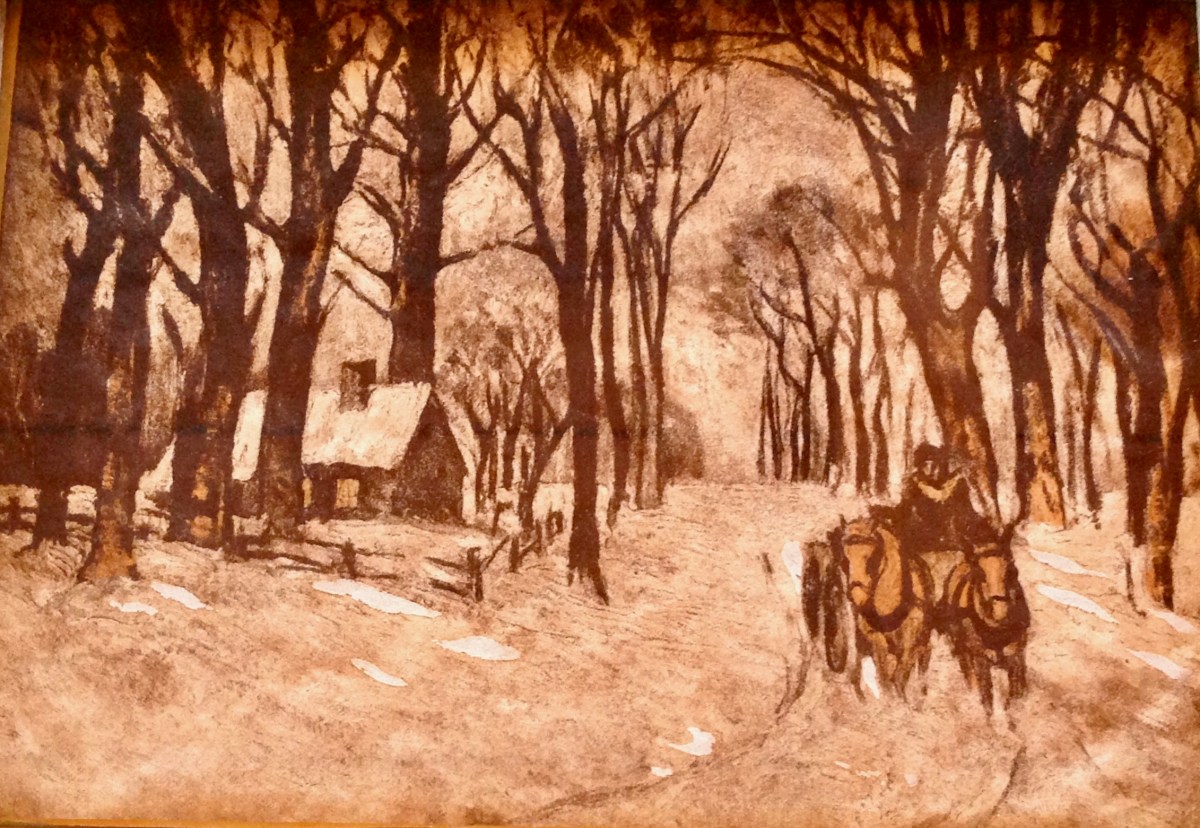
The following short story was inspired by the hauntingly beautiful winter scene pictured. I found this small, 4 x 6, unsigned, pen and ink on paper at a barn sale in Wisconsin many years ago. It remains one of my very favorite pieces. 

Katie keeps the meager fire burning in the small cottage at the edge of the woods, watching her mother twist and turn. Hearing her quietly moan.

Looking around the cabin, she’s desperate for something to do – some way to be useful. But all’s been done in the last two days since the contractions began. So all there is to do is be there when her mother calls, and wait.

Motionless at the kitchen window, she watches the rising sun slowly define the intricate silhouettes of the barren trees behind the barn.

What will the new light bring?

But she’s exhausted and the light is dim. Wiping away the frost and the fog with the apron she’s been wringing in her small hands, Katie watches her father through the kitchen window as he prepares the wagon to fetch the midwife from town. Hitching the horses in the pale light of the lantern, she marvels at his ease and compassion. Patting each of theirs rumps and their necks, and rubbing their broad, long noses, he gently rouses his team to their unexpected task.

Clouds of breath rise from their nostrils and disappear into the cold and still of the mid-winter’s morning as he moves swiftly around the massive beasts, laying the harness as he has hunderds of times before. With bridles slung over each shoulder, he warms both metal bits beneath his thick coat before putting it in their mouths; and for his daily thoughtfulness, each horse lowers his high, heavy head toward him when he holds out their bridle.

Katie smiles.

Until another moan comes from behind and she’s at the side of the bed before the contraction ends and her mom can see again. Gently wiping her brow with the apron, she squeezes tight when her mother grabs hold of her hand and clutches it to her chest.

Smiling again when her mother turns toward her.

Opening her eyes to her daughter, no pain can blur the struggle she sees in her young heart and old hands. She wants to hold her, to hug her tight and tell her everything will be well, but another bolt of pain seizes her thoughts and intents, and she releases her daughter’s hand, clutching the bedsheets instead.

Twice the dawn has come and gone and still the little one is all turned around and stubborn to leave. But I’m stubborn too, she repeats as she squeezes. And the midwife will be here soon.

Pacing the room, Katie hears a horse whinny and looks through the glass and the ice to see the foggy figure of her father climb to his seat, lift his collar against the cold, and call to his team. Running out the door to the edge of the yard, she watches her father disappear into the expanding light.

The horses’ hooves and wagon wheels crush the thin, icy layer that’s formed on top of yesterday’s heavy, wet snowfall, and the sounds of the departing wagon cut through the silence, the winter and the morning, like a tear in the universe.

His universe.

His happy home.

“Click-click,” he urges his horses, while urging himself to peace; to steady his breathing and steady their pace.

All will be fine. She’s a strong woman. Far stronger than me.

“And what would she say of this mood beyond hope?” he calls to his team, resting his eyes on the road up ahead, as the dim and grey of the dawning, winter day becomes brighter and whiter with the strengthening light.

Within Close Range: Good Friends and Bad Decisions

Good Friends and Bad Decisions

Meeting Betsy after dinner at Nonnie and Papa’s. 

But not before swiping booze from their cabinet. 

Having just been dumped, 

she is determined to drown her sorrows. 

As her best friend, 

I’m determined to be right by her side. 

Swig for swig.

Bad Decision Number One.

The entryway sideboard is where they keep liquor. 

I’d come across the contents years ago 

while searching for sweets Nonnie always tucks away

in little, glass dishes 

and old, plastic boxes,

in closets, pockets, drawers 

and in cabinets throughout the apartment. 

The non-candy contents of this cupboard meant nothing to me.

Until now.

Taking a moment before dinner 

to slip into the entry, 

I squat in front of the cabinet

and quietly open the door. 

My knees crackle 

and I cringe, 

as if the telltale sound could possibly be heard above the TV.

I see bottles of all shapes and sizes. 

Some look old, dusty, 

half-drunk 

and wholly forgotten; 

while others, 

still in their special holiday wrapping, 

look ready for a party 

they’d never be invited to.

In front all of these, an unopened quart of Jack Daniels. 

THIS is the bottle I’ve decided to get drunk with 

for the very first time.

Bad Decision Number Two.

I’m antsy, anxious and on edge about the heist all through dinner, 

causing Nonnie and Papa to give each other sideway glances. 

But I worry myself over nothing. 

With Nonnie is washing up in the kitchen 

and Papa already snoring in his recliner, 

I say my good-byes, 

slip the bottle into my purse, 

and slide out the door; 

wondering how soon – 

if ever – 

the missing bottle will be discovered.

In minutes, Betsy’s in the car with Jack and me, 

and we’re heading to Janet Kerf’s party, 

already in full swing. 

Shuffling through the crowded, parentless house, 

to the backyard 

and the back of a garden shed, 

we crack the seal.

Bad Decision Number Three.

Timid first sips burn our throats, 

but quickly warm our insides 

against the evening’s autumn chill. 

The more we pass the bottle to each other, 

the less we care about the burning, 

the cold, 

or the dangerous level of alcohol we’re consuming.

Blurred Decision Number Four.

Betsy’s Ex, 

who we knew to be there, 

becomes the slurred focus.

Blurred Decision Number Five.

Emboldened by my best friend’s broken heart 

and half a quart of Tennessee’s finest, 

I wobble my way through the backyard, 

the kitchen 

and into the Kerf’s living room 

where I proclaim to a packed house,

and at the top of my notoriously powerful lungs

that Kelly Walsh is an asshole.

Bold Decision Number Six.

Loud enough to be heard over the music 

AND din of teenage voices. 

All heads within earshot – 

including Betsy’s Ex – 

turn my way. 

Having never met, 

I don’t really know the ex, 

so I couldn’t really say whether or not 

he is,

in fact, 

an asshole. 

But my best friend – 

and Jack Daniels – 

say he is.

The swaying crowd is more momentarily confused 

than concerned 

as I abruptly stumble from the house 

and back to my very drunk friend 

before anyone has a chance to question 

my center-of-the-party proclamation.

With the ex-boyfriend properly cursed, 

Jack Daniels completely consumed 

and friends really concerned, 

I’m led to a phone

where someone helps me dial home and Chris answers. 

I babble and burble and beg for her help, 

then wait to be poured into the back of Mom’s car.

Early the next morning, 

after having spent most of the evening vomiting,

Betsy and I are woken with unwelcome reminder 

to drive a carful of friends to a football game.

Bad Decision Num-

oh, screw it.

Just West of the Midwest Chapter 13: A Very Short Story Loosely Based on the Truth

With a book that held no interest sitting open in her lap, she sat on the train bound for Shintomi-cho, quietly taking in the faces of the passengers surrounding her.

The conflicting smells of bento [box lunches] and local chicken farms filled the air, creating vastly different sensations that ranged from cravings to queasiness.

The idle train, which had been stopped for quite some time at Kawaminami Station waiting for a freighter to pass, sporadically shuddered and rattled. The taunting motion made her more and more anxious to be moving.

It had been a long and exhausting weekend and the only exercise her mind would allow was staring out the window at the Japanese countryside with the same glazed intensity of a mannequin in a store window.

Acutely focused.

Seeing nothing.

Until, from the murky depths of her gaze, she saw something strange in the woods just fifty feet from the train’s window. At first, all reason told her that what she saw was simply a pile of garbage. After all, just a short while ago, as the train rattled down the tracks toward home, she had mistaken ugly, metal silos for primitive grass shacks, attributing the error to her tired eyes and all but drained mental faculty.

Still… she stared at the object beneath the tree for quite some time.

She wiped her glasses.

Then looked again.

There, lying against an old, gnarly tree was an old man, dressed in the traditional, ancient attire of a Japanese farmer, sleeping.

His face was blackened and worn from the years of working all day in the fields. His rough, bony hands held tightly to a walking stick, as knobbly as the tree itself.

Squinting in an attempt to refocus, she waited for the scene to change.

Or, for the old man’s eyes to blink, his nose to twitch, his body to jerk – even slightly – in order to give life to this strange vision.

Or was it an illusion?

But there he slept.

Motionless.

Turning her attention back to the truth of the train car, where she hoped her mind would find a tangible distraction, she found nothing and no one which held the same interest than what she was sure she was imagining on the other side of the window.

She turned back to the object beneath the tree, expecting to see her ancient farmer replaced by a tarp or some fallen branches.

She shuddered as she focused again on the old man as he slept.

“This can’t be,” she laughed quietly and whispered to no one, becoming more and more uneasy at the sight of it.

Sliding to the edge of her seat, she looked around the train car for a friendly face who would lay this apparition to waste, but hesitated.

“Exactly what would I say?” she thought to herself. “Excuse me, but do you see that ghost beneath the tree?”

So, she remained silent and turned, once again, toward the window, intent on dispelling the strange manifestation once and forever.

Just as she turned, the train began to pull away.

Her heart began to beat faster, as she pressed her nose against the pane. She watched her one last chance to dispel the vivid vision fade into the distance.

The old farmer licked his lips and rubbed his tired eyes.

He stretched, long and slow, then rose from the shade of the tree.

As he righted his ragged straw hat and steadied himself with his walking stick, he cocked his head to hear a strange sound.

A steadily accelerating drumbeat.

The old man looked all around for the source of the sound, but it soon faded into the day.

And the day was fading away.

So on he went.

Down the road.

Toward home.