Just West of the Midwest Chapter 28: The Dead, The Young and One Dirty, Old Man

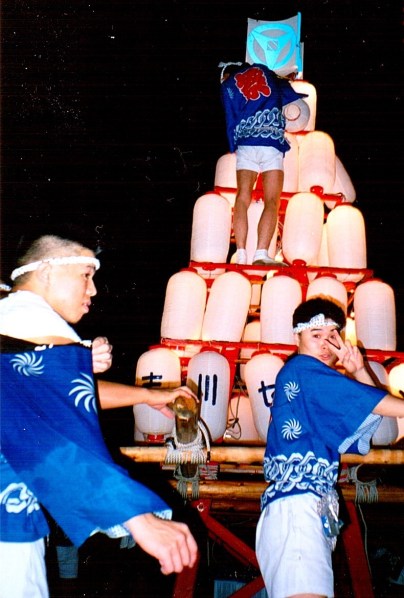
With the heat of summer come a number of different festivals that are celebrated throughout the country. From July 13-15, there is the Bonmatsuri, or Bonodori (the festival of lanterns), a time for consoling the spirits of the dead with dance and music. During this celebration, hundreds upon hundreds of simple white, or beautifully hand-painted lanterns are lit throughout the towns.
52dd8-28-2
Photo by acfrohna

Along the streets.

Down to the river.

Into the cemeteries and shrines.

Effusing with light this lively celebration of both gaiety and solemnity, the lanterns are lit so that ancestors may find their way back from the dead in order to bless the living.

Ancestors are highly honored here in Japan. They’re remembered not only during this celebration, but throughout the year through prayer and offerings of food, flowers, incense and tea.

Each night of the Bonmatsuri, tea is poured every hour for the visiting spirits. On the third night of the festival, hundreds of lanterns are floated down the local river. Each lantern sent in memory of an ancestor. Those which tip and extinguish, it’s said, represents a prayer that will go unheard.

In Shintomi, family and friends gathered in homes throughout the town to eat and drink and honor their deceased relatives. The first night was a perfect summer evening, as a cool breeze blew down the tiny streets of my town.

Through the farms and across our faces.

Carrying the sweet scent of life which, united with the laughter and the music, created an atmosphere that was comfortable and inviting.

Like a loved one’s long embrace.

Moving from house to house that night, performing a lively, uplifting dance for the dead, was a group of young men and women, many of whom were my students, dressed in the traditional summer yukata.

d4dfb-28-0
Photo by acfrohna

Splendid in their colors.

In their youth.

In their joy.

This would be the first of many nights of dancing and singing, fireworks and food, games and parades. All of which are a sheer delight to the eyes.

And succor to the senses.

There were countless occasions during the celebrations when I sat back with a friend or student by my side, or a fat baby on my lap, when I felt the urge to cry.

So happy to be a part of it all.

8fa18-28-1
Photo by acfrohna

Last week, I spent four days in the mountains of Takaharu as a camp counsellor for some thirty senior high school students from around Miyazaki. It was all part of an International Relations project that gave these chosen students the opportunity to spend a few days, “Studying Abroad” in Miyazaki.

Takaharu, or more specifically, Ojibaru, is a beautiful camp site in the mountains, scattered with lovely, little cabins and a main event hall. Waterfalls and small rivers traverse the hilly scenery and at the center of it all stands a shrine built to honor the first Emperor of Japan, said to have been born in this very spot.

There were about a dozen other AETs and CIRs who took part in the event and we planned a number of games and activities, meals, talent shows, etc., to give the students a taste of our various cultures. Sam and I were put in charge of the opening day activities and decided to organize a scavenger hunt. Instead of simply having various items planted throughout the grounds, we decided to have the camp leaders dress up in various costumes. Upon finding them, the students would have to do as they ask. For instance, we had a sleeping princess in need of a kiss (Having her plastic tiara at the ready, Sam eagerly volunteered.); there were sailors you had to dance the hornpipe dance with; a pirate you had to have a sword fight with, a clown you had to juggle for, and so on. Everyone really got into the act and a good time was had by all.

Each cabin leader had six students Much to their glee, I nicknamed mine as soon as I got a feel for their personalities. There was Me-oh-my, Bashful, Cat, Plato, Confucius and Romeo.

Each leader also had a partner for the four day camp. My partner was James. Nice enough.

When not gripped by a catatonic stupor.

I managed to handle things well enough (including cooking three meals a day for eight people), while James – the poor thing (“Are things moving too fast for ya, son?”) stood by.

Taciturn, listless and useless.

There were many activities planned throughout the weekend, such as a tie-dye party, a dance, a casino, the English Language Olympics and a talent show during which all the cabins had to present an act. My cabin, which we called Shangri-la-de-dah, did one of the worst renditions of “All You Need is Love” imaginable, but had a great time despite our lack of talent.

By the end of the camp, I was exhausted, but happy that none of my campers (even the quiet one I called “Cat”, who hardly spoke a word the entire four days) wanted to go home. They even suggested that the camp next year should be an entire month.

Despite former oaths that I would never – EVER – appear on television again, I found a microphone being shoved under my nose and a T.V. camera closing in on my face on the last day of camp. The television crew caught me completely off guard while trying to cook the umpteenth meal for my crew in a small and steamy kitchen, during a 107 degree day.

As poor, pointless James stood by.

Glassy-eyed.

Motionless.

Saliva dribbling from the corner of his open mouth.(Okay, I made up the saliva part.)

I was very hot, very, very sweaty and frankly unnerved by the ambush. I tried to be patient and congenial as the reporter attempted speaking English. Apparently a student of the rote method. Watching the conversation reach new lows linguistically, I soon found myself begging him to speak Japanese just so we could wrap things before I became severely dehydrated from the profuse sweat pouring from my being.

It was a truly awful experience.One made even more ghastly when I was unfortunate enough to be given a tape of the televised event.This tape will never see the light of day and, if I can help it, be the very last of its kind. This time I mean it!

To celebrate the success of the camp, a few of us went to a disco in Miyazaki on Saturday.

That night, I was told I was a dead ringer for both Audrey Hepburn and Julia Roberts. Add these to recent comparisons to Jodie Foster and John Lennon and it all adds up.

All us Westerners DO look alike.

Greg, the AET from Saskatchewan I told you about previously, was part of the camp and joined us. In fact, he’s become a regular part of our happy, little entourage and has become a good friend to both Sam and I. He’s not only a lot of fun to hang out with and very, very humorous, but one whom I’m confident I could rely on in times of need.

For my part, it’s a rather confusing relationship. Perhaps this is because I have a bit of a crush on Greg.

And why not?

A man who can make me laugh as much as he does has always been a turn on. Add this to a great smile, sweet disposition, and abundant creative talents (he is a fantastically funny cartoonist)… how can I help it? But the signs are confusing. I don’t know whether he sees me more as the “sister” type and admittedly, I often feel the same sort of “brotherly” love.

There are times, however, when I feel there might be a spark of attraction coming from him, but neither he (nor I, for that matter) has ever “stepped into the breach,” so to speak. Which is fine, really, because I’d rather just hang out and enjoy his company and friendship rather than mess with things. I’m guessing he feels the same way.

Anyway, our happy, little band of brothers and sisters ended up dancing in Miyazaki until 4 in the morning and then, after downing some burgers, arrived back in Shintomi at the crack of dawn where the entire group crashed in my apartment.

As for any other activities worth reporting, well… I can’t say this is newsworthy, but certainly noteworthy.

Now all of you well know of my uncanny ability to attract lewd behavior across the globe.

There was my first encounter: the penis rubbed against my leg in a crowd in Italy. The masturbating man with the raincoat in front of the Plaza Hotel in New York. The flaccid drunk on the Tube in London. The under-the-table-masturbator at the Brat Stop in Wisconsin. The early morning, open door, front seat jack-off in Chicago.

Well, I’m sorry to report that it’s happened again. I can now add Japan – and of all places, Shintomi – to my list of lewd encounters. At least this time, no actual sighting of a penis was involved.

I went to the beach last Saturday and, as usual, it was completely deserted. It was a beautiful, sunny day and so I stretched out my beach towel, turned on some music and began to soak in the sun. I was singing along with Bonnie Raitt when the tape ended and I sat up to turn the cassette over.

It was then I discovered a strange, old man pacing back and forth just a few feet in front of me. Doing my best to ignore him, with the hope he would simply go away, I turned to lay on my stomach, closed my eyes and tried to concentrate on the music. But even with my eyes closed, the music blaring in my headphones and the waves crashing on the shore, I sensed his presence.

Still present.

I opened my eyes to find that the old letch was now laying behind me, about four feet to my right.

Ogling me.

“Konichiwa,” he grinned, revealing what few teeth remained.

I made no reply, but offered only a dirty look in response to his invasion of my personal space and turned away. A few minutes passed and opening my eyes to peak beneath my folded arm, I looked to the spot I had last seen the old perv and sighed with relief that I no longer saw him there.

Yet something still didn’t feel right.

I immediately rose from my stomach and turned over to find this dirty, decrepit, little, old man laying directly behind me.

I’m talking inches.

Staring up my ass.

I leapt up and started screaming.

I really don’t know any dirty language in Japanese, but I screamed that he was very rude, that this was a big beach and that he should go elsewhere, or I would scream for the police.

It was then I also realized that the doddering deviant was now wearing only his underwear.

Well, that’s when every fowl word I knew in my native tongue erupted from my mouth and I grabbed the nearest piece of driftwood with which to beat the lecherous smirk off his face.

This finally sent him on his way. No doubt to jerk off behind a dune somewhere.

Oddly enough, I didn’t feel the least bit frightened. I’m confident that with the adrenaline rush I was experiencing I could’ve snapped the decaying degenerate in half without much effort.  However, I don’t think I’ve ever felt so damn pissed off that this had happened to me YET AGAIN!

For God’s Sake! Why me?

And what’s even worse is that my sanctuary – my miles of desolate beach where I could be away from the ever-curious people of my village – no longer felt like a safe haven.

Total Bummer.

All I Can Say Is…

  • Typhoon season is once again upon us. All I can say is… the humidity and heat here make me feel like a moldy, unrecognizable leftover wrapped in Saran wrap that someone tossed from a speeding car, two months prior.
  • Now that my Japanese has improved most people around me are speaking at their normal speed. All I can say is… What the hell are they talking about?
  • Sam is getting back from a three week trip to England tonight and she’s planning on coming down to hang out at the beach here. Maybe that’s not such a good idea anymore. Anyway, not having her here for the past several weeks, I’m now certain that she’s been an absolutely vital part of my experience here. Without having Sam as a constant sounding board, shoulder to cry on, confidant, etc., I’m quite sure I wouldn’t have renewed for a second year, or for that matter, enjoyed my first year as much as I did. She’s been there to talk to me about everything. And nothing. On innumerable occasions, she’s helped me get things off my chest so that I can face the next day with a brighter outlook. All I can say is… Thank the Gods for good friends.
551cf-19-0

My love to all. I miss you and think of you often – except when in the presence of a man so good-looking that I find every cell of my body trying desperately to find a way to make him believe that I’m the woman of his dreams and that he is my love slave. That is, until I find him all too passé and dump him for the guy with all the money who’ll jet me around the world, taking me to places like Rio and Monte Carlo, where I’ll ditch him for a Duke who believes I am the Venus de Milo personified and whisks me away to his castle where I meet and decide to run away with his poor, but charming valet, Francesco, who ends up dumping me for some big-breasted bimbo named, Wanda, because of a little trick she can do with a maraschino cherry and a g-string.

Just West of the Midwest Chapter 29: Virgin Territory

I’ll be brief.

I deflowered a virgin.

I’m ashamed to admit that it’s all a bit blurry. It happened during a recent night of carousing in Shintomi with some friends. I met a young man (legal age – at least I think so), Kenji, who was in this local bar WITH HIS DAD.

It all began innocently enough.

There was a little flirting.

There was a little dancing.

There was, of course, a lot of drinking. 

And the next thing I knew – despite the cautions from his dad not to fall prey to the wicked, wanton, Western woman – the young man left the bar with me. We went to another bar with my friends, but the two of us eventually ended up at my apartment where he confessed his purity.

Maybe I felt as if I had total control for the first time in my sexual life. Perhaps I was a little drunk – not only on alcohol, but with the carnal power I had over this young innocent.

I can’t defend it. Or even excuse it, for that matter. 

I can just confess that I took full advantage of it with little concern for what would follow.

The next evening, Kenji returned to my apartment with an armful of stuffed animals he’d spent the entire day trying to win at a local arcade and the hopes that we would repeat last night’s performance. However, I was hungover and sick with shame over my overtly brazen behavior.

I did invite him in, but only to explain, as gently as I could, that there would be no repeat of last night’s activities. He was so very, very, VERY sweet and so very excited about his first foray into manhood that it was hard to refuse his gentle entreaties.

Probably because in the light of the new day, he suddenly seemed so very, very young. 

He eventually left. Broken-hearted.

And I, having returned from my power trip, was all that remained.

Repentant and miserable.

Just West of the Midwest Chapter 30 – Paradise Lost

Mark, called me a few days ago. 

Although I could hear how tired he sounded, there was something else to his tone that I couldn’t put my finger on.

It sounded as if he was talking into an empty glass.

Then it hit me.

“Where are you?” I asked.

“I’m sitting in the family room,” he answered gloomily. “Just me and a few boxes are all that’s left.”

An enormous lump formed in my throat.

Suddenly, I felt not just thousands of miles, but light-years from home.

It was certainly not new news that my parents were moving from the house I grew up in. 

My father had, in fact, been struggling to hold onto it for quite some time and we all knew the end was near. But when I heard my brother’s voice reverberate against the barren walls of what was once the heart of our home, I felt as if my limbs had turned to lead and nearly dropped the phone.

For nearly twenty years our home in Shoreacres had been a wonderful, wooded haven – not only for my parents, my brothers, my sisters and myself, but for a myriad of friends and relatives who relished their time there.

Lounging on sofas.

Swimming in the pool.

Diving into the refrigerator.

Climbing down the bluff.

Watching storms pass over Lake Michigan.

And fireworks up and down the shore.

Many rights of passage were initiated there.

Bones and heartaches mended there.

A marriage celebrated.

Another continuously tested. 

Runaway ponies wrangled.

Strays (of the canine, feline and human kind) fostered there.

Schemes hatched. 

Boundaries broken. 

Imaginations nurtured.

It was a truly spectacular – almost magical – place to grow up.

The two of us couldn’t speak for the next few minutes. When we finally found our voices again, there was little left to say.

We each managed to choke out a “Good Night.” Then, I quietly set the receiver down and stared into my darkened apartment on the other side of the globe.

There would be no going home again.

I wept, trembling, until I fell into a restless sleep.

Shoreacres front

Just West of the Midwest Chapter 31: If This Isn’t a Disco, Why Am I Dancing?

It all began with a phone call.

Sam: Anne, I have a favor to ask.

Me: Why do I already not like the sound of that?

Sam: Now I want you to keep an open mind. Think of it as a possibility for a truly interesting experience.

Me: Now I REALLY don’t like the sound of it.

Sam: You haven’t even let me tell you what it is!

Me: You haven’t given me any indication that I should.

Sam: Just hear me out.

Me: Why should I?

Sam: Because if you don’t, I’ll have all the disgusting pictures I have of you blown up to life-size and distributed throughout the ken. You won’t be able to go anywhere without every single man, woman and child running from you in horror. Eventually, you’ll find the only time you can slither from your home is at night, under hat and cloak, when all people (except those as heinous as yourself) lay in their beds – trying to sleep – but waking, time and time again, screaming your name and trembling with fear.

Me: I think you’ve made your point.

Sam: Little children will create games using your picture in mask form-

Me: All right, Sam, I get the picture. Just ask what you have to and leave me to my misery.

Sam: There’s a festival in Hyuga at the end of September and my office wants you and I to join in.

Me: That’s it? You want me to help out at a festival?

Sam: There’s a little more to it than that… They want us to dance.

Me: Dance? You mean the Twist, the Tango, the Hustle – something like that?

Sam: Not exactly.

Me: Well EXACTLY what kind of dance are we talking about here?

Sam: The kind that has us dressed in yukata, straw hats and geta [traditional footwear] and dancing down the streets of Hyuga for a few hours.

Me: Ha-ha.

Sam: So what do you think?

Me: Ha-ha-ha-ha-ha-

Sam: Really, it’ll be larks. I think we should do it.

Me: Ha-ha-ha-ha-hee-hee-hee-hee, ho-ho-ho-ho, haw-haw-haw-

Sam: Is that a yes?

Me: Not if my life and those of my family depended on it.

Sam: I don’t think you’re being very open-minded about this.

Me: Oh, my mind is wide open! I can just see it now – the two of us stuffed into undersized yukata, falling over our feet and making total asses of ourselves in front of the entire city of Hyuga [population 300,000], most of whom already think we’re freakishly amusing! No way. You better get those photo negatives to the store-ha, ha, ha, ha, ’cause there is no way in hell I’m doing it – hee hee hee hee – US, dancing down the streets of Hyuga – ha ha ha ha – don’t make me laugh!

Sam: Anne?

Me: Ha ha ha ha – yes, Sam? – hee hee hee hee-

Sam: I’ve already told them we’d do it.

Me: -ha-ha-ha-Huh?

Sam: They’ve already ordered the yukata, geta and tabi [split-toed socks] for us… Come on, Anne, we’ll only dance for an hour and then make our excuses.

Me: Sam, I don’t seem to be getting through to you. My answer is an unequivocal, undeniable, incontrovertible, “NO!”

(Scene flashes forward a few weeks later to the city of Hyuga.)

Me: This really isn’t happening.

Sam: Actually, it is.

(I have no witty comeback, but merely throw my dear friend my bitchiest look.)

Me: So, tell me again when this nightmare will unfold?

Sam: 11 o’clock.

Me: And what time do they want us there?

Sam: About 10 o’clock.

Me: And that’s when we practice the dance?

Sam: Practice?

Me: Yeh. That’s the thing you do when you’re expected to perform something you’ve never seen or heard before. Call me a perfectionist, but I always like to make sure I understand exactly how I’ll be making a complete ass out of myself.

Sam: We’ll practice after we get into costume. Don’t worry. It’s not that difficult.

Me: Said the tightrope walker to the one-legged man.

Sam: Don’t be so negative. This is going to be fun. Remember the Yokagura?

Me: Yes! It was utterly humiliating.

Sam: Well, yes, WHILE you were doing it. But now that you look back on it…

Me: May I remind you, Sam, that that was a 10 minute dance in front of 20 or 30 very tired, very drunk or very hungover people, at 6 o’clock in the morning, on top of a mountain. This is dancing down the streets of Hyuga, in broad daylight, in front of thousands of people – stone sober – for several hours.

Sam: There’s a slight difference, isn’t there?

Me: Only slight.

Sam: But they’ll never be able to recognize us with those big, straw hats on.

(I simply offer a “Who are you kidding?” look.)

Sam: Well, whatever the case… Come on, we have to pick Maria up at the train station.

Me: Maybe I can throw myself in front of one.

Sam: I heard that!

Now Maria is a new friend of ours who lives in Nobeoka, a town just to the west of Hyuga. She teaches privately at an all-Girls’ Catholic School there. Originally, she comes from Manchester, England. She’s a very colorful character and always bound to bring something lively to a situation.

We found her waiting at the station in a mood altogether different from our own.She was actually looking forward to the event. So cheery and upbeat was Maria that she almost lifted my sour mood.

This slight surge in my will to live, however, soon catapulted downward when we entered a large room brimming with chattering and excitement. That is, until a spine-tingling silence fell upon the crowd of women when they caught sight of the three of us as we walked through the door.

I swear I could hear a pin drop.

In Tokyo.

Once the initial shock of seeing us wore off, the chattering began anew and, one by one, we were taken through the process of getting into costume.

3699f-30-3

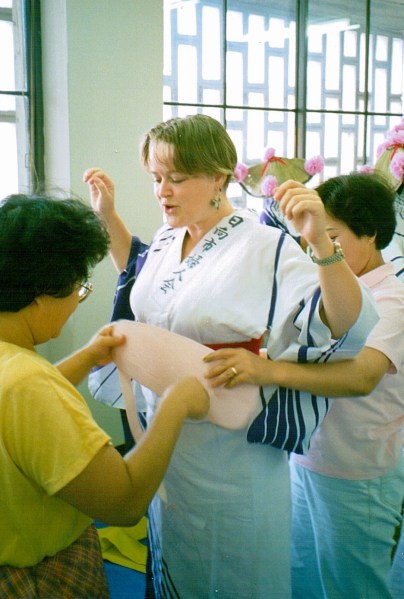
Picture, if you will, a large room in which 40-50 very shy Japanese women are desperately trying to undress and dress without showing more than their wrists. At the same time, three Western women are running around the room, half-naked, trying to convince their dressers that it isn’t necessary to locate full length slips for them to wear beneath what they already feel will be the hottest and most uncomfortable outfit they’ve worn since the invention of the polyester jumpsuit.

The physical differences between Sam, Maria and I and the 50 or so Japanese women who stood before us seems too obvious to mention. However, it must be pointed out that the main difference – or should I say six main differences which would undoubtedly give us away as foreigners – was quite clearly our breasts, which were being bound and stuffed into gowns originally designed without any consideration of the mammary glands whatsoever.

We couldn’t help but notice many of the women glancing our way, “down” their way, and our way again, followed by gasps and concealed giggles.

3fc2e-30-5

Me: How are you doing over there, Sam?

Sam: I’m fi-ay-ay-ow-ay-ne.

Me: Are you sure? Your color looks a bit off. Maybe your obi is too tight.

Sam: I’ll be alri-if-I-don-breafor-the-nex-few-hours.

Me: Where’s Maria?

Sam: Dono-

Maria: Here luv.

(I turned but all I could see was a sea of ark-shaped straw hats with giant, pink paper flowers.)

Me: Where?

Maria: Don’t ask me. I can’t see a bloody thing with this hat on.

Me: I believe that’ll be more of a blessing than a curse.

Maria: Anne?

“Bump.”

Me: I’m here!

Maria: Anne?

“Thump.”

Me: Left, Maria. Now a little to the right.

Maria: Anne?

“CRASH!”

Me: Hey! You look great!

Maria: So do you?

Me: How do you know, you can’t see me.

Maria: Exactly.

cfac5-30-1

Me: I feel ridiculous.

(Sam enters, fully costumed.)

Sam: Come now. You’ll be able to tell your children about this.

Me: I’m not sure how childbirth will be physically possible after the way I’ve been bound up.

Sam: Don’t bitch, just breathe! Now let’s go learn that dance!

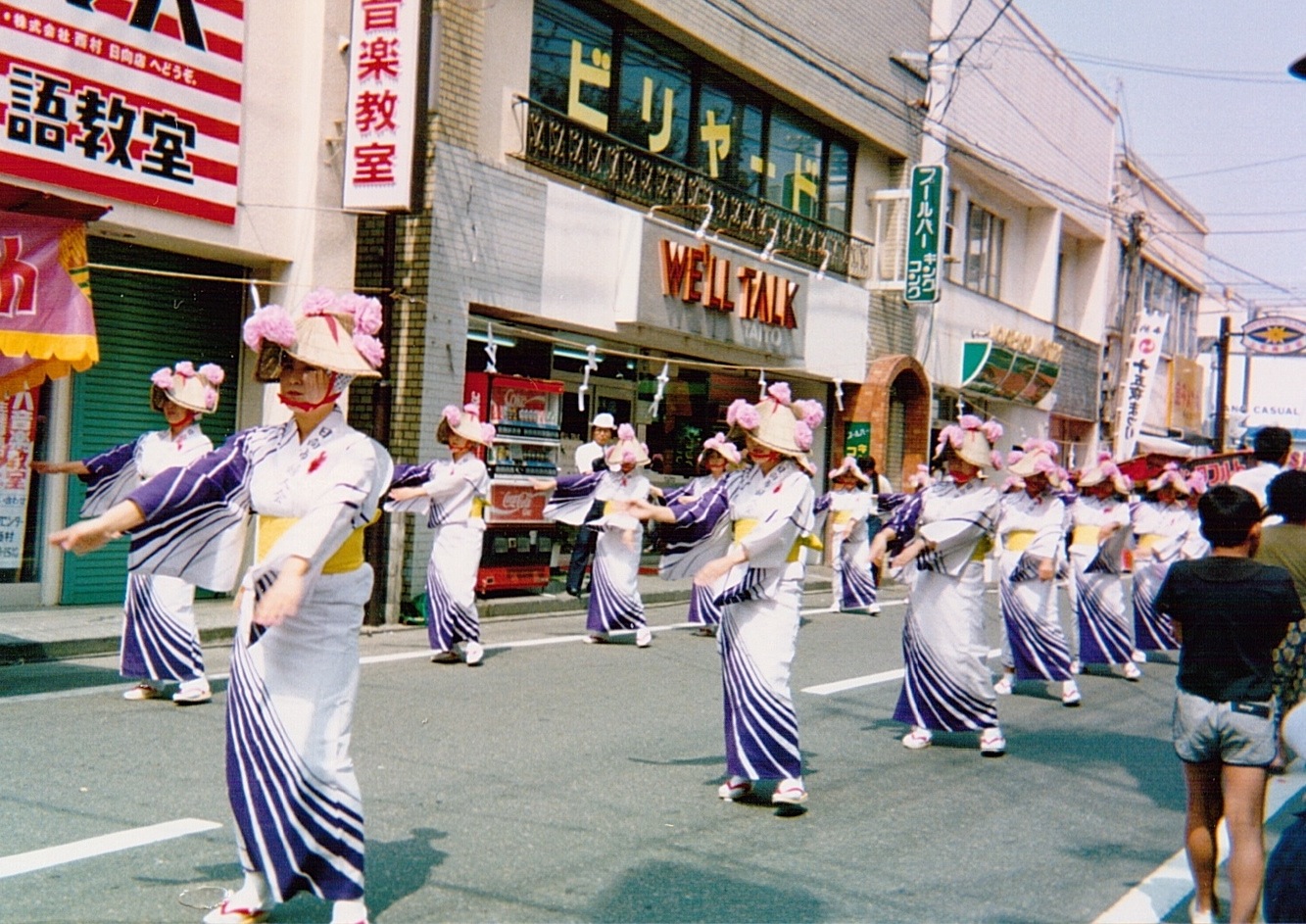
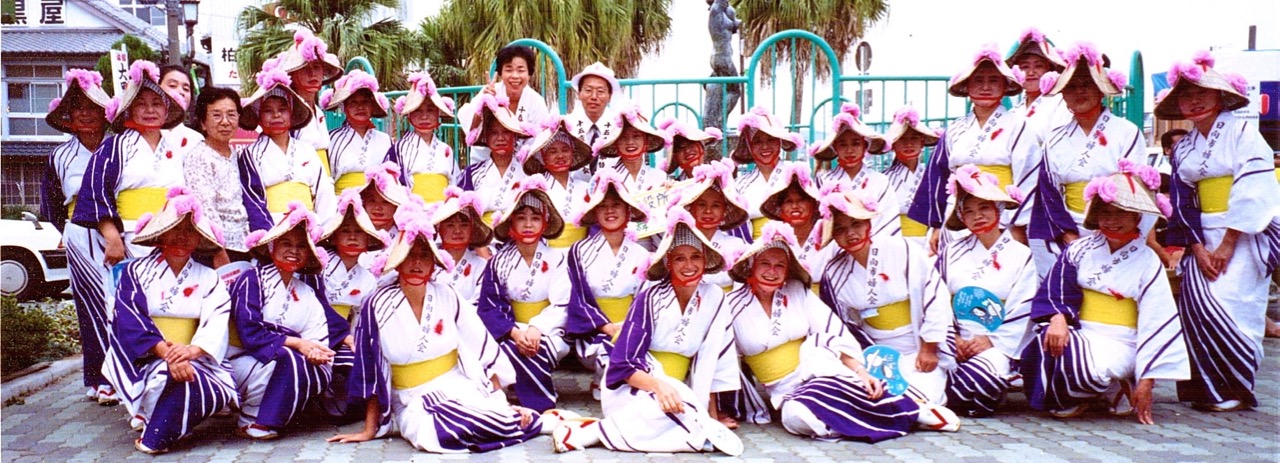
The dance we were being taught embodies a woman praying to the Harvest moon for her one true love. I was praying just to make it through the day without the need of therapy. Or an ambulance.Our practice session lasted about ten minutes until the three of us decided we were helpless and hopeless and that our only chance for coming out of this event with a shred of dignity was to employ the “duck and cover” strategy.

The parade began outside the Hyuga Town Hall where our dance group formed two lines and followed behind a little, white car with a big, white loudspeaker (they really love this device) that piped out the music we would be “dancing” to. After a few practice turns around the parking lot, we quickly discovered that we had no idea what we were doing.

Our fellow dancers kept assuring and reassuring us that no one would even notice us. Yet it was hard to find comfort in these promises each time one of Sam’s students passed our supposedly “inconspicuous” trio and screamed, “Samansa-sensei!”

To make matters worse, we were asked to stand at the very head of the line. Putting a total kibosh on our plans to mimic the dancers in front of us.

As if this wasn’t going to prove awkward enough, as the procession began, we were being touted as a “special attraction” to the day’s events, with the loudspeaker announcing our presence in the group every few minutes.

Necks strained all along the parade route to catch a glimpse of the “gaijin-san.”

The three of us tried to keep our conversations down to a minimum, so as not to make us too easy to pinpoint, but each time one of us looked at the other, we couldn’t helped but crack up.

Now don’t get me wrong, the dance was truly lovely and the women were both charming and graceful in their performance.

822e4-30-6

I couldn’t help but be very appreciative of my front row seat.

It’s just that I never really got the hang of it and was constantly being reminded of my ineptitude each time another familiar face burst through the crowd with a video camera in hand and a huge grin on their face.

“I AM NOT ready for my close-up, Mr. DeMille!”

Nevertheless, the next couple of hours managed to pass with relative ease and we soon found ourselves paused at a shrine with hundreds of other parade participants. We watched a holy man pray for our health and then stood back as a group of about thirty men, all clad in white, took hold of a portable shrine, or “mikoshi” and began the procession once more.

We followed behind. Watching the men carry the tiny shrine. Gently rocking it to and fro. Like a boat sailing atop the ocean waves.

I was spellbound.

Until the music from our little, white car with the big, white speaker called us to realign and begin the procession again. Eventually, we broke for lunch and returned to the town hall where we had an hour to rest up before dancing the remainder of the parade route.

1e3f7-30-0

It was then we learned that the event would go on until 6 o’clock that evening. Maria and I slowly turned toward Sam.

“What?” she laughed nervously. “It’s not that bad. We’re having fun, aren’t we? Believe me, you’ll thank-“

I had her in a headlock and Maria was giving her one hell of a “noogie” when the call of “Bieru” [beer] caused us to halt our assault and run toward the bearer of libations.

With time to kill before the procession began again, we took the opportunity to wander around the town hall to see all the other parade participants. We stopped where the local high school and junior high brass bands were warming up and that’s when Sam and I decided to do some dancing which we were far more familiar with. I led and the two of us swung and twirled, turned and jived around the parking lot (a true feat wrapped in yukata), but soon ran out of breath and stopped to a round of applause. At least now there was proof that we weren’t complete clumsy oafs.

Drawing a short straw plucked from my hat, Maria went in search of more beer, returning a short time later with a look of utter disappointment.

Sam: Where’s the beer?

Maria: …gone…

Me: Gone? That’s ridiculous. It can’t be gone. Are you sure you looked in the right place?

Maria: Oh, I’m sure. I found the beer, but the bottles were all empty.

Sam: I don’t understand. We were the only ones drinking it and I specifically remember seeing an entire case. Now STOP KIDDING AROUND AND GIVE ME MY BEER!

Me: Calm yourself, Sam. There has to be a reasonable explanation… Now then… Maria…

(I said as I grabbed her shoulders and attempted to shake the truth out of her.)

Maria: For God’s sake, I’m telling the truth. You know those very shy, very demure, “Oh I-never-touch-the-stuff” ladies we’ve been dancing with? Well, they’ve been having a bloody party upstairs and drank every last drop. They’re practically swinging on the rafters.

(Suddenly, a roar of laughter could be heard as a group of about twenty women came rolling down the stairs of the town hall, smiles as wide and askew as the brims of their hats.)

Me: Well, I’ll be darned!

It has to be said that this little “pick me up” boosted morale considerably, almost to the point of mutiny. Once we began our dance again, we could hear rumblings from below the sea of straw hats behind us and the rising chant of “Bieru! Bieru! Bieru!” coming from our once “shy” little group of dancers.

The chant would continue and continue to grow louder until the little, white car with the big, white loudspeaker would be forced to stop and open the trunk containing more beer. In the end, I think we had more fun than any other group at the festival. These soft-spoken, unassuming women ended up showing a good deal of spunk.

I have to admit that 6 p.m. rolled around faster than I had expected it to and even though we were all exhausted by the day’s end, we left with smiles on our faces and truly warm feelings in our hearts.

3e54a-30-92b252812529

I have Sam to thank for “volunteering” me.

She was right.

It’s an experience I’ll never forget.

I so enjoyed myself that when I returned to the office the next Monday, I showed them the dance I did and told them what a great time I had.

This was a grave mistake.

They immediately signed me up to dance in a festival in Shintomi next weekend!

Just Wet of the Midwest Chapter 32: Festival Fever

bdc6a-32-3
Photo by acfrohna

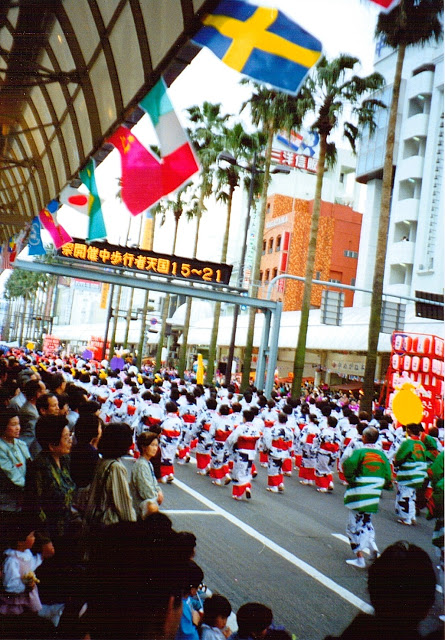
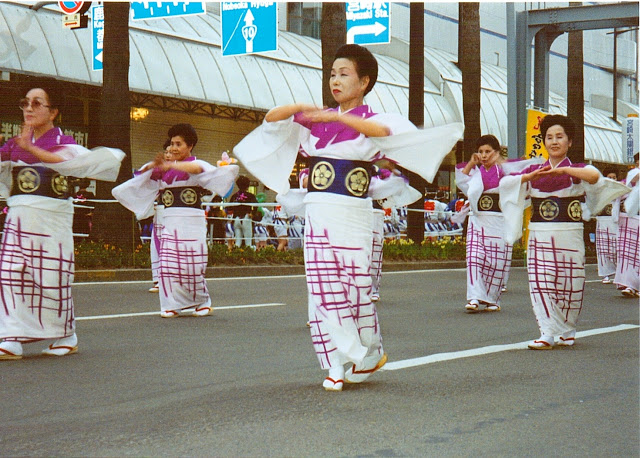
There’s a never-ending cycle of organized social festivals found throughout the year in Japan where I’ve been able to experience this culture in all its splendor, ceremony and sameness. The festivals usually involve synchronized dancing, a copious amount of drinking and eating, and the generally happy gathering of a remarkably large and similarly dressed extended family.

Somewhere – at some point – at nearly all of these festivals, there’s a parade.

dcb0a-32-5
photo by ac frohna

A stream of objects and people. Colorfully costumed.

Radiant.

Graphic.

Assembled in ensembles.

Moving en masse.

0327e-32-1
photo by ac frohna

From the streets, as an innocent onlooker, it’s a delight to watch the well-oiled cogs of the Japanese community at play.

Great rivers of color and movement.

Drifting and converging.

a4579-32-2
photo by ac frohna

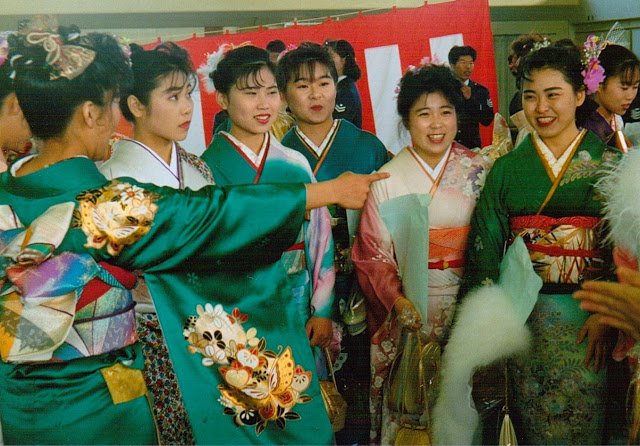
On January 16th, there’s the national holiday, Seijinshiki (Seijin meaning adult or grown-up), which is a celebration for those reaching the age of twenty.

588d4-32-6
photo by ac frohna

Towns and villages throughout the country sponsor “Coming of Age” ceremonies. It’s hard not to get lost in the elegance and awkward grace of these young adults.

Especially the young women.

baca0-32-4
photo by ac frohna

So rich in color and texture that anything or anyone surrounding them dissolves into the background.

Their black, shiny hair curled and twisted with flowers and ribbons.

Their skin, milky white.

And lips, cherry red.

Hidden smiles behind colorful fans.

Or delicate, porcelain hands.

fc4b2-32-7
photo by ac frohna

Each kimono, bright and splendid.

Each obi, so masterfully and uniquely tied.

Reading like a family crest of silk, ribbon and embroidery.

5fdd2-32-8
photo by ac Frohna

Quintessential.

Exquisite.

Timeless.

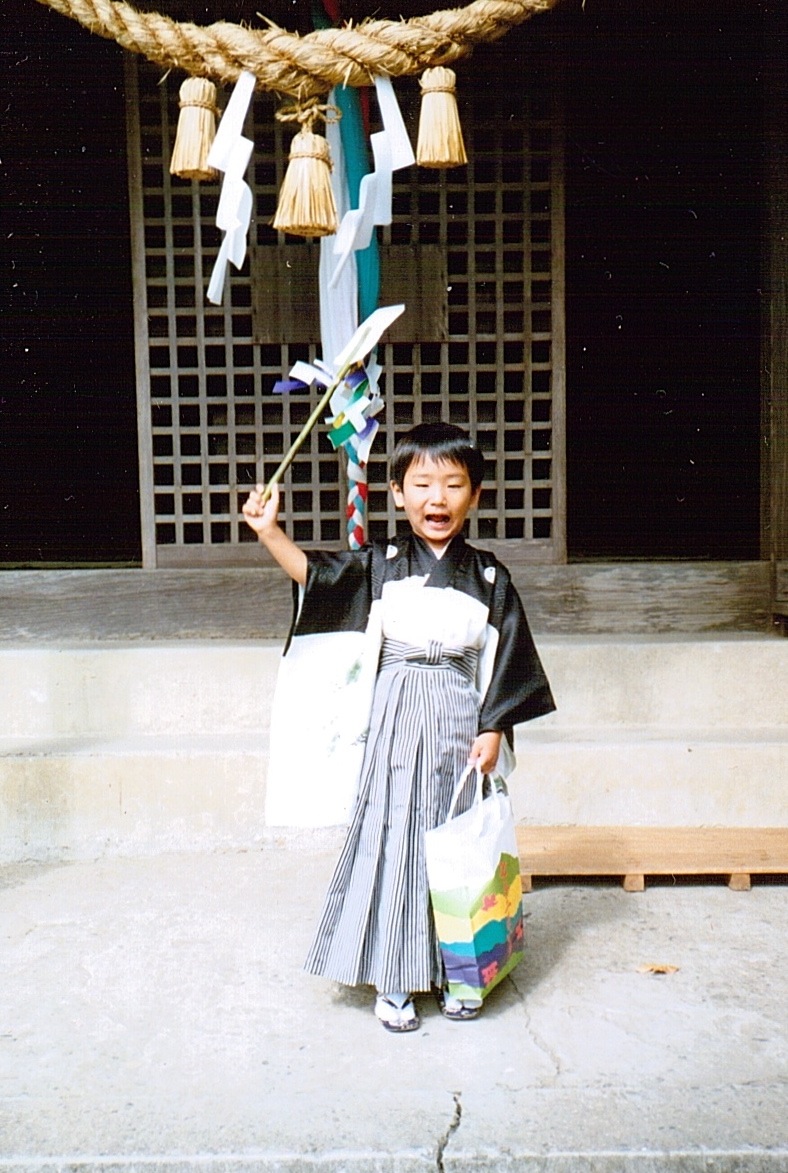
On March 3rd, even though the festival originally marked the passage of 5 years for boys, Koimatsuri (Boys Day), now shares the pond with Kodomo-no-Hi (Children’s Day) and Hina-matsuri (Girls’ Festival). During this celebration, brightly colored Koi streamers flutter overhead everywhere.

Across streets.

From tree to tree, house to house.

Swimming against the currents of wind.

Symbolizing the hope that the children of Japan will be strong.

95f64-38-3

Healthy.

Perseverant.

Such as the carp fighting its way up stream.

Where, it is said, lie the great falls.

Where stands a gate.

Beyond which is a dragon’s life for the determined koi.

90673-18-2
photo by ac frohna

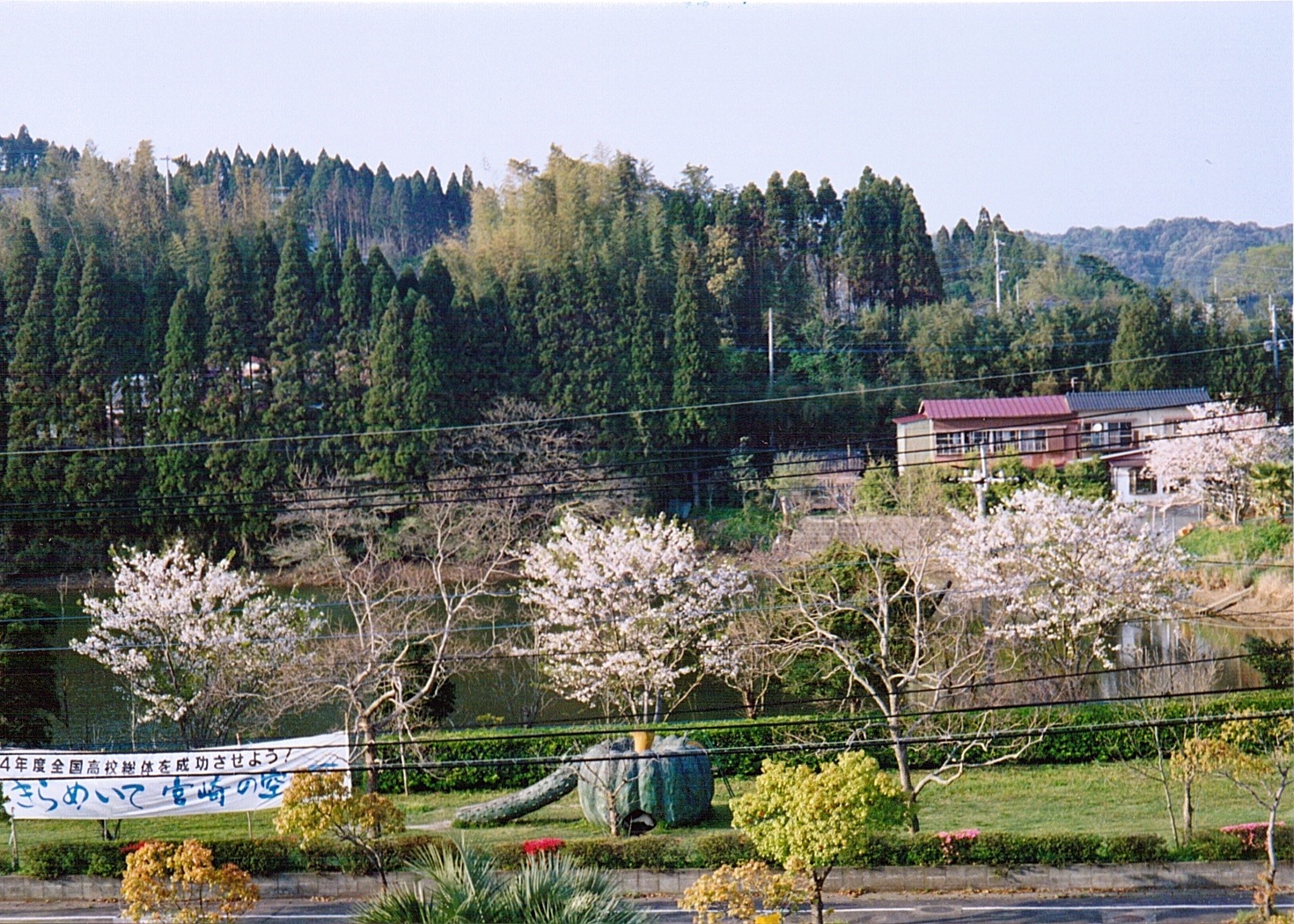
In first part of April there is the fantastically fragrant Cherry Blossom season (Hanami) during which celebrations to welcome spring take place day and night beneath the blossoming trees.

The other day at work, Kuranaga-kacho told Akiko and I to go.

Honor the blossoms.

So, the two of us drove to Saitobaru Burial Mounds where we lazily strolled down the rows of cherry trees.

Beneath their brief, but intoxicating peak.

Relishing, amid the petals, our temporary release from the office.

After the graduation ceremonies in March, come the entrance ceremonies in April.

During this time, there are also parties to say good-bye to old office mates and hello to new co-workers when transfers, promotions and retirements happen in one broad sweep.

Just as in mid-December, there is a Bonnenkai, or Year End Office party, during which failures, frustrations and disappointments are forgotten and only successes are toasted.

Oddly enough, this notion strikes the same chord as the unspoken day-after-drinking protocol in Japan. Whatever happens the night before, remains in the already-forgotten past by morning.

Convenient.

If not slightly lily-livered.

Especially since this applies mostly to men who seem to imbibe – and misbehave – far more than the women here do.

Even with the festival-filled days of summer past, the Japanese fill the cooling days and typhoon season with athletics, as well as cultural and harvest celebrations, such as the Tsukumatsuri (Festival of the Moon) in September.

Being the Land of the Rising Sun, you’d think they’d worship that big red ball on their flag a bit more. But here in Japan, men and women (especially the women) shun the sun with scarves, hats and parasols.

Sometimes all at once.

Instead, they worship the moon and love spending time celebrating its greatness beneath its fair light.

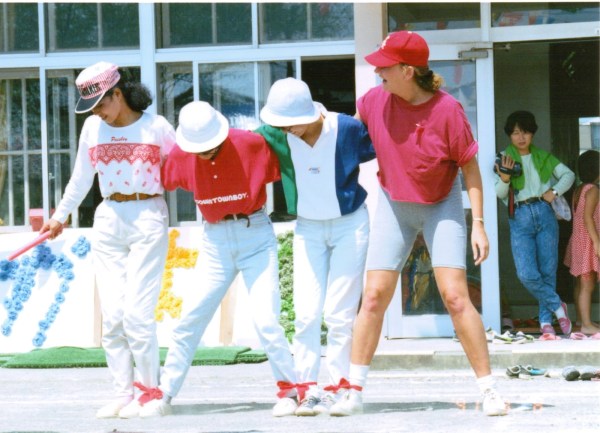
And no fall – or spring – would be complete in Japan without Ensoku, an athletic festival. Exercise is elemental to the Japanese way of thinking. It’s not only a part of school life, but office and social life.

f5317-32-9

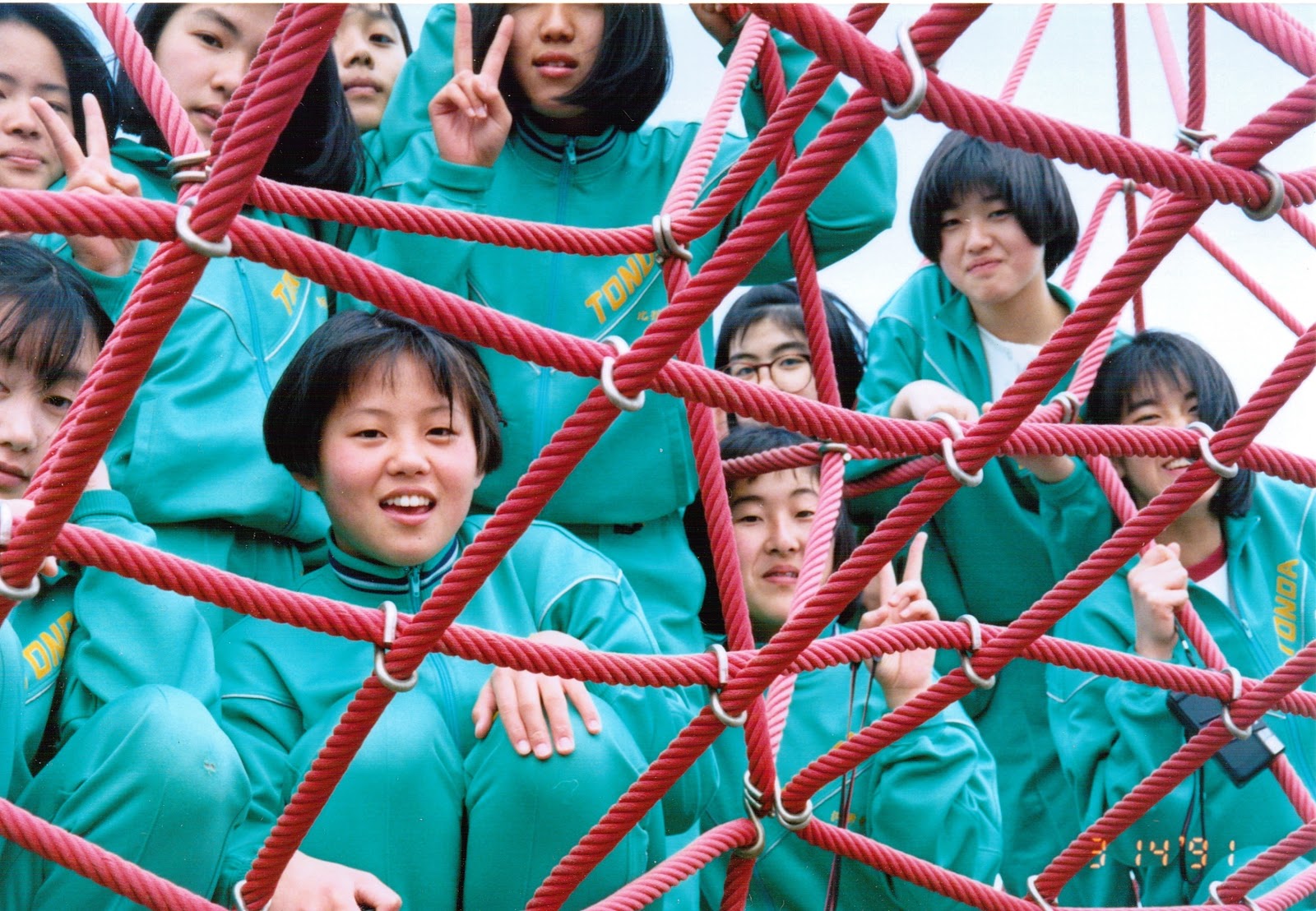
I remember attending my first Ensoku at Tonda Junior High. The school grounds and surrounding woods were an ocean of sea green, genderless, gym suits milling about or engaged in some planned activity or another.

I swam among them.

Joining a search.

Or a game.

Making them use English.

Struggling with my Japanese.

I always love the time I have outside class with my students. When the eyes of their sensei are no where in sight. And the distance to the front of the classroom has disappeared.

c72e4-32-10
photo by ac frohna

All I Can Say Is…

  • Yet another birthday has passed and even though I kept things far more subdued than last year, I still managed to celebrate plenty. In addition to flowers, a boatload of handkerchiefs and more booze than is good for me, my office family gave me an unbelievably cool Canon 35mm camera. All I can say is… if they get any more endearing I might consider adopting each and every one of them.
  • I’m trying to keep up with world events, so I won’t get too out of touch with the outside world. All I can say is… What the hell is going on out there?

Just West of the Midwest Chapter 33: Capital City

Sam and I took a long weekend off and hopped on a ferry to visit one of Japan’s most famous cities, Kyoto.

We boarded a ferry in Hyuga, where for the next 14 hours we would share a large tatami room with the other passengers. By the time we arrived on board, all of our fellow travelers had already claimed their space, grabbed their blankets and their Japanese-style pillows (designed, clearly, by a sadomasochist) and found ways to entertain themselves.

We squeezed out a space on the tatami, settled ourselves in and had a few pleasant conversations with those we’d be sleeping near before the mandatory 10:30 p.m. lights out.

We arrived on the main island of Honshu, in the busy port city of Kobe, Thursday morning and from here took a series of trains, the last being the famed Shinkansen, or Bullet Train, which shot us into Kyoto. Before leaving the station, we made reservations at the Kyoto Century Hotel which we chose not only for its very reasonable rate in a very expensive city, but because it was located near the station and plenty of public transportation for getting around this ancient metropolis.

At 12,000 yen per night, we prepared for a dump, but reasoned that we would be spending very little time there. We paid for our rooms right at the station’s hotel desk. The woman who took our reservations then handed us a map of how to get there and a brochure of our accommodations. Sam glanced at the brochure and with a look of complete surprise on her face, handed it to me.

This must be a mistake, we thought. She must have given us the wrong brochure. We reserved a room at a dump and this place looked like a five star hotel.

“Well,” I warned my friend, “you know what they can do with good lighting and the right camera angle. Besides, these pictures were probably taken years ago.”

A short time later, when we arrived at our destination, I realized that I’d been completely mistaken. We were immediately greeted at the front entrance of the hotel by a handsomely uniformed valet who led us through the very elegant lobby, straight to the shiny reception desk.

We couldn’t believe our luck.

This place was lovely, sophisticated and far beyond our expectations and our current state of dishevelment. We scurried to our pristine and fashionable room, showered off ferry-life and headed out for an afternoon’s adventure.

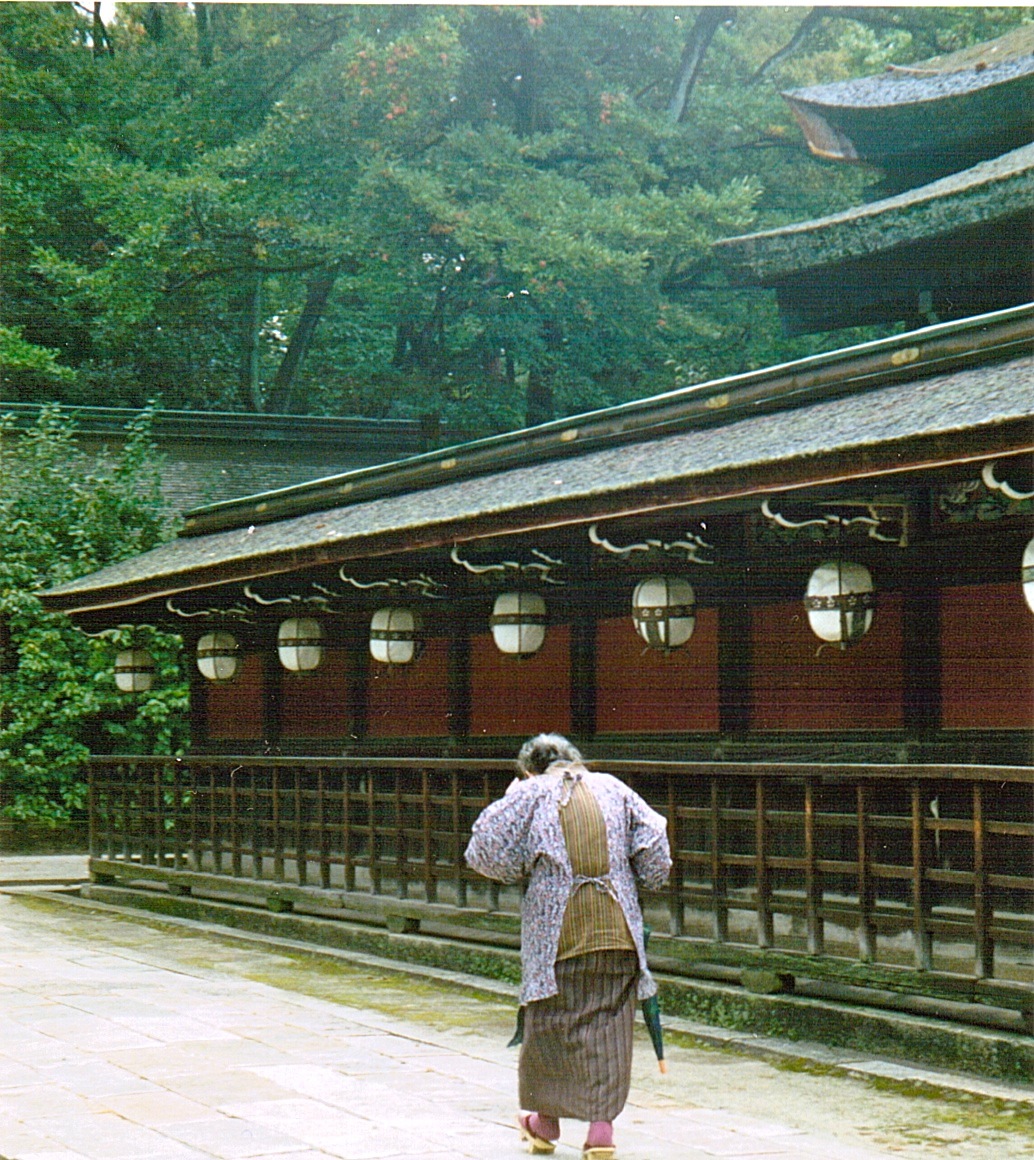
Within moments of our very first stroll, I was already sorry we had a mere 2.5 days to spend in Kyoto, what was the nation’s capital and the emperor’s residence from 794 until 1868. Our first stop was the To-ji, one of the most famous in all of Japan. Around 796 A.D., Emperor Kammu transferred the capital of Japan from Nara to Kyoto and to honor this move, he built two huge Buddhist temples, To-ji (East Temple) and Saiji (West Temple).

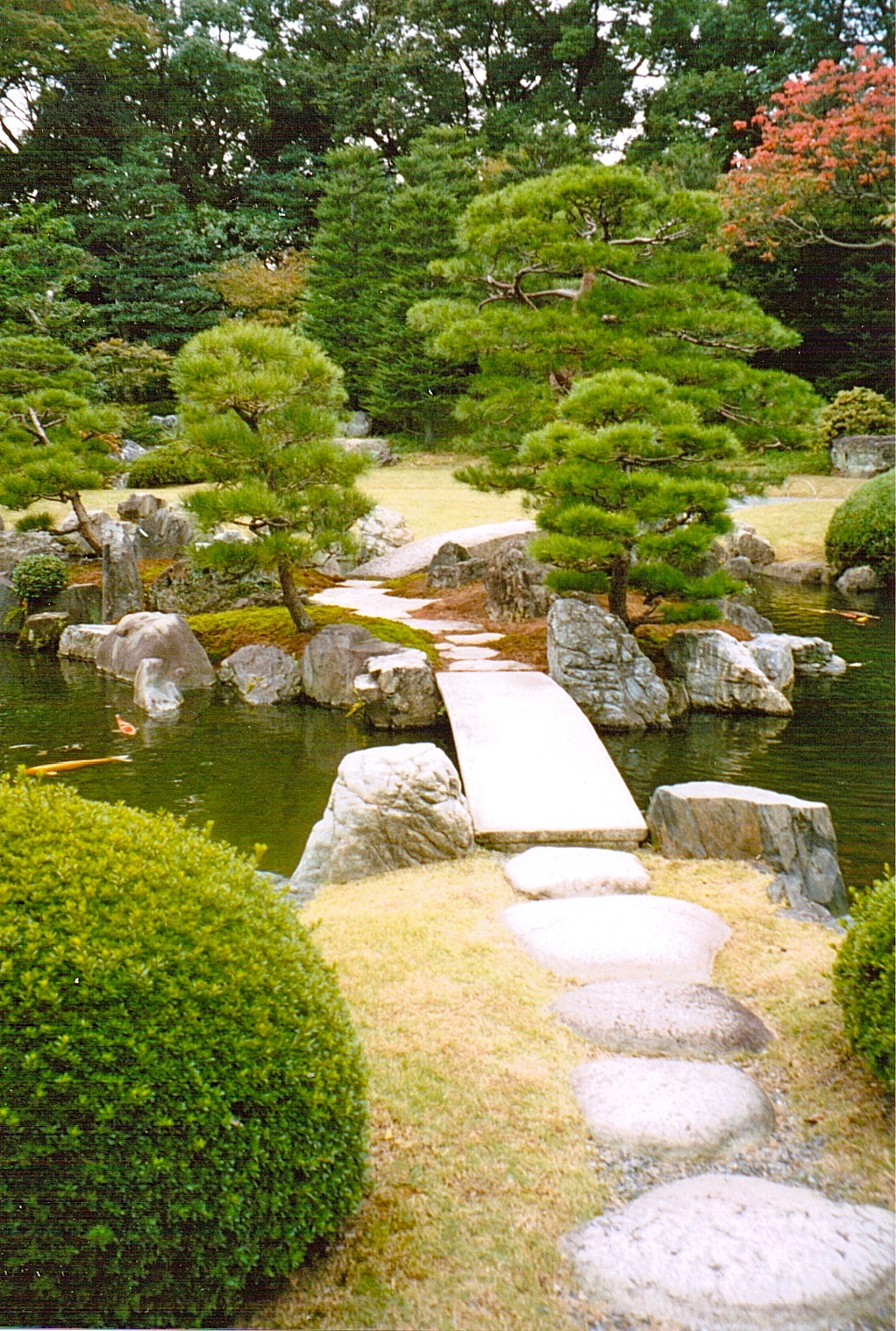
Both temples were destroyed by fire but rebuilt during the Edo Period (1615-1868). Today, To-ji still stands and (at 171 feet high) is one of the tallest wooden towers in Japan. The gardens and ponds surrounding the temple were altogether awesome. A feat in carefully composed asymmetry and meticulous modesty.

Next, we visited the Goju No To, a five story pagoda – the highest in the country. The original pagoda was built in 826 A.D., but due to several fires, the existing structure (an exact replica) was built in 1644. It’s certainly not uncommon to learn that fire has been the cause of so much loss. Even the more “modern” pagoda we stood admiring was made entirely of wood. And not a single nail was used in its construction.

What resonates most deeply for me, however, are not the sights as much as the smells I encountered that afternoon.

A pungent mixture of folklore and tradition.

Ritual and rule.

Which wrapped around me like an old blanket each time I entered one of the historic structures. The incense, forever burning within, curling around and around the delicately carved figures and forms.

Saturating the woods.

Fusing with musty, dusty particles creeping in through the cracks and crevices.

Thick and settled atop the worn surfaces.

The aroma is almost tangible.

Digestible.

One… long… inhale… seems to tell a thousand tales.

Each time I left a building, I’d carry the smells with me as a faint reminder. I’d bury my nose in my clothes repeatedly. Until the profound fragrance faded.

After leaving the grounds of the temple, we wandered around the city, constantly being reminded of how small (and quaint, mind you) Miyazaki is. Where I live in Japan, it’s easy to forget about the remainder of the world. I’ve become accustomed to strange stares by passersby. But Kyoto is truly cosmopolitan.

Our stomachs began to remind us that we hadn’t eaten, so Sam and I pulled out our trusty Fodor’s and decided that what we wanted more than anything was something that wasn’t Japanese. We found a place called “Knuckles” which, according to our guide book, was owned by some ex-patriot New Yorkers who offered honest-to-goodness deli sandwiches. Checking out our rather ambiguous map, we determined the restaurant was in walking distance and started on our way.

In a matter of moments, we were lost.

We stopped in a local establishment, refreshed ourselves with some ale, and asked for directions, which entailed boarding a bus and walking another ten minutes – all for this promising deli menu, which ended up being little more than a disappointing pair of puny, sorry-ass sandwiches that any true New York deli owner would have given the finger.

No matter.

After paying a bill which surpassed the national debt, we found our way back to the hotel where we climbed into bed and set our alarm for an early start the next morning.

Our first destination the next day was Kitano Tenmangu Shrine. Our goal was to not only see the shrine (built in the early part of the 1600s), but to attend an antique market that would be taking place outside the temple that very weekend.

When we finally arrived at our destination –  after being pushed around by an overanxious group of old ladies who had apparently had a heapin’ helpin’ of Geritol that morning – we found the stalls we were looking for, but were disappointed to discover that most offered little more than food and tacky tourist souvenirs.

We bought some roasted corn and figured we’d wander around the market a little more with the hopes of finding something – anything – of interest. However, other than some cool, but useless plastic toys (certainly without the many applications the plastic tiara had bestowed) there was nothing of interest.

Somewhat despondent, we headed into the shrine, roamed from building to building snapping pictures, making funny faces at the little children we caught staring at us, and reading up on the history of the buildings. Quite a complexity of maturity levels, eh?

On our way out, we noticed a side street where a number of stalls were set up and although we had little hope of finding anything of interest, we made our way over and… lo and behold, THERE was the market we had been looking for.

f4483-33-10
Photos by acfrohna

The stalls were filled with marvelous items – both old and new. There was hearty earthenware and delicate china, intricately carved brass and wooden chests and elaborate, hand-painted screens.

Yet what excited Sam and I most were the stalls filled with kimono and obi.

At one of the very first stalls, I found a stunning, white, embroidered wedding kimono (actually, it’s the long coat worn over the kimono) and instantly fell in love with it. Painstakingly hand-stitched down the entire front and back and along each sleeve were flowers and cranes of gold, silver and orange.

I wanted it more than anything I’ve seen since my arrival in Japan.

So beautiful was this coat and in such fine condition that I feared asking its price knowing it was likely well out of my price range, but I would never have forgiven myself if I hadn’t at least inquired. When the old woman running the stall said 5,000 yen (the equivalent of about $45) I nearly fainted. Unable to contain my excitement, I nearly pounced on the garment.

At which point the old woman decided to jack the price up to 10,000 yen.

I quickly retorted. Surprising her with my Japanese. Reminding her of her first price.

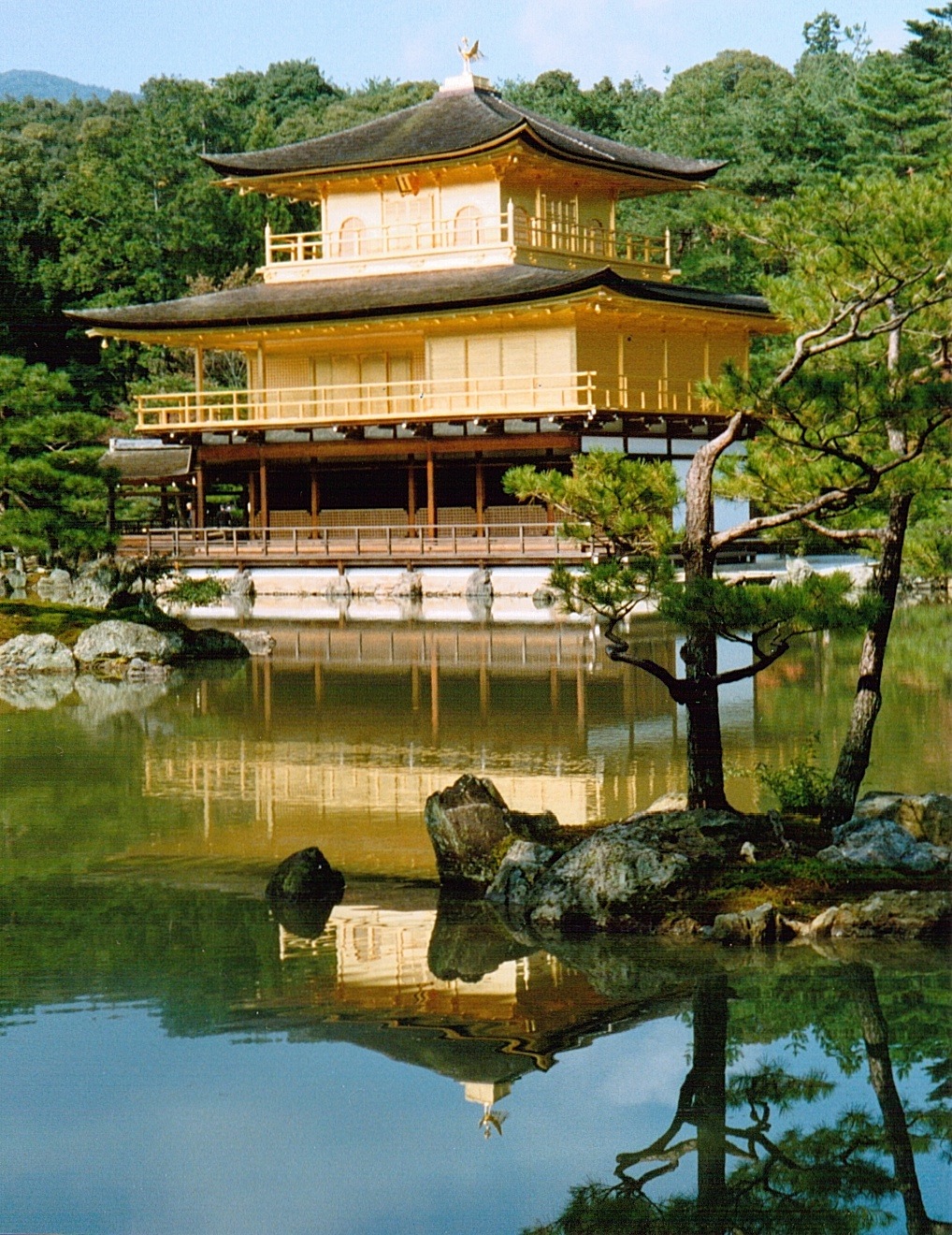
The deal was struck and I was overjoyed with my extraordinarily beautiful garment. Sam, too, purchased a lovely, pure white kimono and we both found a few lovely obi as well. I couldn’t wait to get back to the hotel to examine our purchases more carefully, but we had more sightseeing to do and an entire day ahead of us. With our treasures in hand and big smiles on our faces, we next visited Kinkaku-ji, or the Golden Pavilion – one of the most famous sites in all of Japan – as breathtaking as it is renown.

dc9bb-34-5
3e6be-33-4

Built in the 1220s as a private residence for Kintsune Saionji, the Golden Pavilion is a three-story structure set at the edge of a pond. The first floor was designed in the architectural Shinden-zukuri, or palace style. The second floor, the Buke-zukuri, was styled as a Samurai house; while the third floor was designed to reflect a Karayo, or Zen Temple. Both the second and third floors are covered with gold leaf and Japanese lacquer.

On a sunny, calm day (like the one we were experiencing) one can see a perfect reflection of the pavilion in the Kyoko-chi, or Mirror Pond. The Kinkau-ji was designed specifically along the lines of Buddhist thinking.

Life should reflect a perfect harmony with nature.

And what a truly splendid, harmonious spot it was. Made even more spectacular by the serenity of the gardens surrounding it. The only regret was the constant influx of unavoidable crowds which made it almost entirely impossible to sit back in peace and enjoy the surroundings as they were meant to be enjoyed. If only I had been born into Japan’s 13th century upperclass.

Dang.

Also on our list of sites seen that day were Ryoan-ji and Koryu-ji (ji, if you haven’t figured out yet, means castle). Both were certainly resplendent sites to behold, but what I found even more fascinating were the gardens; especially the famed Rock Garden at Ryoan-ji.

This garden simply consists of 15 rocks and white gravel, believed to have been first laid out by a painter/gardener at the end of the 15th century. This garden is considered the embodiment of Zen art. It’s said that each person who visits it sees something entirely different in the rock and gravel formations. It’s up to each individual to determine what that might mean.

What, you might ask, did I see?

Well… that each piece of gravel represented all the people hovering around the temple, making it impossible to keep any train of thought, let alone delve into a deep appreciation of the art of Zen.

As I found my frustration build with the arrival of each new tour group, I managed to discover a peaceful corner of the garden where a washbasin stood. Carved in the stone along the rim is the inscription (translated in a brochure), “I learn only to be contented.”

Choosing to take to heart one of the most important rules of Zen philosophy, I left the crowded temple with a stronger sense of inner peace.

Our final stop was a visit to Koryu-ji where they have a collection of some of the nation’s most priceless statues, including the Miroku Bosatsu, one of the most renown images of Buddah. The delicately carved face of the Miroku Bosatsu is said to perfectly embody inner peace and that gazing upon it can actually help one to heal. It’s exceptionally beautiful and after close examination of the statue, I couldn’t help but feel as if the carving was, indeed, created from a divine image.

Its smile and countenance is both intimidating and beguiling.

Tranquil and composed.

I couldn’t help but feel serene from the sheer study of it.

Our final day in Kyoto began with the Kyoto National Museum of Modern Art. All I can really say about our visit is… there isn’t much to say. Except that I felt it was, at best, a representation of modern mediocrity. With greater hope of seeing some inspiring exhibits at the National Museum of Art, we headed that way, but soon found a line blocks long due to a special Matisse exhibit – and we simply couldn’t see wasting our last day standing in a line.

We moved on to Nijo-jo, a 35 room castle built in 1603 by the powerful Shogun Ieyasu Tokugawa. He erected it after winning a battle against rival forces and unifying Japan.

Nijo Castle epitomizes the timeless refinement and uncomplicated appeal of Japanese design. Each shikiri (sliding partition, a mainstay in Japanese architecture) in every room of the castle was gold-leafed and hand-painted to reflect various scenes of nature. Whether the towering strength of the pine tree which dominates the mountains of Japan, or the gossamer intricacy of the butterfly.

The wood carvings found throughout the castle’s chamber are also some of the largest and most intricate ever made in Japan. So masterfully carved that I couldn’t be sure the craftsmen were not, themselves, divine.

One of my very favorite parts of the castle was the main entrance, known as “Yoru-uguisu”, or the Nightingale. The dark wood floors were especially designed by the ruling Shogun to warn residents of all who entered the castle late at night. More specifically, enemy intruders.

As soon as you step foot onto the boards which run the outer length of the first wing, a warbling sound, similar to that of a Nightingale, sounds, informing guards quartered nearby of trespassers.

It’s undoubtedly the most pleasant alarm system ever designed and does everything to support an atmosphere bent on showing the Tokugawa’s earthly cunning and power, yet at the same time, a deep desire not disturb the beauty and serenity of the nature which surrounds him.

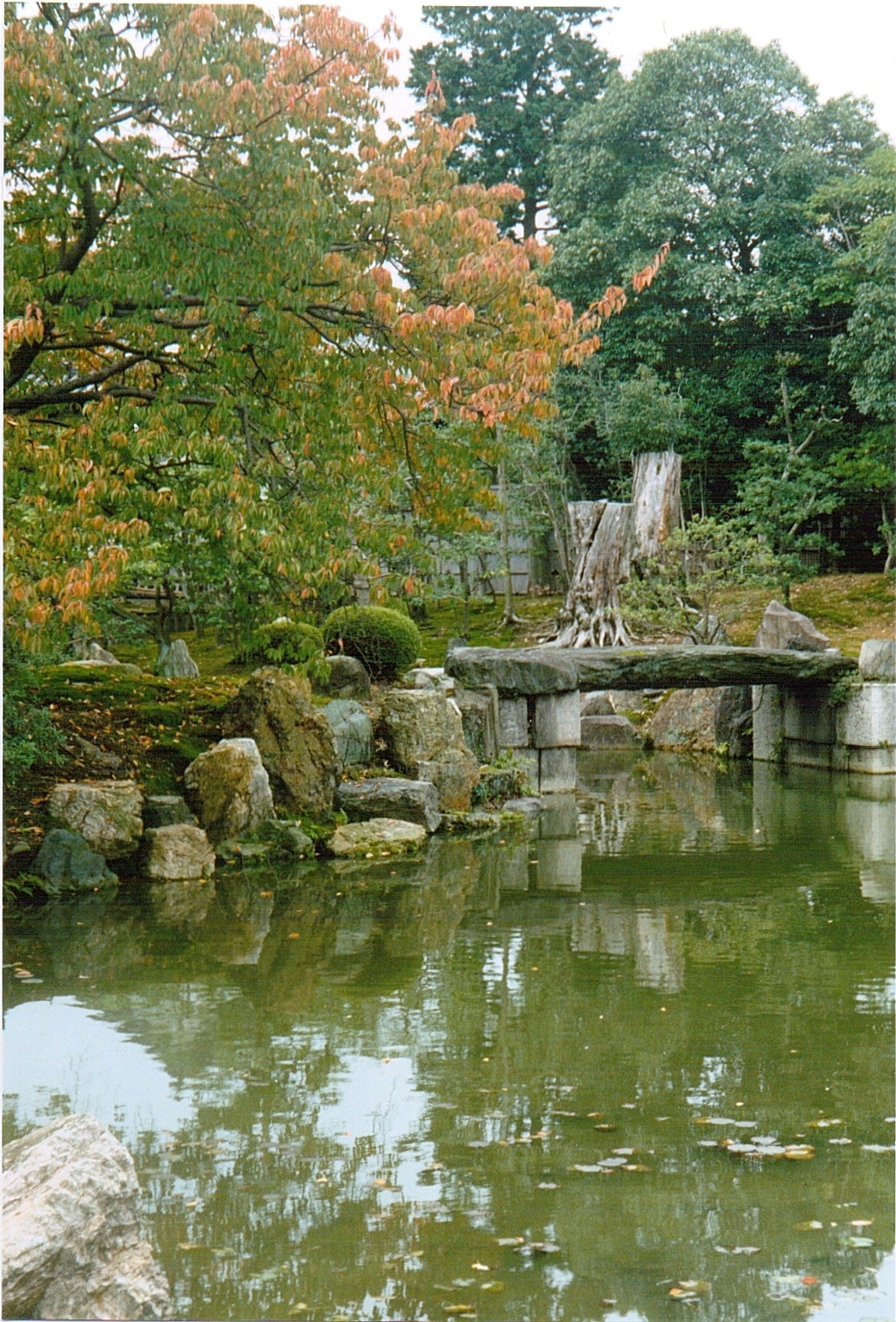
The castle gardens were just beginning to hint of their autumn colors. It was easy to get lost in its well-orchestrated beauty and hard to believe that a buzzing metropolis was just on the other side of its massive walls. So flawless was the scenery that I momentarily found myself feeling painfully awkward and aware of my own imperfections.

Until I remembered.

I learn only to be contented.

Sitting on a bench overlooking the gardens, I closed my eyes and repeated the phrase over and over again in my mind.

I learn only to be contented.

In the silence surrounding me, I finally began to understand the peaceful environs as not simply beauty to be admired, but a perfect reflection of the delicate balance between man and nature.

590ec-33-7

It was a good day.

My love to all and may this letter find you content to be contented.

Just West of the Midwest Chapter 35: Languid in Langkawi

Our trip began on December 21st. Tauro, Sam’s latest boyfriend, kindly offered to drive us to the Miyazaki Airport, where we were to catch a flight to Fukuoka. There, we would then hop on another plane heading to Kuala Lampur, Malaysia, where we would spend the night and hop on another flight to the island of Langkawi in the morning.

Seemed simple enough.

Tauro, being an even greater “Patty Paranoia” than myself, insisted that we arrive at the airport two hours ahead of time. Neither Sam or I chose to argue because we figured we could check in, have a leisurely lunch at the airport, and then be off to our island paradise.

As a matter of fact, we had just been served that leisurely lunch I spoke of when an announcement came over the airport speakers. Sam and I couldn’t make all of it out.

But Tauro did.

Suddenly a look of, “If I tell them this bit of news, I’ll never live to see tomorrow!” came over his face. Apparently, our plane had broken down and there would be no flight to Fukuoka that day.

“That’s not funny, Tauro,” we repeated several times, refusing to believe they would cancel a flight just like that. And not just A flight, OUR flight.

Sam and Tauro went to the ticket counter to confirm the bad news and I stared down at the table of food, no longer in the least bit hungry. The cancellation was confirmed and our only choice now was to try to find a cab that would take us to Kagoshima, two hours away. From Kagoshima, the next flight we could take to Fukuoka – in order to make our connection to Kuala Lampur – was leaving at 3:05 p.m.

It was 1 p.m.

With the speed of Nike, we found a cab willing to make the long trek, threw our bags in back and began what would prove to be the most nerve-wracking two hour cab ride in my life.

Every so often, Sam and I would look to one another for support.

Only to find a face filled with anxiety. And a glimmer of the rage and despair which might ultimately unfold if we missed the flight.

I checked my watch every minute or so; while at the same time demanded the cab driver assure us we would make the flight.

Obediently, and with a strong sense of self-preservation, he answered how we wanted him to. Yet each time, his answer seemed a little less convincing.

The clock ticked away.

Our bodies continued to tense.

Our halfhearted smiles finally disappeared without a trace.

At 3 o’clock – on the dot – we arrived at Kagoshima Airport.

Racing through the corridors knocking innocent bystanders from our frenzied trajectory, we reached airport security. The clocks in our heads muffling everything and everyone around us, including the security guard who was asking for the second time to look inside Sam’s luggage.

The vision of the plane leaving the runway without us was now clear and unmistakable.

It seems the security guard who had chosen to prolong our nightmare either held a grudge against all Western tourists, tall blonds, citizens of the United Kingdom, or simply found life more difficult after that lobotomy, because he began to take every item out of her massive carry-on…one… by… one…

C-a-r-e-f-u-l-l-y…s-c-r-u-t-i-n-i-z-i-n-g…e-a-c-h…i-t-e-m.

I’ve never been so close to killing a man.

S-l-o-w-l-y…h-e…g-a-v-e…u-s…t-h-e…o-k-a-y.

And then proceeded to p-u-t…e-v-e-r-y-t-h-i-n-g…b-a-c-k…i-n… t-h-e…s-a-m-e…m-a-n-n-e-r.

We couldn’t take it any longer. The two of us were simultaneously on the verge of a total mental collapse. Which certainly would have extended our visit with the security officers indefiitely. So, we grabbed the bag, all of Sam’s belongings, and stuffing them back in (leaving all fallen items up for grabs), ran toward our gate.

The furthest one away.

Sweating, panting, cramped and threatening to vomit up the lunch we didn’t eat, we finally, at long last, with nothing left to give, arrived at the gate.

Only to find the plane had been delayed for half an hour.

We threw our bags down where we stood and decided that this would not be a good day to quit smoking.

In Fukuoka, we met up with Maria (who was joining us), as well as Madeline and Robert (also with the JET program) who were traveling to Malaysia as well. I’m happy to report there were no more travel mishaps to speak of and by the following afternoon, we had made it to the lovely island of Langkawi where we happily began our two week sojourn into slothfulness.

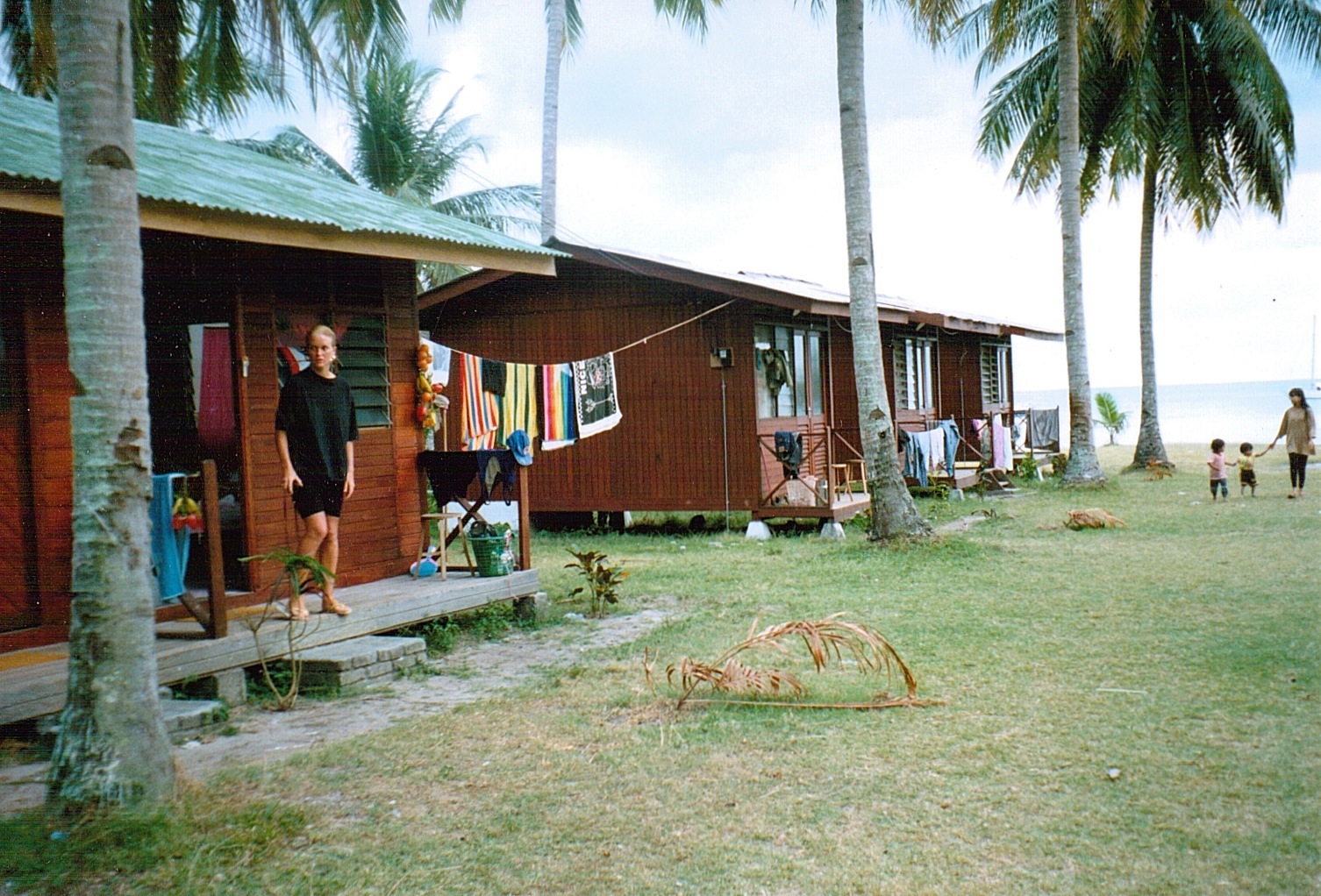
At Robert’s suggestion, we went to the area known as Pantai Kok, a quiet, undeveloped spot on the beach and found a beachside cabin at the Kok Bay Hotel. Now when I use words such as “cabin” and “hotel,” let me assure you, you must erase any visions of Club Med you might have conjured in your head. Our cabin consisted of a double bed, a single bed (more like a slab of concrete on a frame), a fan, the ever-popular florescent lighting apparently adored in this part of the world, and a dimly lit toilet/shower (all in one, mind you) that looked like something out of a mid-century modern torture chamber.

But for the equivalent of about $10 a day, we quickly got over the initial shock.

Sam also decorated our temporary housing with some tacky Christmas decorations which warmed up the place considerably, and once we caught sight of the ocean, which lay a mere 50 yards away, and the mountains, which hovered behind us, we knew we had discovered our home away from home.

4670e-35-10
Photo by acfrohna

We were especially pleased with our lodgings after tasting the first meal prepared at our “hotel restaurant” – a shack at the end of our row of cabins where the woman who owned the establishment (always with a couple of babies hanging from her hip and hand) cooked the most outstanding, savory, spicy, delectable meals we could have imagined coming out of a single wok.

8caf9-35-1
Photo by acfrohna

Maria stayed with us the first few nights, but much to our relief (more on that later), moved to her own cabin across from us for the remainder of the trip.

Much of our time was spent doing little of anything.

We got up. We went to the beach. We ate. We slept.We read. We listened to music.

We ate. We swam. We ate. We swam again. We went to bed.

However, we did manage to brush off the sand long enough to explore a little. On our first day, we got a ride into town from a local taxi driver, named Zaki, who was so very kind, equally honest, and who would become our main mode of transport for the remainder of our visit.

At first, we felt he was way too nice and that there had to be a catch, but after having many conversations with him during our 20 minute trips into town and hearing him say things such as, “In being nice to people, you have nothing to lose.” and really mean it, he soon gained our trust and admiration.

And never once let us down.

We were so immediately charmed by the Malaysian people we met and the places we saw that we formed a plan for the future. Sam was going to open up a coconut plantation, using the husks and shells to create tacky tourist souvenirs. While lounging at the beach, she closely studied the palm-tree climbing techniques of the natives and was ready to give it a go… had it not been for her apparent war wound from “The Big One.”

Maria was going to open “Maria’s Personally Relevant Religious and Feminist Symbols Gift Shop. And, as Sam planned it, I was to marry Zaki and spend the rest of my days having beautiful babies and cooking from a wok.

On our first full day, we went into town to do some shopping – disinfectant being the main priority considering our in-ground toilet and shower shared the exact same space – and soon discovered how incredibly inexpensive things were. This turned our errand run into a shopping frenzy.

Having become accustomed to the outrageous cost of living in Japan, we felt downright greedy and even a little guilty – as if we should be offering the local shops and stalls more money than they were asking. However, we soon learned that this gesture would have been quite a cultural no-no due to the fact that bartering is a custom here. Before understanding this, we couldn’t fathom why we seemed to be routinely shocking salespeople when we handed them full price.

They’d look at us… pause… and then lower the price of the item before we had a chance to argue.

On Christmas Eve, we sat on the porch of our cabin with a couple of beers and watched the sun set over the mountains. So did most of the people staying in the cabins all around us. It was like a strange community of nomads from all over the world who came to this small island to settle, if only temporarily, into a state of complete and utter calm.

At about 9 p.m., all of the electricity on our side of the island went out. A few moments later, hotel proprietors made their way from cabin to cabin with candles, which were placed on each porch, creating a warm glow that wove itself into the soft breezes and gently sweeping waves. We softly played Christmas songs on our cassette player and enjoyed the peace and harmony that the blackout had created among the cabin dwellers.

That is, until Maria decided that too much peace and harmony was a bad thing.

I must preface this by explaining that before we came on holiday, the three of us had decided that each would bring something to enhance the holiday season. Maria brought Christmas pudding and a bottle of whiskey. Sam brought decorations, party hats and poppers. I brought each of us underwater goggles, as well as star, heart and butterfly-shaped sunglasses for the beach. This, or so thought Sam and I, would be our presents to one another. Maria thought differently.

9eee0-35-5
Photo by acfrohna

That night, she presented us with additional gifts. But certainly not in the spirit of “tis better to give than to receive.” Somehow the subject of New Year’s resolutions came up, and after spewing off some ridiculous promises Sam and I knew we’d never keep, Maria discharged her resolution with such malice it made both Sam and I speechless.

“Well,” she spat out, “I know what my resolution is. I’m going to stop giving presents to people who don’t deserve them!”

Suddenly, the celebration didn’t feel very joyous anymore. As if Christmas had just been sucked into a big, black hole.

Now normally, I pride myself in being able to recover rather quickly from such negativity, but this was the proverbial straw which broke the camel’s back. For some reason or another, Maria had been taking stabs at both Sam and I from the onset of the vacation. Actually, Sam received the brunt of Maria’s wrath and my only guess as to why this might have happened was because of our close friendship.

Which Maria seems to take offense to.

Sam and I made wholehearted efforts to salvage the remainder of the evening. To regain that sense of love and harmony.

Maria would have none of it.

Neither Sam or I wanted to make a scene and decided to call it an evening. Maria went to her cabin (which she had procured that day) and Sam and I slipped into ours, trying to make sense of what had transpired. We soon tired of the conversation, closed our eyes and attempted to sleep.

The area of cabins where we were staying had quieted down by 10 p.m. or so, with only an occasional utterance from vacationers returning to their rooms for the night. Our cabin was dark and still, except for a grumble and toss from Sam and an old ceiling fan that shakily squeaked, clanked and clattered around and around and around.

The sounds were just beginning to form a strange, methodic rhythm that was lulling me to sleep when we heard it…

“CROOOOOOOOOAK-clickety-click-clack-pop!”

“CROOOOOOOOOAK-clickety-click-clack-pop!”

From the way it resounded through the room, I was sure that whatever the creature was must surely have been the size of Mothra.

I stiffened and every single hair on my body raised to attention.

“CROOOOOOOOOAK-clickety-click-clack-pop!”

“What the devil is that?” Sam asked with a shiver.

“Who the hell do I look like, Marlin Perkins?” I whispered into the dark as I slid the covers over my head.

Sam was about to ask just who the heck Marlin Perkins was when-

‘CROOOOOOOOAK-clickety-click-clack-pop-CROOOOOOOAK!”

“Go turn on the lights and see what it is,” Sam commanded.

I suddenly found myself flashing back to my childhood. When my sister, Mia, who always climbed in bed last, would insist on my climbing out of bed to turn the lights out.

“YOU turn on the lights, Sam,” I insisted. “After all, you’re the one closest to the door.”

“Yes,” Sam shot back, “but the light switch is in the middle of the room.”

“Yes,” I maintained, “but we’re both, more or less, the same distance from the switch.”

Sam scooted her position on the bed further left.

“Not anymore,” she replied.

I couldn’t see, but I could just tell she had a grin from ear to ear.

“You’re so damn immat-”

“CROOOOOOOAK-clickety-click-clack-pop!”

“And just what am I supposed to do once I’ve turned the light on?” I whined.

Now Sam, obviously the brains of this operation, thought long and hard about the question.

“Find that THING and get it out of the room.”

“The Nancy Drew mysteries were based on your life, weren’t they?”

“Who?”

“CROOOOOOOOAK-pop-pop-CROOOOOOOOOOAK!”

“Never mind. All I know is that I’m not going to be able to sleep until I find out what’s making that noise.” With that, I mustered up my courage and, putting one foot on the wet and sandy floor, stretched as far as I could to reach the light switch.

Feeling eerily like Elastic Man, I found the switch, “click,” and jumped back in bed.

Flicker-flicker-flick went that damned florescent light. Our eyes readjusted and scanned the room for any strange, slimy, icky, exotic, creepy-crawly things.

Nothing.

“CROOOOOOOOOAK-pop!”

Both our heads spun to the light above the bed.

Nothing.

“It’s hiding,” Sam whispered.

“Are you sure you’re not related to Sherlock Holmes?”

Sam was just about ready to rebut, when she spotted something out of the corner of her eye.

“It’s COMING OUT!” she screamed.

I spun around with terror in my heart and cowardice racing through my veins.

AND THERE IT WAS!

… a tiny, green chameleon about the size of my index finger.

“That’s what’s been making all the noise?” I laughed.

“Now’s your chance, Anne. GRAB IT!”

“I’ll do no such thing,” was my reply.

“What are you talking about?”

“Those things are like our own little mosquito trap. It won’t do us any harm. Let it be.”

“Are you telling me you’re just going to let that strange creature spend the night in this room?”

“You’ve had worse spend the ni-”

“No need to get nasty.”

“No really. It’ll be fine. Now, why don’t you turn off the light so we can get some sleep.”

“You turn off the light… You turned it on.”

“I don’t believe you,” I grumbled as I stepped out of bed, yet again, to switch the light off.

A few moments passed.

‘CROOOOOOOOAK-clickety-click-clack-pop,” sang our little lizard friend.

Now comforted by the acknowledged size of the beast, I began to fall into a peaceful—

“BUUUUUUUUUUUZZZZZZZZZZWHIIIIIIIIIRRRRRRR!” came a sound out of no where.

“BUUUUUUUUUUUZZZZZZZZZZWHIIIIIIIIIRRRRRRR!” came the sound again as it swopped down around our heads.

Sam screamed.

I gasped.

“Are we to be plagued by every night creature in Malaysia?” bellowed Sam. “This one cannot stay. There is no room at the inn!”

I climbed out of bed.

AGAIN.

And turned on the lights to see a beetle the size of the car named after it, circling the room, ready to dive bomb again.

“For God’s sake, kill it,” yelled Sam.

At that precise moment, a downpour began outside.

“I can’t kill something that size,” I winced recalling my recent run-in with the spider in my apartment as I threw the switch back to off and jumped back into bed and under the covers.

“Maybe it’ll go away… Maybe the lizard will eat it.”

“Or vice versa,” Sam whined.

“Shhhhhhhh,” I urged my yellow-bellied friend. “Do you hear that?”

“Hear what?”

“It’s not flying anymore. I’ll bet the lizard ate it.”

“Maybe you’re right,” my friend replied with little conviction.

“Of course I am. It’s the law of nat-”

‘WOOOOOOOOOOP-WOP-WOP-WOP-GRODLOOOOORG!”

‘BUUUUUUUUUUUZZZZZZZZZZWHIIIIIIIIIRRRRRRR!”

“CROOOOOOOAK-clickety-click-clack-pop!”

Sam wept and moaned from beneath her covers.

I had had enough.

Once more, I was out of bed, switching on the lights and scanning the room for the maker of the new sound.

Nothing.

I looked for the tiny chameleon.

It was no where to be seen.

But… the beetle was within range.

Grabbing one of the party hats Sam brought, I climbed on the bed.

Legs shaking.

Hands quivering.

I inched my way toward the winged automobile.

I paused.

“I can’t do it, Sam.”

“Of course you can, Anne,” urged my candy-ass friend. “Now be brave. You’re a woman of the nineties!”

With that, I cupped the creature within the hat, against the wall. As it thrashed against the sides, I shouted for Sam to hand me a nearby brochure so that I could cap off the hat.

The creature was mine.

Slowly, I moved toward the door. Just as I was within reach, Sam let out a blood-curdling scream, “LOOK!”

I looked to the window on our cabin door and saw before me an incredibly large iguana suction-cupped to the glass with its long, taloned feet.

“WOOOOOOOOOOP-WOP-WOP-WOP-GRODLOOOOORG!”

My imagination registered a lizard the size of Manhattan. In actuality, it was about two and a half feet long.

“What do I do? What do I do!” I squealed still holding the beetle in the party hat.

Sam merely mumbled unrecognizable sounds from beneath the sheets.

The rain was now thundering against the tin roof.

The beetle was beating itself against the walls of the hat.

The lizard was still hanging around the florescent light, like a green-skinned coward.

The Iguana remained where it was. Its scaly belly pressed menacingly against the glass.

I slowly approached the door, rattled the doorknob with my trembling free hand and prayed. The lizard peacefully slid away into the darkness.

Flinging open the door, I tossed the beetle – party hat and all – into the torrent of rain and slammed the door behind me. After turning off the light for what I hoped would be the very last time that evening, I jumped into bed – worn out.

‘WOOOOOOOOOOP-WOP-WOP-WOP-GRODLOOOOORG!”

“CROOOOOOOOAK-clickety-click-clack-pop!”

“Screw it,” I mumbled as I closed my eyes and fell asleep to the sounds of Langkawi nightlife.

And the whimperings of Samantha.

And I didn’t even touch upon our encounters with the water buffalo and wild boar!
____________

On Christmas day, Rob and Madeline came to Pantai Kok and we had a very laid-back celebration, followed by an incredibly delicious dinner in town that night. At the restaurant, we met up with two girls whom we’d met on our shopping excursion and it was decided to meet them (and their sailing acquaintances) the next evening for drinks.

The following day, we hiked up the mountains behind our cabin to see some waterfalls we were told about and there we spent half the day swimming and sliding down smooth rocks into cool, clear mountain pools.

It was heavenly to be surrounded by so much green and such good company.

When we returned to our beach that day we found that Maria had found what appeared to us to be a holiday romance with a German girl named Andrea. Much to our great joy, this meant that Maria was now able to enjoy her vacation, which left Sam and I unfettered and free from guilt at a friendship gone awry. When Rob and Madeline left a few days later, we found ourselves spending much of the rest of our time with our new friend, Ian, and his 16-year-old son, Adrian.

f40ab-35-3

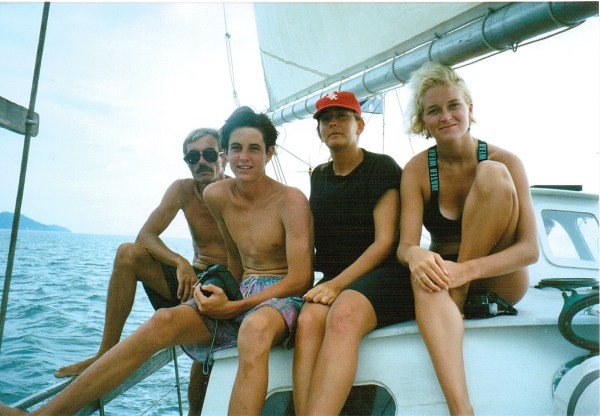
Ian, a full time, nomadic, Australian, sailing-type was taking his son on an adventure of a lifetime; traveling from sea to sea together on their boat “Silver Lining”.

Going where the wind blew them. Making money by offering tourists, like us, the chance to sail around the islands.

It was certainly a romantic notion – to go where the tides take you.

While on Langkawi, we met a lot of these wanderlust sailors hailing from across the globe – Germany, New Zealand, Finland, Australia, America. All doing their best to permanently avoid what all of us were there to only temporarily escape.

On New Year’s Eve, Sam, myself, and several of our new friends, decided to forgo the festivities being planned by various resorts around the island. Instead, we lit a bonfire on the beach, bought some champagne and beer, and had a little party of our own. It was here I met Tom and began a very brief, rather uneventful, holiday romance.

Brief side note: I’m sorry to say, I haven’t heard from Raymond for months and although I keep hoping to be pleasantly surprised by that long-awaited letter or phone call, I have to be realistic and have wretchedly resigned myself to the idea that this romance was never meant to be. Big… long… broken-hearted… siiiiiiiiiiiiiiiigh.

Now back to the story at hand.

Tom, from what I’ve been told, is a rather well known sailor. As the skipper of his boat, “Nine Tails” he was the first man ever to circumnavigate the world in a catamaran. Tom is a handsome man of 48 – although I have to say that his demeanor was sometimes that of an 84-year-old. Maybe our age difference was a bit intimidating for him, or maybe it came from spending so much time alone.

Who knows.

I have to say that the “seven seas” sailors we kept encountering on Langkawi were undeniably charming and interesting folk. But strangely sullen.

Sadly disenchanted.

And, most certainly, out of touch.

You’d ask them how long they’d been at sea and they’d reply, “What year is it?”

Tom was no exception.

At first, I found it all very romantic, but the more I listened, the more I heard them relay their hardships, disappointments, failures, misgivings. Just like all us landlubbers. Ironically, they set out to avoid what no one can truly escape.

Life.

And to top it all off, these hale and hardy seafarers had thousands of stories to tell, but often only passing acquaintances to share them with.

I found this particularly sad.

Nevertheless, there was something alluring about Tom and I just couldn’t help but be enticed.

3d8ac-35-7

At 16, Adrian was certainly getting his share of the sailor’s experience. He had dropped out of school to join his dad on this adventure, but one could tell, and he was quick to admit, that he was starved for companionship and the real world. For this very reason, Sam and I took him under our wing and gave him the little brother treatment for the remainder of our stay. He ate it up like a banana split.

2a56e-35-4
Photo by acfrohna

So lovely was Adrian that when it came time to say good-bye, I couldn’t help but feel deeply saddened. I’ve always found it very difficult to part from someone – no matter how long you’ve known them – with whom you’ve shared wonderful experiences. And it NEVER gets any easier.

Our seaside New Year’s Eve celebration ended with wedding festivities. That’s right, Sam married a French man named (and this must be said with an “outrageous accent”) Lauran. The nuptials had first been discussed during one of our recent sailing excursions, which included Lauran, who became immediately smitten with Sam. So, after leaving the beach for a local bar, our merry entourage gathered together the necessary items for a proper wedding – a bouquet, a groom, a bride, and Captain Ian to perform the ceremonies.

Ian became far too drunk to complete his charge, so I took over.

b0dfd-35-8

Now Sam and I can say we’ve each been married in strange foreign lands to strange foreign men. I did tell you I got married a few months ago, didn’t I? It was after a community athletic festival. Kuranaga-Kacho performed the ceremony at a small after-party consisting of 20 men and myself. After my office papa-san consented to the marriage and was even willing to give me away (as well as perform the ceremony) I was wed to a young man, Miki.

I haven’t seen him since the reception.

Men.

Well, all in all, my vacation in Malaysia was one of the best of my life and leaving the beautiful island of Langkawi – and all the lovely people we met – was a bit gut-wrenching.

However, reality – or at least Japanese-reality – awaited and as tempting as the offers I had to become a crew member on several different sailing vessels were, I had to refuse.

Curses.

My love to all. I hope your holidays were happy ones and may your new year prove to be one filled with mystery and surprises, except for the insect and reptilian kind that make strange noises in the hidden recesses of a florescent-lit room, during a heavy thunderstorm, on a remote island in Malaysia, while your lily-livered friend hides under her covers, expecting you to eradicate them all.

9acf8-35-12

Just West of the Midwest Chapter 34: Luckiest Gal Alive

It was just before winter vacation began.

On a Sunday. About 7 p.m.

I had just returned from spending the night in Hyuga with Sam.

I was tired, dreading work the next day, and longing for my vacation to begin, when the doorbell rang.

Assuming it was one of my neighbors, or one of their children, I slowly made my way to the door trying to come up with an excuse for why I couldn’t visit or play. When I opened the door, I found a young man there.

Without the normal Japanese formalities and ceremonial language associated with a visit, the young man simply and silently began to enter my front hallway. Assuming he was one of my students (who, in hindsight, would have been a student who had been held behind a few years), I gently put my hand to his chest and bluntly told him I was tired and would see him at school during the week. I then closed the door and returned to re-reading a story I was working on.

A few minutes passed and the doorbell rang again.

With a great sigh, I dragged myself to the door and opened it, once again, to find a young man standing there.

Now, I’m assuming it was the same young man.

The reason I wasn’t – nor will I ever be 100% sure is because, this time, the young man at my door was wearing sunglasses.

He was also wearing a hat.

And a mask.

He didn’t say a word, but was breathing heavily. And it wasn’t because of the three flights of stairs he had just climbed. To my great horror, I looked down to see the intruder had his penis in his hand and was masturbating.

He tried to force his way in.
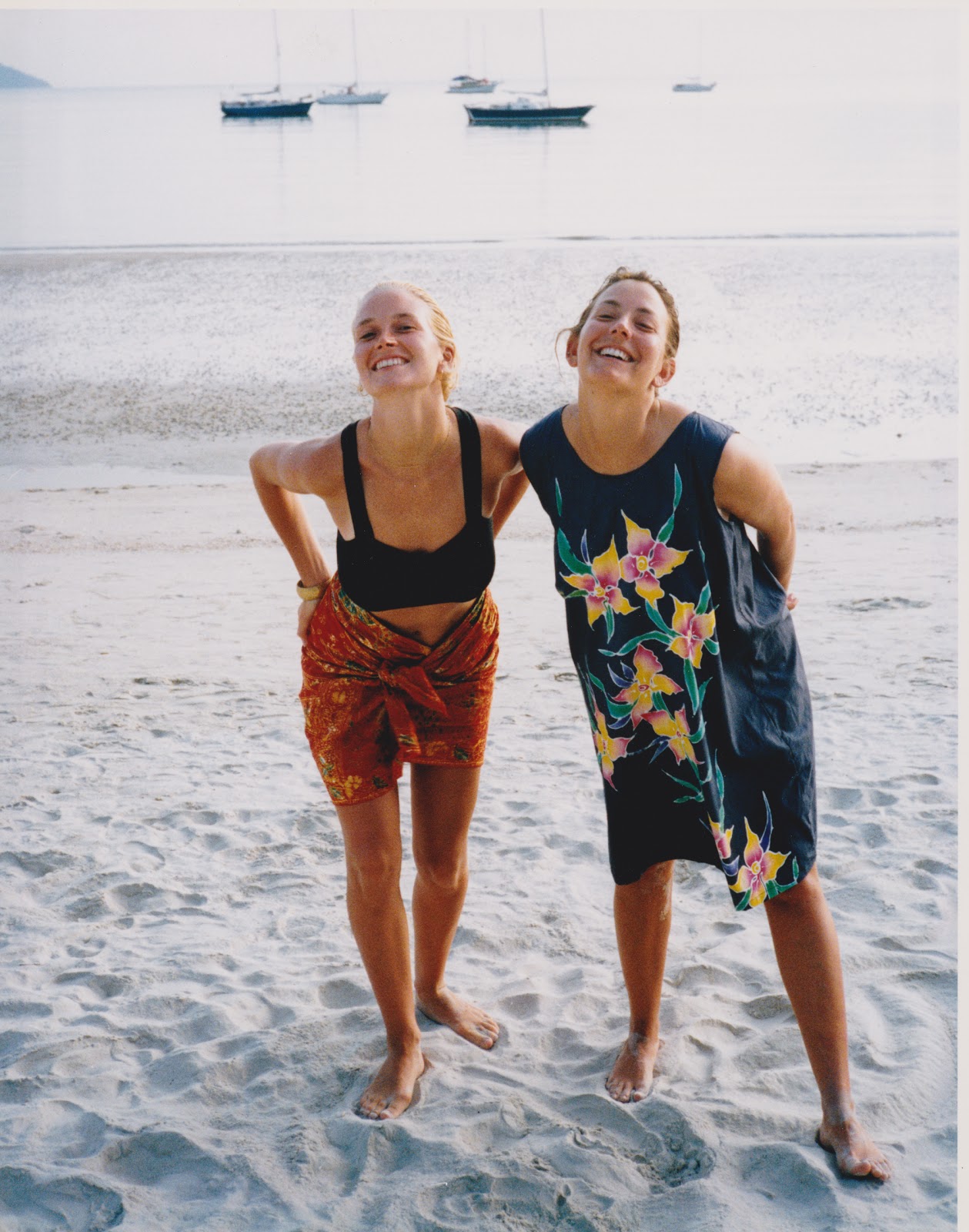
I attempted to slam the door on his pathetic, little dick.

There was a struggle.

But my adrenaline overpowered the little maggot and I finally managed to push him from my apartment and lock the door. My hands and body were shaking violently as I slumped to the ground.

What the fuck just happened?

I didn’t know what to do.

I didn’t know who to call.

I first tried friends who lived in neighboring towns, but couldn’t reach a soul.

Then I called Junko, who helps me at the Community Center. It was a conversation I NEVER expected to be having with her.

While I waited for Junko (who had called the Shintomi Police, as well as Oki-San and Kuranaga-san) to arrive, I sat in the corner of my apartment.

Weeping.

Trembling.

Angry.

Revolted.

In total disbelief that it had happened.

Again.

Except this time, at a whole new, ugly level.

“What the hell is wrong with men?” I moaned as I rocked back and forth, semi-fetal.

It’s bad enough that I’ve had to be victim to it in the assorted public places I’ve had the misfortune of being in. But hell, I could usually chalk it up to bad timing – being in the wrong place at the wrong time. This, however, was altogether different.

It wasn’t a drunk in a bar.

Or a letch in a crowd.

I didn’t accidentally stumble upon it.

This was at the threshold of my home.

It was with intent.

It was with force.

I began to shudder anew as I thought about what might have happened had I not been able to shut the door between us.

What brings a person to such acts?How does a person learn such behavior?And how will this sickness manifest itself in the future if the young man doesn’t get caught and get help

Is there even help to be had?

“Oh God,” I thought with another severe shudder causing me to heave more sobs, “this friggin’ psycho might be living right next door, or just down the street from one of the little girls in the neighborhood.”

At that thought, I found myself at the toilet moments later.

Vomiting violently.

As I leaned against the back of the bathroom wall wiping the bile from my mouth, I felt an immense anger for not having done more. He might have been wider, but I had the size advantage. I could have easily pushed him down the flight of cement steps just a few feet from my front door. Or at least done some major damage with a powerful kick to his exposed groin.

But all I could do was shut the ugly scene behind the door as quickly as I could.

Now HE was out there.

Junko, the police, and the others arrived on the scene and we went through what happened several times, with Junko translating what was clearly making her very, VERY uncomfortable.

So much so that I was soon questioning just what she was telling the police. Especially after I was informed that the incident wasn’t of a “sexual nature.”

Are you fucking kidding me? A masked man attempts to force his way into my apartment with his dick in his hand and it isn’t being considered a sexual assault?

What fucking century is this?

I was stunned into silence and far too emotionally wrecked to try to argue. So, I sat back and watched as one of the five policemen inspected the area where the struggle took place.

He was looking for fingerprints.

A wave of nausea passed over me again as I watched in horror as the black dust revealed  fingers clenched around my front door.

Finally, after a couple of hours, and at my insistence I would be fine, I sent everyone home and was soon soaking in a hot tub.

Trying to wash away the awful feeling that I had done something to deserve it.

________________

After not sleeping a wink, I found myself at Kaminyuta Junior High the next day hiding from everyone when I wasn’t expected to be in front of a class. Quite frankly, I was on the verge of tears at every moment and simply couldn’t hold a conversation.

I kept looking into the many innocent faces of the 11-15 year old boys I teach and couldn’t help but feel incredibly sad that some of them might turn into the mess that arrived at my door the night before.

I also continue to struggle with the idea that there’s a reason these things keep happening to me.

It can’t be a long and promiscuous sex life. For god’s sake, I was a senior in college before I lost my virginity. And in the years since, trysts have been few and far between.

I’ve never even been comfortable making eye contact with the opposite sex. Especially after the variety of degenerates who have foisted their sickness my way.

Yet this nagging feeling that I somehow deserve every perversion heaped upon me still lurks in the shadows.

Most acutely, this last one.

After all, I haven’t exactly been chaste here. I guess I figured while the going is good…

Nor have I tried to be very covert in my dalliances.

And this is a small town.

Maybe, I keep thinking over and over, I brought this on myself.

But then there’s another voice.

And it’s strong.

It says that that’s a bunch of self-loathing crap.

Deep down inside I know that I didn’t deserve that. No one deserves that.

Yet it keeps finding its way to me.And I’m forced to keep asking the same question.

Why?

I know that a couple of weeks on the beaches of Malaysia will help put this incident further to the back of my mind. And, in time, I’ll be able to laugh about it. Like I have all the others.

Maybe not so much laugh, this time, as let go.

Just West of the Midwest Chapter 36: Nobody’s Perfect

It has come to my attention that there has been a great deal of Japan-bashing going on back in the United States lately. For shame and hang on… I’m about to get preachy!
Look. I’m not a blind supporter of this country simply because I happen to be living here. I see its faults and I strongly disapprove of certain aspects. I also feel that Japan has a lot more to learn about international cooperation. But then again, I can say the exact same thing about my homeland.
I can only hope that what I’ve been writing to you (and hope you’ve at least been glancing at) for over a year and a half) has taught you a little something about this country and that you are not among those who are blaming Japan for the problems the U.S. is facing. If anyone is to be blamed, how about those who promised change when we elected them to office?
Yet the problem really isn’t only with politicians, but with everyday people, everywhere. Especially people who have never tried to understand something – or someone – with different ideas, values, cultures, expectations, apprehensions, aspirations. Heck, I’ve struggled here often to help people understand a little more about my culture, my lifestyle, our society and our history.
Admittedly, it’s been a long, slow process.
But we’re learning.
Together.
And that’s all that really matters.
Hate breeds hate.
Misapprehension creates conflict.
Ignorance nurtures prejudice.
So no more blame, or name calling.
Enough said. Unless you want to get statistical. In the past few years, Japanese companies have created jobs throughout the States. Nissan, as one example, has provided over 130,000 jobs for American workers in the Midwest alone.
Chew on that, Japan-bashers.
* * *
I mentioned in my last letter that there was a possibility of staying here for a third year. I was offered what, at first, appeared to be a very enticing position. I was to be teaching and more or less running (with Sam) an English School in Hyuga.
The salary seemed too good to be true and I thought of it as a great opportunity to teach English on our terms, without the often strict and unswerving guidelines set down by the Ministry of Education. However, after a great deal of soul-searching and serious thought to my future, I decided that accepting the offer was not in my best interest for a number of reasons; one of the most important of which is that I would be taking on a great deal of responsibility (with very little business experience) for starting a school from scratch. I certainly have learned a great deal about teaching English, but not nearly enough to take on such an enormous challenge.

Another reason for my declining the offer is financial in nature. The salary we were offered seemed fantastic – to begin with – but then we began to figure in expenses that we haven’t had to incur under our contract with the Ministry of Education. Taxes, housing, insurance and a list of various other comforts which would no longer be paid by the Japanese government. A very harsh reality indeed.

The most important reason for my not accepting the job, however, has to be that my heart is not really in teaching English as a second language. If I’m going to set my sights on a career in teaching, I would prefer the subject be literature – not language.

Suddenly, the salary, responsibility and the high expectations began to look more like a burden rather than a boom. I explained all of this to Mr. Maeda (the academy’s financial backer) and although I thought he was going to be very put out, he was, instead, very understanding and even offered help in seeking financial assistance regarding the possibility of studying Japanese literature at a local university.
Sam also decided not to take the position.
What does all of this mean?
Well, I’m still looking elsewhere for other job opportunities. However, my friends, it likely means I’ll be returning to the States in August.
Jobless.
Homeless.
And very near penniless.
Although I’m relieved to have finally made some of the tough decisions, the biggest regret I have is leaving my little town of Shintomi. It physically pains me to think about having to say good-bye to my life, my friends and my family here; that I’ll no longer find comfort in their warmth and compassion; joy in their laughter and their teasing; strength in their instruction and protection that guided me from the moment I set my bags down until now.
It will almost be like losing a beat of my heart.
Over the next few months, I expect times will prove tearful and chaotic, but I plan to make the most of my last moments in Japan.
I think I’ll be heading to China before heading home, but nothing is definite as of yet.
So, I’ll see you all in August.
Until then…
* * *
Side Note: The Shintomi Police caught the depraved young man who tried to force his way into my apartment a couple months ago. I don’t know many details, but I had to sign a document declaring that I believe he must be punished within the full extent of the law. 

Although I should have felt relieved, I didn’t.
I just felt a little nauseous.

Just West of the Midwest Chapter 37: The End Is Near

Time and time again, I’ve been meaning to write in this strange, public journal of mine but have, as of late, found myself distracted and disheartened by the thought of leaving Japan; amplified by the fact that I’ve been packing up things I’m planning to ship home by surface mail.

As a result, my apartment is looking rather sad and barren and I’m feeling more than a little forlorn, especially with no job prospects to return to and the hope of going back to school for my Ph.D. dwindling with my bank balance.

I’m still unsure of where I’ll be living, but if I don’t spend the first couple of weeks with my family (most of whom have migrated north to Wisconsin, the Land of Cheese), I’m going to be disowned, disinherited and disemboweled. After this, I’ve decided that my best course of action (if I plan on finding employment that doesn’t require muck boots and a shovel) is to move down to Chicago, move in with my sister, Mia (She doesn’t know this yet… well… she does now.), and hit the pavement.

If anyone you know is looking for an overeducated underachiever, with little direction, less money and lots of debt, I’m your woman!

As for life here in the Land of the Rising Sun, a short time ago, the nation went through its annual shifting of positions. Teachers, salesclerks, office workers, principles, etc., are transferred to new locations, promoted, retired – what have you – and replaced by both new and familiar faces. It’s usually standard for a person to stay in one position for a certain number of years (teachers, for example, normally stay at a school for 5 years) and then are required to go elsewhere.

As a result of this annual shift, my adorable and completely lovable, Hashimoto-sensei retired and was replaced by Shingaki-sensei. I now also have two new teachers at Nyuta and Kaminyuta – both teaching my first grade English classes. One of these teachers can’t speak any English and does her best to avoid me whenever possible. Thank god this was not the case any time during my last two years here because I would have been miserable and terribly frustrated.

I feel so very fortunate that each of my teachers: Yamamoto-sensei, Kubota-sensei, Hashimoto-sensei and Hatakeyama-sensei, have been such wonderful and ever-enthusiastic teaching partners (even if the job itself has been less than perfect). I feel truly blessed to have known and worked beside each of them.

The biggest change during this season of change, however, was the fact that Oki-Hosa, Yoshino-san and Kuranaga-kacho (the three people still at the Board of Education office who had been with me from the very beginning) also moved on to new positions within the Town Hall. When I was informed this was happening, I was (to say the least) taken aback and broke into uncontrollable tears in the middle of my office.

But I could hardly help it.

Not only did this change bring even greater focus to the end of my job and my fast approaching departure, but intensified the emotion of having to say good-bye to three very special members of my strange and ever-amusing Shintomi family. Not having them there at the Board of Education Office everyday has not only proven to be very, very sad, but very awkward. The new people in my office are really very nice, but we don’t – couldn’t – have the same rapport.

Not with the time left and so much water under the bridge.

When hearing the news, I had an inconsolable emotional outburst which was not only witnessed by everyone in the Board of Education Office, but everyone in the adjacent Community Offices, as well as by all of my principals (who happened to be there for a meeting that day). Word of my tear-filled reaction quickly made its way through the Town Hall and, as I soon learned, spread like wildfire through each of my schools, to the Community Center and beyond.

I felt like an utter fool.

My Shintomi family, on the other hand, was overjoyed by the fact that I was so miserable.

As far as school goes, I have my good days and my bad days, like any job. The new first graders are, as always, adorable and give me reason to smile. The other day, after making my first visit to a classroom and introducing myself, I finished my little speech and said my good-bye, to which the entire class replied in loud voices with gigantic smiles, “See you later, Alligator.”

It was too precious.

After class, they all came running up to me to ask what “See you later, Alligator” meant.

I did my best to explain, but focused more on teaching them a little more nonsensical English. Now, if I say to them, “See you later, Alligator,” they reply with exuberance unmatched, “In a while, Crocodile!”

My job here is done.

———————————

At the end of April, Japan celebrated Golden Week, which (as I might have explained in an earlier correspondence) is named for the unusual amount of holidays that fall within a week of one another, such as: Greenery Day, Memorial Day and Children’s’ Day. So, Sam and I took the week off and, watching our yen, decided to stick around Miyazaki and make it a relaxing, healthy holiday.

Honestly!

I went up to Hyuga, rented a bicycle, and for the next week (which gave us perfect weather everyday), we cycled, sunned and swam. Not knowing where we were going or exactly what our plans would be, we simply hopped on our bicycles each morning and took off to remote parts of the region.

These were not very difficult to find.

All we had to do was turn off the one main highway that runs along the coast of Miyazaki Ken and we’d soon find ourselves in the middle of nowhere; where little mountain villages popped up amid the rice fields, beside the ocean, atop a mountain.

Here, the modern monstrosities all too common among the urbanized landscape of Japan were replaced by old wooden houses and barns as quaint and pleasant as the natural environment which surrounds them. Narrow, winding roads led us through forests and fields where the smell of pine and wildflowers reminded us that there are still places that reject the mediocrity of modernity.

Occasionally, we’d stop and sit by a river flowing peacefully through the mountains, or rest on a bridge that offered a commanding view over farms and valleys, cooled and reinvigorated by the ocean breezes.

We explored one of the oldest parts of Hyuga, Mimitsu, where legend has it the very first emperor of Japan, Emperor Jimmu, set out to conquer all of Japan. The streets – barely wide enough to fit a small car – were lined with low, wooden houses and stores that although sun-bleached and weatherbeaten, were impeccably kept. If it hadn’t been for small traces of the modern world – such as telephone lines and gas meters – it would have been hard not to believe that our bicycles were, in fact, time machines which had transported us back a century.

We were equally entranced by the various smells and sounds of this tiny port village where the briny ocean breezes blended with the local fish market, and the calls of the gulls chimed in chorus with the chatter of old women on the steps of a shrine.

Each night, exhausted and thoroughly contented, we’d shop for a simple dinner, sit back to watch a classic tear-jerker, and look forward to the next day with childlike anticipation.

All sadness, all negative thoughts, were barred and banished.

——————————

Once again, I have people from all parts of Shintomi deciding that it’s time for me to settle down and get married. All are gravely concerned that I’m rapidly approaching the age considered well past “wedding cake” (a term used to describe an unmarried woman in her mid to late twenties) and that if I don’t want to marry a Japanese man, then they’ll pray to the various Gods that I will find one immediately upon my return to the States.

Gods Help Me!

Speaking of men… (you knew I would have to get back on that subject sooner of later) I had a bit of a run-in with one particularly primordial male the other night when I was out with Greg, Sam and Vance in Miyazaki.

The evening was progressing along quite well, when in transit from one place to the next, Sam was accosted by a fat slob in one of the crowded arcades. He actually came up and pinched her on the butt and proceeded to say lewd things to her.

With steam shooting from her ears and indignation in her trembling voice, she told me what had happened. Well… having had similar and by all standards far worse experiences both here, there and just about every-fucking where, I decided that it was finally time to put my foot down – or as it would prove in a few short moments – elsewhere.

Having enough alcohol and justifiable indignation coursing through me, I turned heel and, ignoring the fact that the ogre looked as if he could very well be a yakuza (Japanese Mafia), I met the fat offender face to face.

I told him that he was very rude to my friend and said that he shouldn’t have done that.

He answered with a lecherous smirk.

I answered with a hand on each of his gargantuan shoulders and a knee to his groin.

He doubled over in pain.

His friends standing nearby dropped their jaws and began to laugh. Passersby stopped in their tracks.

My friends (slowly backing away from the scene) prepared for the worst.

But the big ape was so shocked (and probably even more embarrassed) that I was able to turn from the scene with a dramatic flourish and stomp away without harm. Not a word was spoken until we were safely ensconced in a new establishment.

“Well,” I finally said with nervous laughter, “part of my role here is to promote international understanding… I think at least one person understands Western women a little better, don’t you?”

I have absolutely no regrets for my actions. In fact… it felt kinda good. A little like sweet vindication for all the pervs from my past.

——————————

I’m officially finished with work on July 17th, but plan on hanging around Shintomi for a couple of days to say my good-byes – and spend a little more time with Hiro.

Who the hell is Hiro, you might ask?

He is tall, dark, very handsome, a med student, not married, not engaged, not a thousand miles away, NOT a virgin, not a perv, and really, very charming. I met him when his mother, whom I know from the Community Center, invited me to join in a local celebration a few weeks ago.

The event at which we met seems to revolve around honoring somen noodles. I’m not really sure of the meaning behind the event, but the result is both delectable and delightful. All around the neighborhood, strange contraptions were set up in the streets in front of homes.Large bamboo trunks (which had been sliced in half lengthwise and dried) are propped at about a 30 degree angle and then fresh water is run down them like a culinary luge. From the top of the pole, the, shall we say, noodle bearer, takes a handful of freshly made somen noodles from a large bowl and drops them down the watery channel toward people sitting and chatting around and beside the noodle delivering apparatus.

Armed with hashi and lightening fast reflexes, diners catch bite after bite of these cold, delicate, springy noodles as they shoot down the bamboo pole and then dips them into a bowl of yummy, light, salty, sweet sauce.

Ice cold beers always at the ready.

Smiles as plentiful as the noodles.

And yet another indelible experience that even the years ahead cannot possibly fade.

Simply awesome.

Since this wonderful culinary event, Hiro and I have spent quite a bit of time together and admittedly have big, huge crushes on each other. The loveliest thing about this romance, during these last days in Japan, is that there is a finality to it that has taken all the pressure off either of us to fulfill some pre-conceived notions and fantasies.

It’s just plain sweet.

Without a tinge of sadness or regret.

Just West of the Midwest Chapter 38: Seven Hundred and Sixty-Six Days

2dc7e-39-0

Unimaginable.

This will be my last piece of correspondence from Japan.

During these past two years – these last 766 days – marriages have been performed.

Children born. Careers have changed.

Loves have been lost. Wars have been fought.

Dreams have become clearer for some. And closer for others.

In the last few weeks, I’ve found my senses heightened by the knowledge of my approaching departure. The sights, sounds and tastes of Japan that have become as familiar to me as my own reflection, are now reborn.

Wrought by experience, intense and profound.

Even the daily walk from my front door to the Town Hall has been re-animated as I try to absorb any and all things I hope to remember about my little town.

The familiar faces of the shopkeepers.

The buckets of fresh lilies at the grocery store checkout that I purchased every week in big bundles. Making my return home at the end of each day sweet and welcoming.

The ever-present street cleaners with their straw hats, white scarves, gloves, boots and brooms, charged with whisking away mess.

Neighbors keeping the gossip vine tended.

Little giggles behind hidden smiles.

943a3-37-2
Photo by acfrohna

On this daily walk, I pass the old tailor’s shop where an elderly man sits behind a long, sliding glass door open to the street. Bent over an ancient sewing machine, barefoot and cross-legged, he always works with great care and concentration.

Yet nearly every day I’ve passed him in the past two years, he’s lifted his old, gray head and called through the cloudy glass door, “Konichiwa.”

Smiling and bowing over the handiwork still clutched in his wrinkled, old hands.

We’ve never formally met. But I’ve come to know his friendly, furrowed face well.

In the days he’s not been in his usual place, I’ve felt strangely disappointed – worried even – as if his absence would somehow irrevocably misalign the comfortable rhythm my life has found in Shintomi.

Just a few steps away from the tailor’s is a tatami weaver’s shop where, amid all the rice straw and mats of the workshop, resides an old, gray billy goat who bleats loudly each time I pass.

Such devotion to my comings and goings has never once failed to make me smile.

Off the main street, along a narrow path through thick, green woods, I’ve daily passed the twisted, well-worn steps leading to a small, wooden shrine which looks to be as old as time.

On the days when the ocean breeze blows through the woods, it coaxes the old, tarnished bell, hung above a carved, wooden offering box, to chime softly on its own.

Only once have I dared to cross its threshold.

For fear I might offend its devotees or worse, rouse its deities.

The brief moment I did linger made me wonder.

Should I have more faith?

Up a small hill, through a cluster of low, wooden houses, I see Kizukume River making its ways from the mountains of Miyazaki to the Pacific Ocean.

The days when the river is low, I can look down from the banks and watch a group of boys wading through the water, skipping stones and picking up various forms of life that failed to make it the final few miles.

Occasionally, if the boys catch sight of me, they’ll call me down.

Or run up the bank to show off their finds.

Explaining with great enthusiasm how they happened upon such a small wonder.

I’ll touch the object in their hands and make a face that evokes chuckles all around and after listening very closely to their latest adventure, I might just pick one of them up and spin them around; knowing that in doing so, it will only be a matter of moments before there’s a long line of neighborhood children who want me to make them fly, “Mo ichido!” (“Once more!”)

Down my street, for the past two years, I’ve been almost daily greeted by a dog on a chain (I don’t know his name) who will, without fail, race me from one end of his line to the other.

Leaping over yard obstacles.

And through a part of the bushes he’s trampled to extinction.

Panting and barking and wagging his tail at the end of the trodden trail, he ever-patiently awaits my customary scratch behind his ears.

I’ve never let him down.

2b7c3-37-1
Photo by acfrohna

Just outside my apartment building, there is a small playground where the children of my neighborhood gather. On the days that we meet, they explode with tales of their precious moments. And they ask the very same questions they’ve asked for two years about the strange place from which I come.

Sometimes I’ll make up stories.

And places.

Just to see the looks on their faces.

The boys like to show me how far they can jump, how fast they can run, how high they can swing and how strong they are.

Until I hand them my bulky school bags to carry.

My little playground friend, Miyata-kun, has made me a very special promise. Someday, he swears, we will marry.

At present, he tells me he is 7 years old.

He thinks it best that I return to Japan in 15 years, so he may fulfill his promise.

These familiar faces and places have been witness to my good days.

My bad days.

And my really bad days.

To my stumbles, my forays and follies.

They’ve been an essential part of a very fortunate choice I made two years back.

To try something different.

Never did I expect this place to feel so much like my home.

———————————

Word of my departure has spread throughout the town and people whom I’ve barely spoken to now seem to know my immediate and future plans better than I do. With this in mind, my weekly schedule has been insane due to the overwhelming number of farewell parties being thrown in my honor.

I’ve had a consistent hangover for days.

Now I’m sure many of you might think I have absolutely no self-control, but the fact is that the Japanese custom of keeping glasses full (in addition to my reputation for being able to handle astronomical amounts of alcohol), has resulted in my being plied with beer and Shochyu at every turn.

If I attempt to hold a hand over my glass to avoid another refill, I immediately read the disappointment on the faces of friends and my Shintomi family who want to make the most of my final days.

And I relent.

This is made even more difficult when, as the guest of honor, it would be considered rude if I didn’t accept a refill from every member of the party.

If only I could have been stealth enough to do what I once witnessed Yoshino-san do at a gathering. Having her glass filled, yet again, I watched out of the corner of my eye as she slyly dumped her drink (when all heads were turned) into a nearby potted plant – now deceased.

One particularly shining moment in all this farewell hullaballoo was a dinner I attended at a local establishment I frequented with Yoshino-san. I really wasn’t expecting much more than your typically lovely and delicious fare that evening, so when I was led to the private party room in back and opened the sliding door, I found myself (for the first time in a very long time) left utterly speechless by what I found.

The long table which lay before me was surely the most incredible display of culinary artistry I’d ever seen – and in two years of eating my way across Asia, that says a lot.

The Masta (owner) had turned the table before me into an extraordinary ocean scene. As if a fisherman had just pulled his net in from the water.

He had carved (I’m not even sure that’s the proper word to describe the cutting technique he used.) a large net out of daikon (a large, white, winter radish) and, as if twisting and flailing in one last desperate attempt to free themselves, there were a variety of heads and tails of fish rising through the net.

Middled by sashimi.

Which the Masta knew to be my absolute favorite food.

Carrots were carved into coral.

Marinated seaweed was flowing from shells.

I was overwhelmed by its exquisiteness and found my eyes filling with tears (I’ve been crying a hell of a lot lately), as I slowly made my way around the entire circumference of the table before sitting down, delighted and dumbfounded.

As if this farewell gift wasn’t enough, I was recently presented with a magnificent yukata (a summer kimono), complete with a beginner’s obi (pre-folded and formed into a lovely bow the color of goldenrod), geta and tabi. It is, without doubt, the loveliest and certainly the most special piece of clothing I have ever – or will ever – have. It was hand sewn by a lovely woman, Michiko Sei, the mother of one of my most passionate students of English.

fbc55-yukata2b-1
Photo by acfrohna

The yukata is made of a light cotton fabric. It has the deepest of blues as its background and drips with swathes of aqua blue which looks like rain pouring over the large pink camellias with their pale yellow centers in full bloom.

On the inside collar, the date (July 10, 1992), my name, and the name of the lovely woman who made this treasure is carefully embroidered, so that even as the years pass, the future generations I hope and help to create, will know of this very extraordinary time in my life.

I honestly don’t know what I did to deserve such a very precious thing, but I will be forever grateful for the lovely people of Shintomi who have not only been extremely kind, but exceptionally generous.

f79f5-38-1
Photo by acfrohna

The other day, I had my last class at Nyuta Junior High. After class, as I was heading to the teachers’ room, a group of boys approached me and we began our usual session of ribbing each other. The next thing I knew, I was surrounded hundreds of my students – all of whom were trying to have one last chance to talk with me.

Someone asked me to sign their notebook. This began an outpouring of requests.

For the next half hour, I was signing books, notebooks, pencil cases, mats, hands, and every variety of school paraphernalia one could imagine.

Several girls also wanted a token to remember me by. They asked if they could have one of my earrings, but being rather expensive, I had to say no. They surveyed me from head to toe, trying to think of something they could take. We finally settled on some tiny locks of hair.

Probably not the best idea.

When they showed the strands to their friends, I was bombarded with similar requests.

I promised, instead, I’d stop by school next week with some mementoes which didn’t involve my going bald.

f55bc-38-4
Photo by acfrohna

Some of my students are having a rather hard time coming to terms with why I have chosen to “abandon” them. I’m continually being asked why I’m going back to the United States and why I don’t want to stay in Japan forever.

I’ve tried to make them understand, but I’m not sure I’ve been very successful.

Part of this has to be because I’m often menaced by the notion that I’ve made the wrong decision – even though, just below the surface, I know that staying is not an option. I know I need to step beyond my cozy, little job in Shintomi before the pleasant, but un-stimulating duties required of me become nothing but drudgery.

And me a whiny, nagging drudge.

That’s not how I want to remember my time here.

I also know the disquiet I feel is simply masked sadness knowing so many unavoidable, final good-byes lie ahead.

08141-37-7
Photo by acfrohna

I’ve told my students about the new teacher who will replace me. A girl from New Zealand, but they don’t seem to care.

I’m sure things will change the first moment this new face steps into their classrooms.  Although I have to admit that I like the idea of being considered irreplaceable and have recently found myself a little more than resentful at the thought of someone taking my place in the hearts of my students and friends.

In my town.

In my apartment.

Nevertheless, as they say here, “Shikata ga nai.”

It can’t be helped. Besides, the town is thrilled that they’re getting another AET, as they should be. To have been approved for a fourth year in a row is unusual, especially for such a small town. But because of the great reports they’ve received about my time here and Shelley’s (the AET here before me), they’ve been given another year in the program.

That makes me truly proud and very happy for them.

I was asked to prepare a good-bye speech (in Japanese) which I’m to present to the entire staff of the Shintomi Town Hall. Even though I should be used to this after two years filled with similar requests, I’m not sure I’ll be able to hold it together. Not only because of nerves, mind you, but raw, unconstrained emotions which have me blubbering round the clock lately.

The following is the speech I have planned:

When I was first told I’d be living in Shintomi-cho, I tried to locate the town in my atlas. According to the map, it didn’t exist. Yet I didn’t panic because I’ve always found that the smallest places in this world often present the biggest adventures.

When I arrived here two years ago, I certainly expected things to be different. But to be honest, EVERYTHING here was far more strange and curious than anywhere I’d ever been before. This was intensified by the fact that I couldn’t speak a word of Japanese and I knew very little about your culture, other than what I’d read in anticipation of my new job.

From the beginning, however, it’s been my desire to learn about Japan.

Not just as a witness to it, but a participant in it. For I believe that our eyes cannot teach us what our hearts never feel.

My heart was happy to discover the common bond we have to co-exist peacefully and our willingness to acknowledge – and accept – our differences, whether cultural or spiritual, economic or political.

There is a great deal we can learn from each other.

And so much at stake if we don’t.

And even though there have been days that I’ve been disappointed and frustrated by the people (both Japanese and foreign) who have refused to learn anything from one another, I have also experienced the great joy that comes from understanding that our differences can also be our greatest assets in becoming better people.

My Shintomi Family and the many friends I’ve made here have been kind enough to make my two years in Japan a shared adventure.

A shared learning experience. A time in my life that I will always be very, very proud of.

I want to thank all of you for this unforgettable, unpredictable, extraordinary adventure.

You will ever be a part of my heart.

——————————

With the few remaining days left, I plan to make the most of it by annoying various friends in the Town Hall while they attempt to work, playing games with my students at lunch, joining in treasure hunts on the beach and fighting the urge to offer a teary farewell – possibly even a hug – to ABSOLUTELY EVERYONE I see on my way through town.

My seven hundred and sixty-six days here have been an incredible experience and will always be one of the most important times in my life.

I have become a better person for it.

To a small degree, I have experienced the prejudices of being a racial minority and have found it both infuriating and discouraging, enlightening and character-building. At the same time, I’ve greedily indulged in the special attention and privileges I was given for this very same reason.

I have seen ancient ceremonies on chilly mountain tops and participated in local traditions down the hot streets of summer.

I have learned much from the young and old I have befriended and hope that I have left nothing but fond memories in my wake.

Leaving my little town of Shintomi will be the most heart-breaking thing I’ve ever had to do.

My love to you all… it’s off to Beijing, then home… see you in August.

Just West of the Midwest: Epilogue

Sam stayed for two more years teaching English after I, as she put it, “cruelly abandoned” her. During this time, she and Jeff (Remember our friendly neighborhood Canadians?) got married.

Sam soon got pregnant and the newlyweds decided to return to Jeff’s homeland for a while. In Canada, they had their first child, Hannah. Sam and her new family lived in Banff, in the Canadian Rockies, for two years, where she taught ESL (English as a Second Language) part-time at a community college and where Jeff worked as a tour guide for Japanese tourists.

In 1997, Sam and Jeff decided to return to Japan, this time to Hiroshima and then, to Okayama where they taught for 7 years at a private girls’ junior high/high school. In 1998, they had their second daughter, Emily. Both girls were educated in the Japanese public school system until they decided to return to Vancouver, British Columbia.

Sam has continued teaching: first ESL, then high school, and now Kindergarten, at the only public elementary school in BC to teach Japanese as a second language. Jeff and Sam now own and operate a foreign language academy.

After keeping in touch over the years and finally reuniting after 20, Sam and I remain great friends who still continue to make each other laugh.

A lot.

I also reunited recently with Greg, our other fine Canadian friend, who also lives in Vancouver. He came to visit my family and I in Prescott and I’m pleased to report that we had an awesome visit which I hope will be repeated before another two decades pass.

So wonderful to see such heart behind old friendships.

1175f-402bepilogue

As for me, the years following my time in Japan proved less fruitful than Sam’s. I returned to Chicago where for the first year I, yet again, lived and struggled to make ends meet alongside my sister, Mia.

I managed to find yet another underpaid, dead-end job managing a photographer’s studio and the occasional gigs substitute teaching and freelance writing, until an ad in the newspaper prompted me to apply for a position in Italy, as a nanny.

Desperate to be abroad again, thinking it would be inspirational for fulfilling my (then) dream of writing children’s stories, I donned my best Mary Poppins garb (carpetbag and all) and talked my way into a job caring for a handful-of-a-seven-year-old boy and a sweet-tempered, round-faced two year old girl and (unbeknownst to me prior to my arrival) living the life of a cloistered nun in a once beautiful, ancient, multi-partitioned, family villa on the top of a mountain overlooking Lake Como in northern Italy.

Talk about your opposite ends of the spectrum.

This lasted just under a year until I resigned (both parties being quite happy about the decision) and returned to Chicago where, once again, I struggled to make a living and a life for myself, returning to old employers and old jobs which, however grateful I was for the opportunity, would lead me absolutely nowhere.

In 1994, having had enough of big city lights, butting heads with my sister, and living in the midst of some truly terrible neighborhoods, I headed north to join my parents and some siblings already living in Wisconsin. Here, I found an apartment, a job at a small newspaper and, eventually, my husband – and best friend, Kurt.

For a few years, I regularly corresponded with a couple of my friends and a few of my best students from Japan, but as the language began to fade from my memory from disuse and their letters became far more complicated, I regrettably stopped trying to respond.

For many years, I corresponded with Tom, the Australian sailor I had met in Malaysia. It was always wonderful to hear about where his sailing adventures had taken him of late, even though each letter seemed tinged with a profound sense of sadness and loneliness. Even more sad was when, after telling him of my impending marriage, Tom decided not to write any further. Saddest of all, however, was when fact-checking for this book, I learned that Tom had passed away a few years back.

During my twelve years in Wisconsin, while raising my two daughters, Eva and Sophia, I honed my craft as the master storyteller you see before you, working as a writer and editor for local and regional newspapers and magazines and writing four remarkably fascinating Wisconsin history books.

Moving to Prescott, Arizona in 2010 and finding myself unemployed and steaming headfirst into middle age, I knew it was time to tell my own tales.

Honestly, I had as much fun writing this as I did living it.

Well… almost.

And when my daughters read these pages, it’s my sincere hope they’ll still listen to my advice about life.

Most definitely NOT do exactly as I did.

Strive to do their own thing.

Have their own remarkable adventures.

And ALWAYS find good friends to both live and share them with.

Wisconsin Days: March

0BF6B682-D919-426B-B964-689C03C01AEA
Photo by ac frohna

The sun shines brightly through the bedroom window and beckons me to rise even before Eva begins her morning ritual of cooing me awake from the nursery next door. Stretching long and hard and hesitating before throwing the warm comforter aside I gaze out the window at the bright blue sky and bent, barren treetops. It has not been a very harsh winter, nevertheless it’s March and in the Midwest that means winter has already been two months too long.

Delaying the departure from my bed, I try to recall what the first days of spring smell like, instead of the stale odor of a house that hasn’t ushered in the outdoors for many months. Inhaling long and hard, I imagine the sweet smell of a newly mown lawn and the swelling winds just before a summer thunderstorm.

Closing my eyes and, rather than the same leafless branches I have seen since November, I picture the first tiny, bright green leaves about to unfurl all along the branches of the oaks, hickories, and maples in the neighborhood.

I even try to imagine a spring shower dampening my face and the cool moist dirt beneath my fingernails, and just as I am about to take a great, big, imaginary bite out of the freshly picked tomato, I hear my daughter gurgle and murmur and wrestle with her bunny. With a dreamy sigh, I toss back my covers expecting to be hit with a blast of winter cold, but much to my delight the late winter sun has filtered in and settled all around me. Climbing from bed, I make my way to the window and open it, hoping the day outside will be just as kind.

It takes no imagination to hear the enthusiastic morning warbles and cheeps, twitter and tweets of the birds already enjoying this happy hiatus from the cold. With a great big smile and an excited pang in my heart, I clap my hands and scurry to Eva’s room singing, “Spring is coming, Noodle, spring will soon be here. Let’s go outside and greet the day, for spring is very near!”

Rushing through our morning routines and happily neglecting my deadlines, I dress Eva and strap her to my chest, call for the dogs, and hurry outside to welcome the pleasant day. Although the cool winds still instantly summon thoughts of winter, there’s no mistaking a change of season is upon us.

I can feel it in my bones and smell it in the air.

As I wandered from one dormant garden to another, my excitement over the impending season is very powerful – so powerful that I feel as if I concentrate hard enough I can almost will the buds to spring from the earth before my eyes – and even find myself a little disappointed when nothing issues forth upon command.

Yet I know very well that life will soon stir without my urging.

As we slowly make our way over to the vegetable garden, I begin to make a lengthy mental list of all the things I’ll try to grow this summer and all that has to be done to prepare the beds for the coming harvests. I imagine Eva, now bundled up and bound to me, soon crawling across the sweet smelling earth and playing beneath the hot sun, taking her first steps across the dewy grass and chasing the summer-slim barn cats.

My smile grows even wider when I look ahead to the days when my daughter will have her own little garden patch where I will teach her the simple pleasures of digging in the dirt and making something grow.

With Timber and North at our heels, and Eva at my chest, I head across the prairie behind our home. Each time a blast of wind strikes our faces, I hear my daughter suck in the cold air and squeal with delight at being out of doors and out of our snowy asylum.

So on we continue, ignoring the remaining winter’s icy reminders.

Whispering in my daughter’s ear, I speak of spring; of swaying fields and stormy skies, of prairie grass and wild asparagus, of hillsides blanketed with wildflowers and woodlands scattered with secret patches of subtle flora, restrained and fleeting, of puddles of rain and fat, buzzing bees.

We walk and talk and throw sticks for the dogs all morning and in these hours, I, like the earth, stir toward reawakening.