Within Close Range: The Checkered Beacon

At the corner of Sheridan Road and Sheridan Place, right across from East Elementary and Lake Bluff Junior High School sits Artesian Park, two blocks of village green where every Fourth of July the grassy field turns to festival and carnival and fun and every winter, the sunken baseball diamond is flooded to make an ice-skating rink.

As soon as the temperature dips and the rink freezes solid, villagers swarm to the park, packing the small patch of ice with skaters of all ages, sizes and skills; with races of speed and games of Crack-the-Whip, hockey sticks slapping and half-hearted “Hamill Camels” spinning.

Huge smiles crowding pink cheeks.

The park’s field house is also opened, where a giant crackling fire in a giant stone hearth, hot drinks, long rubber mats and long, wooden benches, welcome skaters looking for secure footing and a temporary reprieve from the nippy wonders of winter.

Such happiness in hot cocoa and crackling fires.

In being a part of village life, instead of apart from it.

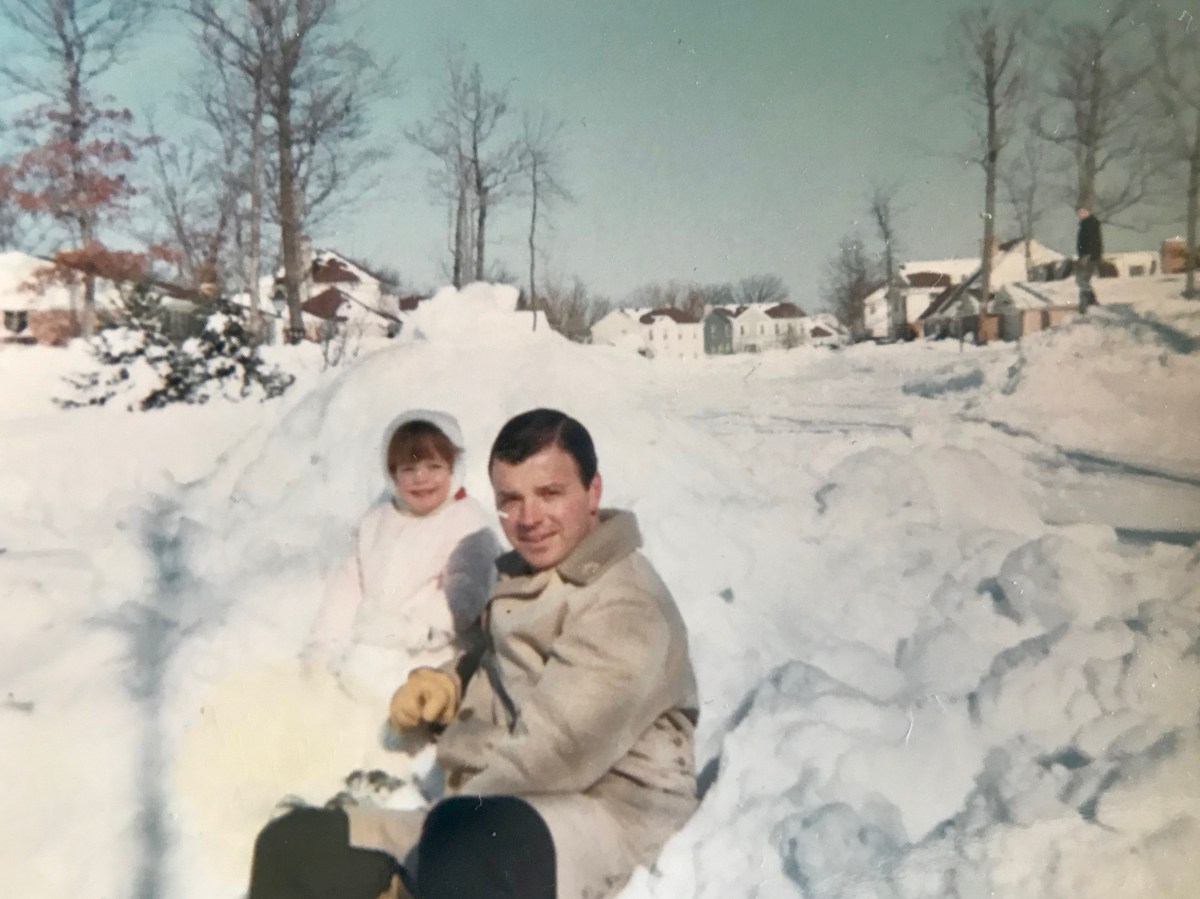
Layered, bundled, skated and packed into the station wagon, anxious to get to the rink and our friends, we watch Dad re-shovel the shoveled path by the garage. 

When Mom finally steps through the back door, all heads swivel toward the flash of candy apple red which has newly invaded the icy, grey scenery.

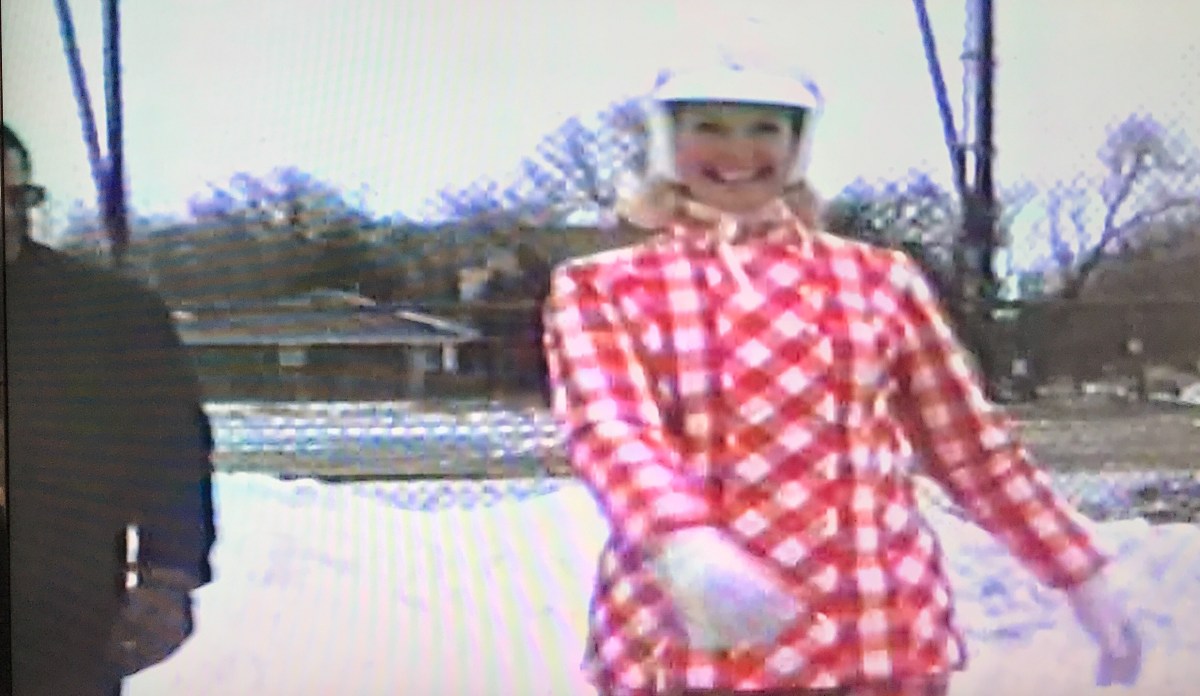
There stands Mom in an outfit the likes of which Lake Bluff villagers have never – nor will likely ever see again – a red and white checkered snow suit, with its belted jacket and matching knickers (Yes, that’s right, I said knickers.), red cable knit stockings, white knit gloves, and a matching, white knit, helmet-shaped cap with ear flaps and a large, snowball-sized pom-pom on top.

It’s something to be seen… and near impossible to miss.

She’s something to be seen. 

But that’s usually Mom: statuesque, blonde, beautiful, incomparable. 

Ever the model. 

Not afraid to be individual, and always, always fashionable.

Even when that fashion might be questionable…

… at least from the viewpoint of her five, young impressionables.

But Mom is glowing. 

Excited for the family outing. 

Eager to put her weatherproof, yet fashion savvy snow suit to the test.

But Mom is GLOWING

Like a giant, checkered barber pole.

And everyone from Dad (whose briefly raised eyebrows are a dead giveaway) to Mark (who strains his tiny, bundled body to turn and stare wide-eyed at the walking tablecloth) are stunned silent by the new outfit that speaks volumes.

As Dad winds the wagon toward town, whispers around the rear seats are exchanged. It’s agreed that the best course of action is evasive – a rapid, rear door exit will surely guarantee reaching the rink quickly and losing ourselves in the nameless, motherless crowd in moments.

As luck would have it, a parking space – one actually big enough to accommodate our Grand Safari station wagon – opens up right in front and above the bustling rink. There’s no more delaying the inevitable fashion statement that’s about to be thrust upon the unsuspecting citizens of Lake Bluff. 

As soon as Dad docks the wagon and shifts into park, Jim and Chris leap from the center seat and never look back. 

In the very rear of the wagon, however,  Mia and I are at the mercy of Dad who needs to open our escape hatch from the outside (a major miscalculation on our part), and who is leisurely lacing his own skates; while Mom struggles to wriggle a wiggly four-year-old into a pair of hand-me-down, oversized skates.

Dad finally releases us, and leaving Mia to fend for herself, I make fast, teetering tracks to the ice, losing myself in a swarm of bladed, unbounded activity. 

From the anonymity of the crowd below I watch, – mortified – as Mom’s checkered ensemble appears around the rear of our wagon, moving very, very slowly over ice and snow toward the rink. 

Giving everyone within a three mile radius ample time to take it all in.

Radiating red against the endless, ashen clouds.

Unembarrassed. 

Unaffected. 

Unbelievable.

Forcing me deeper into the throng of villagers, into the sea of somber, Midwestern winter gear. Commonsensical clothes in practical colors blending together like the dark waters of a deep, churning lake.

Unsteadying me. 

Disorienting me.

Drowning me in denim and down; in unfamiliar faces and forms, swirling and twirling and lawless.

I feel panic rise and tears swell and wish everyone would just… STOP!

Until a beautiful beacon appears.

A sudden flash of something dazzlingly bright shining through the drab-colored chaos. 

The most wonderful sight I’ve ever seen. 

Giving instant comfort. 

Guiding me home.

To the arms of Mom. 

To the warmth of her hug. 

Wrapped tight in all her red and white checkered glory.

Within Close Range: The Pressure of Writing

She moves up and down the rows of desks 

filled with tiny, crouched figures 

hovering over lined paper 

and clutching #2 pencils. 

Filling the aisle with her middle-age width 

and Avon perfume, 

I feel the warmth of her body and breath 

as she leans over me 

and sighs.

We’ve been here before.

I’m just not getting this pencil-holding thing.

I thought I was doing it right. 

The letters on my paper look pretty much like everyone’s. 

Pretty much.

But every time she stops at my desk, 

she firmly cups her hand over mine and squeezes  

hard

until she forces my tiny, anxious fingers 

to curl around the long, yellow pencil 

with the well-worn, pink eraser.

“A firm grasp is the key to proper penmanship, my dear,” she says, 

trying to sound patient 

about my substandard pencil etiquette.

Not wanting to disappoint her

again

I clench that pencil 

as if my very breathing depends upon it, 

until my fingers cramp from it, 

and the lead of the pencil 

presses so hard against the paper 

that the letters bulge through the opposite side.

When she asks us to turn our papers over 

and sit quietly until everyone finishes, 

I close my eyes 

and feel each raised letter with my fingertips. 

Wondering whether any one else 

has to press that hard 

work that hard 

to squeeze out the letters 

and words, 

and sentences, 

so very anxious to burst forth.

Within Close Range: The Car Ride

Much of my early views of Florida are seen above a sea of car upholstery, through rolled up windows, where the only things visible are the tops of Palm trees and passing trucks, condos and clouds, and Nonnie and Papa’s heads hovering over a wide expanse of leather stretched across the latest Cadillac’s cavernous front seat.

Here, conversations are muffled, and occasionally in broken Italian, so young ears can’t possibly understand; and elevator music versions of Rock ’n Roll songs play softly; where Papa’s cautious, half-mile-to-execute lane changes regularly cause the turn signal to remain blinking. 

It must be an audio-visual black hole (I think to myself), oblivious as he is to both the flashing green light and the constant clicking for miles on end.

The sound of it lulls me into a stupor, until Nonnie finally notices the signal of perpetual motion and snaps at Papa to turn it off. 

A few miles pass and all is peaceful, until the car begins to fill with a terrible smell.

I turn to my cousin, John, who’s holding the backseat’s cigarette lighter, with an indecipherable look on his face, as the smell of flaming follicles slowly wafts through the well-sealed compartment.

“What’s burning?!” Nonnie shrieks, “Something’s burning! Jimmy, something’s on fire!”

Papa pitches the lumbering Caddy to an empty parking lot at the side of the road, unrolls the windows, and orders everyone out of the car. 

John’s dubious deed is soon discovered.

Papa gives his grandson “the eye”; while Nonnie stands there mumbling and grumbling and shaking her head.

After one last inspection to ensure nothing else has been set on fire and throwing John one, last incredulous look, Papa orders everyone back in the car before signaling his return to the road, where, for the final miles to the restaurant, I lose myself in the smell of burnt hair and the click of the sedan’s left blinker.

Within Close Range: The Upstairs Universe

The adult-free upstairs is our universe, our private world of fun and games and funny voices, where Jim’s rolled up socks turn into stink bombs of such infamy that as soon as you see him take off a shoe, you run… 

as fast as your stockinged feet along a polished wood floor can take you.

It’s also where fuzzy, red carpeting turns to molten lava and chairs and tables become bridges, and the sofa, an island where captives and carpet monsters fight to the death in battle after battle.

In the universe upstairs, sloped-ceiling closets and dark crawlspaces (too-small-for-adults places) become hideaways where we can bring pillows and posters, flashlights and stuffed animals, and write secrets and swear words on the 2 x 4s and plaster board.

And listen to Mom in the kitchen below, until the heater switches on and the great metal shafts fill with air and fill our ears with rumbling.

At the very top of the back steps, behind a tiny door (not more than three feet square), Jim has spent the entire day building a spaceship. Fabricated from old outlets and switches, and a roll of duct tape.

With Mark as his co-pilot and imagination as his rocket fuel, he rallies us to climb into his crawlspace capsule. 

I sit back in the darkness, surrounded by boxes of memories –  Mom’s heirloomed wedding dress at my elbow and Christmas decorations at my back – anxious for the countdown.

Excited for blast off.

For leaving the earth far behind.

Calling to his co-pilot to flick switches labelled with a big, black magic marker, then moving his hands up and down his own duct-taped controls, I hear the sputters and rumbles of Jim’s vocal-powered rockets.

Hugging my big, Pooh Bear, I watch our fearless pilot, in the beam of a dangling flashlight, lean back and call to his unlikely crew through the cup of his hand:

“Hang on! Here we go! Ten… Nine… Eight…”

Jim’s rumbles begin to rise.

“Seven… Six… Five… Four…”

I feel the crawlspace shake and rattle.

“Three… Two… One… BLAST OFF!”

I squeeze that silly, old bear and close my eyes to see the fast-approaching cosmos…

And there I float in the infinite black. 

In the infinite stars. 

Until Jim shouts, “Meteors!” and all hell breaks loose in our top-of-the-stairs cockpit.

The hallway light suddenly cuts through the cracks and the dark – and the meteors – and the call of dinner brings us back to earth.

Within Close Range: Bullies

Because our home’s so far away, 

I’m the first picked up by the bus each day

and the very first stop after school –

which makes every student on our route  

sit forty minutes more each afternoon

and me, an unwelcome sight.

Full of hormones and hate, 

those in last few rows of the long, yellow bus 

moan and groan 

as soon as I climb on,

making me nervously skitter to the nearest seat

where I crouch 

and hide 

and wait.

The hardcore insults come later

and louder

cloaked in the anonymity of the rumbling and motion 

of our rolling prison.

Deaf to what he hears, 

the bus driver just stares ahead

and goes where he’s told. 

United by the same neighborhood, 

in the opposite direction,

they snarl and nip at the back of my neck –

piercing my thin skin. 

It’s us versus them, 

in every nasty word. 

But the “them” they think I am 

is absolutely absurd.

When their rabid, backseat words 

have more than their usual bite, 

I step from the bus 

and race to the woods, 

searching for a way to shake the hurt 

in the thick, dim patches of unpeopled forest. 

I disappear among the ember-colored leaves 

which cap the many trees

before the heavy freeze 

steals the color from the land.

And there, I simply am.

Where I step to the sound of my breathing,

the movement of the clouds, 

and to the busy hush of forest life about, 

reminding me to go about my own;

and to heal my wounds

with the comforts of home.

Within Close Range: Within Close Range

It’s early spring and still outnumbered are the days of thawing, when the sun shines through the nearly impermeable grey just long enough to make the corral thick and pliable for the heavily-coated ponies to imprint the half-frozen peaks of ice and manure.  

With little inclination to be out of doors, Mia, Mark, Jim and I, along with cousins Mary, Gina and Bill, are all hanging out in the kid’s room upstairs, twitching and giggling and getting riled by Jim, the regular instigator of such behavior. 

But this time, instead of hanging around to help control the chaos, Jim leaves, leaving his younger siblings and cousins to deal with the consequences – the most important of which is that Mark is wound-up and dangerously near the one thing in the room Jim should have taken with him: his Benjamin Air Rifle.

Jim got the rifle for Christmas and had been target practicing with it that morning. Dad doesn’t like the idea of the eight-pump, .177 caliber pellet gun, but Mom’s Missouri farm roots makes her believe that it’s every boy’s initiation into manhood.

In Jim’s defense, he never shoots at living things – mostly targets, trees and tin cans. 

However, he does get an enormous amount of satisfaction turning its site on siblings for the sheer satisfaction of watching faces contort; which is likely where Mark got the idea.

Picking up the air rifle, he aims it across the room at Gina, sitting on the sofa. 

Each of us demands he put the weapon down, but Mark already has that look in his eyes which tells us he’s stopped listening, and before anyone can say another word, Mark presses the trigger and discharges what he thinks is air through an empty chamber.

Gina, already curled into a defensive ball, is hit. 

The lead pellet rips through her jeans and grazes the skin on the back of her left thigh, already bruising when we gather around to inspect the wound.

Everyone – including Mark – is stunned and silent.

Gina’s eyes grow wide and wild.

“You little fucker! You shot me!”

We all look to Mark for an explanation, but he’s off – like his shot – out of the room, down the back stairs, and out the door.

Having returned to the scene at the sound of Gina’s scream, it takes mere moments for Jim to form an angry mob to go in search of the lone shooter, now taking refuge somewhere in the damp, barren woods surrounding our house. 

We follow the leader around the backyard and back woods, looking for a spark of tell-tale color among the sullen, gray tree trunks. 

Then something turns… Jim’s allegiance. 

In an instant, we’re all in his sights and half-heartedly running for our lives. 

Finding a safe spot from his line of vision, I’m watching from the barn stalls when Jim spots Mark weaving through the trees and across the frozen patches of slippery leaves in the back circle by the cottage. 

He’s trying to make a break for the large stretch of trees just across the driveway. From there, it’s certain he can outmaneuver Jim through the woods to safety. 

The problem is the twenty foot stretch of open pavement.

But spring is in the air and Mark is feeling a little wild.

We all are.

Jim gives the rifle an extra pump and takes aim at the small figure now bounding across the asphalt. 

In one very lucky shot… he hits his target, and like a plastic carnival duck floating atop a painted carnival pond, Mark is knocked flat. 

Jim insists it was meant to be a “warning” shot.

As all games are officially over at the first sign of blood, Mark limps toward the house where he pulls down his sock to reveal the day’s second wound on the back of his ankle. 

Mom’s soon on the scene, ordering Mark into the kitchen (with everyone following close behind).

She cleans and examines the wound and declares the pellet must have skimmed the surface of his skin (just like Gina’s had, but we felt best not to mention).

Satisfied with Mom’s answer, the hunter and all those hunted walk – and limp – away.

—————-

Forty years later, having just had x-rays taken for an orthopedic shoe insert, Mark’s doctor enters the room and hangs the film on the light box, and with a strange look on his face, points to a light spot behind Mark’s left ankle.

“This is a metal object,” he says, “… and it looks like a bullet.”

Both Mark and the doctor stare at the very clear, small, rounded object appearing on the screen. 

“No, that can’t be right,” Mark insists. “There must be a glitch on your x-ray machine.”

But the doctor assures Mark that the object is no glitch.

“Do you happen to know how it got there?” the doctor asks, now looking a little sideways at his patient.

Mark stares at the small metal object imbedded in his achilles tendon and suddenly it all comes flooding back to him. 

Before leaving the parking lot of the doctor’s office, he sent this image out to remind us all of a childhood within close range. 

Within Close Range: Dinner at the Celanos’

Dinner means waiting.

It means setting the table 

with placemats and napkins,

and neatly set silver, 

pitchers of water 

and plates for your salad; 

and waiting and waiting,

as smells from the kitchen, 

from sizzling pans and simmering pots, 

waft through the house 

like intoxicating fog.

Making it hard to concentrate 

on anything but the the clock,

and the driveway, 

where we turn our attentions 

every few minutes, 

hoping for headlights.

Stomachs gurgling.

Tempers shortening.

Dad finally showing 

and ever so slowly…

shedding his suit. 

Un-harried. 

Unhurried 

to get the meal going. 

Though children are moaning. 

Haven’t eaten in minutes. 

But dinner begins 

when Dad’s ready to sit.

And no sooner.

Within Close Range: Curfew

Every mile or so, 

I glance to the clock. 

Hoping time will stop.

Or that it’s not really five o’clock.

The final mile along the road, 

I roll down the windows to air out the smell. 

The woodland creatures are beginning to shift,

so once in the driveway, I turn the lights off

and roll slowly along, with the engine hushed.

Safe inside, it’s straight to the fridge.

Grabbing cold pasta, I start up to bed.

But a light from the den stops me instead.

And before I can step a tip to a toe,

Dad rumbles from the den, 

strong and low.

And I have nowhere else to go.

Perched on his favorite, swivel chair, 

he’s flanked by portraits of ungrateful heirs.

Grumbling at the empty driveway 

and disappearing night,

he’s been swiveling there for hours 

without a child in sight.

Staring at my bloodshot eyes, 

he asks if I know the hour,

and things aren’t looking good 

for this early morning flower.

“What could you be doing 

until five in the morning?”

All at once, the truth pours forth 

without a single warning.

I tell Dad how the day was spent 

cooking with some friends, 

then going to a drive-in 

for a zombie marathon;

about the beautiful night 

and the shoreline fire, 

the remarkable moonlight 

as we waded in the water.

Baffled by my sudden truths, 

Dad takes a moment to recompute.

“I’m just waiting for your sister.”

(as the final plot twister)

were the next 

and last 

words from his mouth.

Equally confounded, 

I leave the scene ungrounded.

Looking from an upstairs window, 

just above where Dad keeps vigil,

I see the dawn beginning to dance, 

and know, poor Mia, 

doesn’t stand 

chance.

Within Close Range: The Double Date

Home from college,

my dance card empty,

Jean has ignored me

and arranged a double date. 

Making my way toward the kitchen

to re-hydrate my bone-dry jitters,

I pass Dad in the den. 

He’s sitting in the swivel chair, 

with his back to the windows, 

pretending he’s reading. 

He’s also pretending not to see me. 

Isn’t happy about this evening.

With boys ever at the heels of Mia and Chris, 

he takes frequent comfort in my constant datelessness. 

But really, is the The Garden Journal so utterly absorbing

that my noisy, high-heeled entrance, he’s utterly ignoring?

Not Dad.

(Can’t suppress eye roll.)

And what about Mom? 

Still hovering in the kitchen, 

without a purpose in sight. 

Both acting as this was my very first date. 

Not exactly soothing.

Just need to keep moving.

A difficult task in absurdly high heels

which already feel like burning coals.

Through my water glass, 

I watch Dad rotate right

to face the new, oncoming lights 

bouncing off the dimly lit walls.

A swivel slowly left, 

he’s watching Jean and our dates.

The doorbell’s ringing, 

but Dad’s not budging.

Instead, he’s whirled right back around 

that book might as well be upside down.

(Can’t suppress eye roll.)

I take a deep breath and open the door.

Jean’s smile is enormous. 

I look to the floor –

I know she’s trying.

But there’s something she’s hiding –

like my date being just about as happy as I am.

Reaching out a limp, wet hand

What’s this poor guy’s name again?

I hear swiveling. 

Dad’s up and coming.

Then… passing,

without so much as a greeting.

(Eye roll mentally happening.)

And why is he stopping,

pretending to search for something?

Empty-handed, he’s returning.

I can almost hear the growling.

Keeping his fixed glare –

swiveling like the chair –

on both the boys,

until he quietly disappears.

I push my companions out the door,

hoping the night will hide my humiliation 

and breath new life into this double date situation.

But I’m not counting on it,

and neither is Dad,

who’s peeking through the curtains, 

shaking his head 

as he calls to the kitchen,

“She won’t be marrying THAT one.”

(Can’t suppress eye roll.)

Within Close Range: an evening with officer gildemeister

An Evening with Officer Gildemeister

Been sitting here for hours,

finding haunted, frightened faces 

in the station floor’s contours.

Don’t know whether to be relieved 

that the next person I see,

isn’t Dad.

But I was simply standing there

when someone gave me my first beer.

Just before all hell broke loose

in the parking lot of St. Mary’s Church and School.

Everyone saw the squad car. 

Everyone but me –

and the boy who got busted with a bong – 

but now he’s even free.

The scene’s a constant loop in my head:

beers flying, 

friends fleeing, 

voices shouting,

me freezing.

Blinded by flashing.

Too late to fling it.

Too late for dashing.

Why did I leave that stupid dance?

I just went to see the band.

Hoping to spark the lead guitar’s flame,

but the flame from a first crush never came.

“Is there someone else I can call?”

I can think of one name, that’s all.

“They have to be adults,” the cop sneers.

“Dr. and Mrs.” I mumble.

Of course, he knows the teenage sons.

and thinks they’re nothing but trouble.

Dirty, hippy, smart ass punks 

with long hair and ripped jeans;

thundering laughs and motorbikes,

and EVERYTHING that he dislikes.

At last, a fast-moving figure, 

in a tousled wig of blonde, 

darts through the doors 

with a generous smile

to face the big man with the gun.

A lady of very small stature

she is nearly eclipsed by his size. 

“Are you going to tell her why you’re here?”

she looks up to the cop and she smiles,

“She doesn’t have to tell me a thing.”

was all she had to say,

stunning the big, little, speechless man

bringing joy to my miserable day.

I suppress the urge to hug her.

But she’ll get a tearful later.

And I’ll be forever grateful

to Inga, my memorable savior.

Within Close Range: Clogs

Lake Forest High School’s West Campus

is a giant, brick and cinder block monstrosity, 

designed with all the charm and comforts 

of a state penitentiary. 

Sterile, 

uninviting, 

uninspiring, 

practically windowless, colorless, 

and completely humorless. 

Its warden roams the cinder block dungeons 

in his plaid polyester sports coat, 

smelling of cigarettes and body odor; 

wielding his insignificant power 

with more brawn than brain.

I’ve done everything I can to steer clear.

But best laid plans…

Still mocking an outdated documentary 

on health, hygiene, and the hazards of smoking;

featuring mildly graphic surgery footage, 

phony teens in dungarees, 

and from a hole cut in his larynx,

a smiling man blowing smoke rings,

I start down the stairs to my next class

but never see past the very first step

because the clog on my right foot has chosen to go ahead – 

getting only as far as the arch, instead –

landing my half-clogged foot on the step’s metal edge.

I plunge toward a staircase-ful of surprised friends

and new enemies, 

twisting and hurtling through the innocent 

and unsuspecting.

Coming down hard on my back.

With the grim, fluorescent lighting above 

and the cold, cement floor below,

I am returned to the moment 

by the moans of the stunned and wounded 

getting to their feet.

I attempt to do the same, 

but am gently pushed back to the cold concrete.

“You can’t move.”

“I’m fine,” I sigh in response, 

attempting to sit up again.

“No,” says our teacher,

as she pushes me back to the ground 

(a little more firmly this time).

“I mean, I can’t let you move until the principal gets here.”

“I’M FINE!” explodes off the cinder block walls. 

Faces grimace.

The class is soon sent on their way,

while like a one-shoed idiot, there I lay…

waiting…

imagining how the news of my nose dive

is already spreading.

Sprinting unnecessarily up the flight of stairs; 

a figure is soon looming over me on the landing –

an oppressive cloud of Aqua Velva and brown plaid.

And now I’m truly wishing I was dead.

Finally ensuring my captors 

there’ll be no need for an ambulance, 

to lawyer up,

or even help me up,

I hobble away,

bruised and humiliated.

Less than two weeks later,

fate becomes a hater – 

as I tumble down another set of steps.

People are beginning to wonder. 

Including the school nurse,

who meets me at the office door, 

shaking her head. 

Scrutinizing my footwear.

She hates clogs. 

Thinks they should all be put in a big pile 

and burned.

Just wait til she catches sight of my new Dr. Scholl’s.

Within Close Range: At the Edge of the Bluff

It’s an early spring day in the heartland.

Anemic, damp and miserable.

Clumps of stubborn snow and ice, 

grey and grimy, 

still dot the sidewalks and lawns.

Faces look pale and anxious for sun.

After the usual sermon of incense and absolution,

followed by stacks of pancakes and sausages, 

we know something is up 

when Dad drives past our neighborhood, 

further and further from home.

Passing unfamiliar faces and unfamiliar towns,

until backseat boredom is about to grow horns.

Passing another tiny town, 

and a solid white, storybook farm,

Dad finally slows and signals a turn.

“Shoreacres Country Club, Members Only”, 

reads the uninviting sign.

Swallowed by the dark of the woods,

the wide, low wagon drifts silently down the road, 

flanked by a small, trickling brook, 

winding past towering trees 

and long stretches of green. 

Everything is covered in a fine, frigid gloom, 

including another set of pretty, white buildings,  

silent and still on this dreary afternoon.

As we drive by a faded, old, green water tower, 

headless and frightening in the fog, 

our destination is finally divulged: 

a new home.  

I sink further into the wagon’s rear seat, 

where the unfriendly neighborhood disappears 

and I can see nothing but the thick, dark clouds. 

The silence is broken only by the sound of gravel 

crunching beneath the wheels of the wagon, 

now weighted with disappointment.

We twist down a long driveway and stop.

So inching my way back up, 

I survey the house. 

It’s dark and sullen.

Like the day. 

And my mood. 

Dad says, “We’ll just take a peek.”

But even I know what that means.

So, like prisoners into an exercise yard, 

we file from the car, 

and stand in an unhappy cluster in front of the house –

which isn’t yellow – 

like ours.

Which has no sign of neighbors, 

a school, 

the Good Humor Man,

or a new treehouse –

like ours.

We’re coaxed to a long row of windows 

which look through the cold, empty rooms, 

and beyond,

where lies a huge expanse of lawn.

And water, as far as the eye can see.

Racing to the rear of the house, 

we stand the edge of the bluff, 

looking out over the grand, Great Lake

right there at our toes.

We can see the silhouette of Chicago, 40 miles south.

Excitement for this strange, new place now erupts.

This place will become significant for all of us:

A decades-long breeder of unsupervised fun.

First beers. 

First cigarettes

And, of course, first bongs.

Secret rendezvous for teenage loves.

Outbuildings will be havens for fainthearted runaways

who soon long for home just a few feet away.

Follies of youth.

Such glorious days.

Until this world begins to erode.

To implode.

And all begin to scatter.

But, oh, what fertile earth it was

living life in the woods 

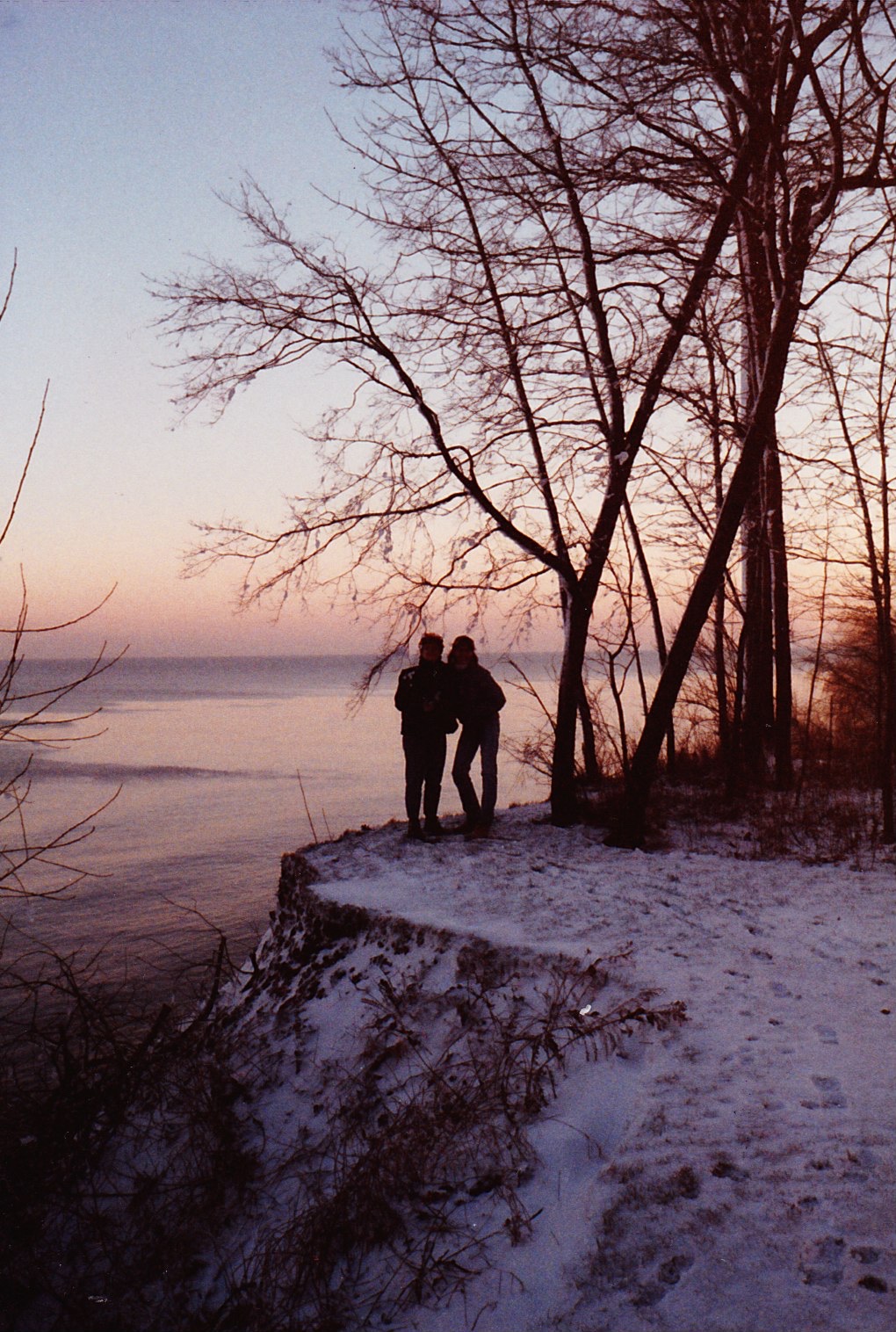
at the edge of the bluff.

Within Close Range: Chief – in three parts

Part One:

Chief is an ornery Appaloosa, 

short and fat, 

with black spots on the rump of his dirty, white coat. 

And the devil in his eyes. 

Of little training and no past consequences,

he’s a 9th birthday present from Dad – 

whose childhood pets were porcelain cats – 

and mostly Mom, 

a self-proclaimed Missouri farm girl,

with a steely, stubborn confidence over competence.

From the other side of the pasture fence, 

she urges me to remount:

“Make him know who’s boss!”

I struggle to my feet 

and limp toward the obvious answer

now grazing on prairie grass and wildflowers.

In between greedy mouthfuls, 

Chief raises his wild, blue eyes, 

beneath poorly cut bangs –

which I do myself. 

(No wonder he’s ornery.)

He’s quietly watching my pained approach 

and just as I get within a few feet, 

with a flick of his tail, he’s off – 

bucking and snorting as he goes.

Mom’s words are unrecognizable 

from the far end of the field.

But the tone is clear. 

So I move toward my spotted nemesis,

expecting him to bolt at any moment.

But this time, he lets me mount.

It’s all too easy, a voice inside warns.

But Mom’s is louder.

Barely settled in the saddle, 

Chief lifts his head and pins his fuzzy ears

flat against his thick skull.

Grabbing the reins and the horn, 

I know what’s coming.

Somehow still in the saddle at the canter, 

annoys my little, four-hoofed devil, 

who swerves from his path toward a cluster of pines.

Two, in particular,

which stand a pony’s width apart. 

I close my eyes and hold on tight.

Like yarn through an embroidery needle,

Chief threads us between the pines.

Scraped from their stirrups, 

my little legs bounce off of the pony’s big rear-end 

as we leave the trees for pasture 

and gallop toward Mom;

who’s still lobbing impractical words over the fence.

I feel my grasp on the saddle-horn weaken,

as my resolve that I’ll soon be tasting earth, 

grows.

And I let go.

Part Two:

Mom thinks a pal might keep Chief calmer. 

So early one spring, in comes Billy Gold: 

a blue ribboned, well-trained, Palomino,

which we trailered behind the wagon 

from his Missouri home.

Chief dislikes the new arrival immediately.

I think he’s dreamy

with his white/blonde mane and ginger coat, 

still winter thick and warm to the touch. 

Feeding him a carrot,

his hot breath and fuzzy lips 

tickle the palm of my cold, red hand.

Mark and Mia remain on the fence.

Watching.

Still unsure of whether Billy Gold –

like Chief –

is sinister.

In my thickly lined hood, 

tied tight against the cold, lake winds, 

I don’t understand their warnings

until far too late. 

Chief’s powerful teeth clamp down.

The pain in my butt is searing.

I’m howling.

Billy Gold bolts.

But Chief just stands there.

A nose length’s away.

Staring.

As I hop around the half-frozen earth,

swearing.

And rubbing the area already swelling.

My siblings’ shocked silence explodes into laughter, 

followed by a closely contested race to the house 

to see who’ll be the first to blather. 

Meanwhile, a purple-red welt, 

banded by marks of Chief’s big, front teeth, 

grows and throbs with each step toward the house

where Mom greets me with an ice pack 

and an ungoverned smile. 

Part Three:

When Chief isn’t trying to shed us,

or eat us,

he’s on the lam.

Devilishly clever.

Expected and regular.

The phone rings. 

Mom cringes.

Apologizes. 

Then sounds the alarm.

Steering the station wagon straight toward town.  

We found him in a graveyard once, 

On a foggy morning, one fall. 

Striking terror in the old caretaker 

who thought he’d seen it all.

Until galloping across the graves, 

he saw a ghostly, pony-sized sight,

with bad bangs, 

bouncing in the soupy light.

Pursued closely by a tall, beautiful, blonde 

in flowing, full length, lime-green chiffon. 

His hands still trembling 

when we waved from the road,

as we slowly crept toward home 

with our pony in tow.

But much of the time, Chief’s antics are close

and off I dash with grain and a rope; 

tracking my pony’s sod-ripping route 

through the blue-blood, buttoned-up neighborhood, 

across disapproving neighbors’ pristine lawns. 

From behind their glass houses, 

shaking heads frown.

One rainy, spring day, while chasing the brat,

he stops his mad bucking 

and turns in his tracks

to face me.

He pins his ears, which puts me on guard.

Then that damn pony starts to charge!

I am quite sure that we’re going to collide

When a voice – 

loud and fed up – 

calls from inside.

I drop the bucket of grain.

I drop the pony’s halter.

I gather all my courage.

My universe is itching to alter.

Setting my feet and standing my ground, 

I watch him close the gap.

And just as he’s an arm’s length away…

I give him a great, big

SLAP

at the tip of his long, white snout.

Suddenly, all Chief’s piss and vinegar

done

run

OUT! 

With a half-hearted snort, 

he lowers his poorly banged head, 

turning his devilish focus 

on the grain bucket instead.

And with noses aligned, 

we linger toward home, 

understanding more of each other 

than we had ever known.

Within Close Range: The Phone at the End of the Hall

The phone at the end of the hall, right next to my room, comes to life in the middle of the night; its merciless metal bells clanging, resounding off the tall walls of the winding front steps, and down the long, carpet-less hallway. 

Startled from my dreams and tormented by its unanswered ring, I crawl over whichever dog or cat is hogging most of the bed and quickly shuffle toward the noise, hoping to get to the phone before another blast of the bell pierces my brain. 

Fumbling for the receiver – and words – I already know that the only kind of news that comes in the middle of the night is usually bad. 

Or at least not very good.

And if I’m answering the phone, it means Mom and Dad didn’t, and I’m about to be made the reluctant messenger. 

Sleepless in the hours that follow. Anxious to hear the garage door rumble. 

Hoping the yelling and the lecture happened during the ride home. 

And that all the gory details will come over a bowl of cereal in the morning. 

Happy everyone is back home and in bed. 

And all is quiet at home again.

Within Close Range: The Neighborhood

Just northwest of Chicago, in Deerfield, Illinois, King’s Cove is 1960s, middle-class suburbia, where Good Humor trucks and men in white hats sell Chocolate Eclair bars with the solid chocolate centers, as they jingle past weedless, well-mown lawns and small, tree-filled lots.

Where neighbors are friends, your best friends are neighbors, and school is the next block over. 

Our house in King’s Cove is an unmistakable yellow, like hard-boiled egg yolk, as is the wood grain panelling on the side of the Grand Safari station wagon after Mark, a paint can, and a brush are left unattended. 

And even though it’s small for seven, it never feels crowded, except in the one, tiny bathroom we kids share. 

All tangles and toothpaste.

Our yolky Colonial has all that we need, all that we know: a small front yard with a tiny patch of grass and a newly planted tree, a split rail fence, and a lawn in back. 

Dad built a treehouse here, where my best friends, Cherie Dusare and Lynn Bubear and I, hoist the ladder, shut the trap door, and nurture our first true friendships, formed by first experiences. 

And I begin to discover the courage to find my own voice among the din of four siblings.  

No longer contented by blanket and thumb and going quietly unnoticed in our tiny world of well-worn paths through quiet backyards, which lead to school and monkey bars, and friends the next street over; where each winter, the Jayne’s sloping lawn next door turns to a sledding hill and every summer, the Beak’s back patio and mossy garden pond come alive with wildlife in the shade of the trees.

I like to sit on the small, stone, vine-covered wall and watch big-eyed frogs, bold chipmunks and bright orange koi go about their business of being beside the small, trickling waterfall, in the dark, green garden of this house on the corner.

Across the street live Amy and Abbey, the dark-haired twins – and my friends – who dress the same and make me wonder what it would be like to see another… be another me?

But my best friends live at the other end of the block where the three of us sneak into the Dusare’s paneled living room, enticed by taboo and a best friend’s promise of seeing a picture of naked men. 

Tip-toeing and giggling as we cross the shag carpeting, socks and static electricity spark already heightened senses. Cherie knows exactly where the album is in the long, low, hi-fi cabinet with the accordion door. 

She grabs it and holds it to her chest, scanning the scene for signs of adults. 

My heart beats through my crocheted vest. 

This is my apple. 

I take my first bite.

Thanks to dim, red lighting and well-placed fog machines, Three Dog Night offer me little more than a nibble. 

But my curiosity is peaked.

And it’s my very first secret to keep with my first best friends from the neighborhood.

Within Close Range: The Great Chicken Debate

Whether going out or eating in, food either consumes Nonnie’s thoughts or busies her hands for hours each day, managing laborious feats and four-course, Italian feasts – piping hot dishes of handmade manicotti or tender, breaded cutlets, garlicky vegetables, hot rolls, vinegary salads and sweet desserts.

Second helpings are always encouraged at Nonnie’s dinner table and praise for the cook, expected – as well as a little too vehemently rejected.

The three greatest mis-steps at this Italian table? 

One: cutting spaghetti. 

Either twist it or prepare for a gentle cuff on the back of the head from Papa. 

Two:  if all diners are not seated at the table while the food is still visibly steaming… Nonnie will burst several blood vessels. 

And three:  never…EVER… say you’re not hungry. 

Utter blasphemy.

We like to rattle her with unexpected visits and ravenous appetites, watching her forage through the refrigerator and freezer, brimming with outwardly unidentifiable, but doubtlessly delicious leftovers, sealed inside ancient Tupperware and old Cool Whip containers. 

Happy to see us, but perceptibly agitated that she can only offer what she sees as barely acceptable fare, each serving is dished up with a generous dollop of misgiving.

I’ve never known anyone as good at cooking as Nonnie, who complained about it more.

So it’s little wonder that while visiting in Florida, the moment Papa announces we’re having dinner out, a palpable – near frenetic – excitement  electrifies the apartment.

Following the proclamation, Nonnie spends most of the day in her housecoat, in a walk-run, making sure everyone’s dress clothes are pressed precisely, her hair is maintaining its proper “do” beneath a sea-green hair net, snack intake is severely monitored, and her sisters, Camille and Rose, are consulted and updated (via long distance) on EVERYTHING.

For Nonnie, dining out is the equivalent to an audience with the Pope. 

For me, such an event proves far more predictable than papal. 

More “Holy Cow” than Holy Spirit.

And it most definitely means Italian – old school – with its enticing smells and curtained nooks, smartly dressed waiters with thick accents, and an animated maitre d’ who greets everyone like family. 

It means trompe l’oeil walls of rural Tuscan scenes, rich, red fabrics draping doorways, and rolling dessert carts filled with cannoli and tiramisu.

From well below the mouthwatering chaos, I watch the loaded serving trays — piled high with pastas and soups, roasted chickens and fresh seafood — pass deftly overhead, with a “Scuza, Signorina!”, until a hand on my shoulder gently guides me out of the busy traffic and into a chair in front of a round table covered in linens and complex table settings. 

A fast-moving figure from behind casts a well-aimed cascade of ice water into one of the two stemmed glasses set at eye-level before me.

Tempted and tormented by big baskets of breadsticks and freshly baked rolls, my hand’s gently spanked away from a second helping.

“You’ll spoil your dinner,” Nonnie scolds. (What she secretly has in mind is a bakery heist for tomorrow’s breakfast.)

Excitement rises with the arrival of the menu which ignites imaginations and appetites.

Wherein the problem lies… with inexplicable regularity, when presented with an abundance of choices, Nonnie almost inevitably orders veal.

The choice seems harmless, but it’s enough to make family members cringe and Papa’s blood boil – not because baby cow meat is one of Nonnie’s favorite things to eat, but because every time she orders veal (whether Marsala or Picante, upscale joint or neighborhood favorite), she usually ends up taking only a couple of bites.

One for eternal optimism.

The other, raging cynicism.

Then raising her head from her plate and, wearing utter disappointment as a mourning veil, complains meekly but unmistakably.

“This isn’t veal… This is chicken.”

And like clockwork, another battle in Nonnie’s tireless crusade to unmask poultry dressed in calf’s clothing begins, prompting children to slip lower in their seats and adults to start commenting about the day’s weather; while Papa bows his head and sighs with exasperated disbelief. 

He and his wife then begin a short-lived, but emotionally escalating and frustrating exchange that will end with Papa vowing to never take Nonnie out to a restaurant again, and Nonnie looking self-righteous, misunderstood and miserable, as she rummages through her dinner-roll-filled-handbag looking for a tissue.

The drive home is what I imagine floating in space is like.

Silent. 

Solitary. 

Dark.

Except for the lights emanating from the dashboard (most particularly, the green turn signal arrow which Papa habitually leaves blinking) which let me know other life forms still exist.

A few days pass, then Papa announces we were going out to dinner. 

Again. 

(Sigh.)

Nonnie’s excitement rises anew… 

Until the waiter approaches her with his pen and pad in hand, and with all eyes anxiously upon her… she orders the veal.

And Papa ends up swearing that it’s the very last time he’ll ever take her out to dinner.

A vow he’ll repeat until the day he dies.

Nonnie, however, will work tirelessly in her quest for veal for decades more.

Within Close Range: The Elevator

From the time the youngest of us is moving independently of a parent, Gina, Mary, Mia and I are seen as a small, drifting quartet of cousins at family gatherings. 

Two distinct gene pools, one common goal: to discover new spaces and unknown places, where no eyes and “No!”s could block our intentions. 

Not to sit and behave, but explore the dark closets and dusted cabinets of quiet rooms far from grown-ups, though never far from mischievous brothers. 

Gina usually rouses us to expand our adult-free borders; opening doors and waving us through – and when things don’t kill us – boldly stepping past us. Reassuming command.

And we follow.

Just as we do when she leads us out the door of Nonnie and Papa’s apartment and down a long, humdrum hallway of dubious hues, and thick, padded carpet that silences our patent leather footsteps and makes us whisper.

Without any wear on my new, leather soles, I slip and I slip as we pick up the pace of our great escape, past dark, numbered doors behind which come the murmurs of TVs and mumbled voices, and other people’s lives.

Our little flock focuses on the big, brown, metal door at the end of the hall which will lead us to uncharted worlds and unsupervised floors; to a quiet, pristine lobby where unsat-on furniture needs to be sat on, and plants are dusted; and the floor is so highly polished, it glitters and gleams like a magical, marble lake that I want to skate on in my stockinged feet.

Mary presses the button with the arrow pointing down. The elevator hums and clicks and begins to move, and the newly learned numbers over the door blink in slow succession, until the lift stops and the door slides open.

In our reluctance to fully accept our independence, we hesitate and the door glides shut. But there’s an unspoken allegiance, so Mary re-presses the button, and back open it slides. 

Pushing us into the small, room with dark wood panelling, Gina reaches for the lowest button, and off we go to the little known land of the lobby. I can see its floor before the door is fully open. It shimmers and shines and lures me from the safety of my flock and the moving box.

Gina follows.

Mary follows.

Mia doesn’t.

We watch her tiny body disappear behind the sliding, metal door. 

Mary and Gina’s big, brown, Italian eyes go wide and I feel something – panic – suddenly rise. The elevator starts moving, the numbers start lighting, and Mia’s now off on her own adventure – without Captain or crew, or even a clue, as to where she’s going. 

At a loss for what to do, we just stare at the door of the moving contraption which slowly ascends to the top floor and stops. Will she get off and try to find her way back to Nonnie and Papa’s? 

Does she even know what floor they live on?… 

Wait… 

Do we? 

With this grim realization, the once strong lure of shiny floors and silky chairs is now replaced with powerful thoughts of Mia and Mom and home; of familiar faces, full plates of pasta, filled candy dishes.

And facing consequences.

Worried and wordless, we hear the elevator again click into motion and anxiously watch the numbers descend, kind of hoping when the door slides open, we see a familiar grown-up, or… 

Mia!

Standing in the exact same spot in center of the elevator where she’d been deserted, looking slightly startled, but happy to see us. 

Before losing her again, we jump in and watch the elusive lobby disappear behind the sliding door. 

Now all we need to figure out is what button will lead us home. 

Gina presses all of them.

When the elevator next stops, we hope to recognize something or someone, but nothing and no one is there. The next floor offers a replica of the last and I feel tears bubbling just below the surface. 

As the door opens to the third floor, it reveals a sight I thought I’d never be happy to see, Jim and John, sent out to search for their sisters and cousins.

“WE FOUND ‘EM!”, Jim hollers, as the boys race back down the brown and beige hall, to the front door of the apartment where Nonnie stands shushing… and waiting… with oven mitt and apron, and a look of consternation.

A scolding is at hand.

Gina smiles at each of us, then turns toward Nonnie.

And we follow.

Within Close Range: First Dance

When the station wagon rolls away from the curbside, dark and swarming with youth, I begin hunting for familiar faces or voices amid the chatter and the laughter. 

Desperate not to be standing alone among the dimly lit clusters huddling on the church lawn, cowering, I weave toward the bright light of an open door where a line of my peers is slowly filing into the basement for the Friday night dance.

Plenty of familiar faces dot the scene, but not a friendly one in sight. Until there, at the bottom of the crowded stairs, flash the comfortable smiles of good friends, as happy as I am at the sighting.

Into the dim and din of the dance, we move in a small, giggling mass to areas of equal un-interest: the drinks table, the snack counter – then, to the sidelines surrounding the dance floor, where tiny gangs of nervous pre-teens and new teens twitch, taunt and tell tales.

A group of boys laugh and push and swat at each other as they glance across the floor at a particular ring of girls. Finally, the boy with red hair and distractingly long limbs plucks enough courage to cross the floor toward the girl he’d been dared to ask to dance. 

But just as he’s making his way across the vast, sparsely populated stretch of beige and green-checkered linoleum, a popular song comes on which springs the crowd – and his targeted partner – into action. 

The dance floor erupts with awkward motion.

The moment – and momentum – are lost.

But the darkness emboldens, and as the first slow song starts spinning conquests are won, as the line drawn between the opposite sexes begins to blur. 

Now the dare proves not only daring, but profoundly stirring. 

Alluring.

One song leads to another, and another, and another.

New couples on the dance floor encourage others across the hot and cramped basement. 

And the boundaries blur further.

Are any eyes on us? 

On me?

Retreating to the easy obscurity of a dark corner, I watch the clock on the wall – and my friends – whose eyes now focus across the room. 

Across the divide.

Within Close Range: Mutton Stew

I’m in the middle of the pine-paneled restaurant at Boyne Mountain Resort (somewhere at the top of Michigan’s mitt), sitting in a large, carved pine chair – twice as large as it needs to be. 

Looking around the big, round table, there are siblings to the left and siblings to the right, with Mom and Dad straight ahead; and everyone capable of reading the menu, is. 

Scanning mine for a third time, my eyes keep returning to the word “stew”, which conjures a mouthwatering picture in my head – big chunks of tender meat in a rich, dark gravy.

“How different could mutton be from beef?” a voice in my head insists – repeatedly – drowning out all inner arguments and already placed orders.

It’s my turn.

“I’ll have the Mutton Stew, please.”

The waitress looks up from her pad, hesitates, and then looks to Mom and Dad.

“Oh, Annie, you won’t like that,” Mom gently suggests. “It has a very strong flavor.”

But I protest.

“Anne Elizabeth.”

“Please, Dad,” I plead, revving the perpetually high-powered motor that drives most eight-year-olds.

Mom urges, once more, to reconsider, but I remain unflappable. The lady is waiting and “The Troops” are hungry and restless. Dad raises his eyebrows, then nods to the waitress.

“All right then, Mutton Stew for the young lady.”

Triumphant, I can already taste the dark, rich gravy. 

Minutes seem like hours. The baskets of crackers and breadsticks and the pats of butter on small mountains of ice in the center of the big, round, constantly spinning, Lazy Susan are rapidly disappearing.

Beyond the large, glass windows overlooking the resort’s ski hills, the slopes are ablaze with white and dotted with skiers still eager to slip and slide down the gentle, rolling, Midwestern hills. 

It’s a wonderful sight, but the hungry voice in my head has recently enlisted my stomach, now rumbling, low and loud. Until the waitress returns with her overburdened tray, all I can think about is stew.

Burgers and fries pass by my eyes. Mom has soup and Dad’s given pasta. It takes two hands to carry the large, shallow bowl heading my way. 

I’m so excited, I can hardly keep still in my seat. 

My eyes eagerly follow the large, round bowl to the place setting in front of me and I look down to see…

… a sea of grayish-brownish goo; its foul smell already invading my nostrils.

Pungent.

Powerful.

Horrible.

My hunger instantly retreats, but all eyes at the table are on me. Even the waitress is loitering nearby, which means I can’t possibly back down before the first bite and so, with reluctance, I grab the smallest spoon and in it goes.

Releasing more stink from the bowl of brown-gray gloom.

I scoop up a small, dark morsel; highly doubtful about this dubious-scented mouthful.

It’s instant repulsion. 

Unbridled revulsion. 

A funky chunk of grisly meat that my tongue and teeth want to reject and my throat wants to eject into the clean, white napkin in my lap. But it’s swallow it, or my pride. 

The mutton punishes me all the way down.

Without a word, Mom and Dad turn their attention to their own plates. All follow.

While I’m left alone to stew.

Within Close Range: Papa’s Store

As buildings begin to replace trees along the Edens Expressway, I watch for familiar signs that we’re getting nearer Papa’s store.

Up ahead, on the right, stands Nickey (with a backward k), a giant, winking, smokestack of a man urging motorists to take the next exit for their very own, souped-up Chevrolet. 

The first downtown-bound sentry means twenty minutes more. 

Further along the constantly changing horizon, the magnificent, cherry red, neon lips of Magikist – 80 ft. high and puckering up for passersby for years – appears on the left, dazzling and hypnotic, garishly separating the suburbs from the city; the quiet and conventional, from the wonder and the chaos. 

Fifteen more minutes. 

At the very edge of the highway, around the next bend, looms the monster of a Morton Salt building and a great expanse of roof (almost level with the highway) painted with it’s iconic logo. I like to count how many seconds its takes to pass this massive, salt-filled warehouse.

And the girl in the yellow dress, with her big umbrella and box of Morton’s.

One-one-thousand, two-one-thousand, three-one-thousand…

… until it disappears from the smudged rear window.

Ten minutes more. 

Taking the next exit, we’re no longer speeding past the inner-city scenery, no longer isolated from the purposeful sprawl, but entering the industrial grime of Ohio Street’s massive warehouse district, desolate and dingy; where faded ads cling to crumbling brick walls and vast stretches of soot-stained windows lay dark and broken along shadowed streets, gray, cracked and worn from the Windy City’s daily grind.

I sink in my seat and cautiously scan the familiar but frightening streets for signs of trouble. My uneasiness arising from the barely discernible (except for the simultaneous “click”), but habitual practice Mom has of locking the doors before the first red light. 

Only after old brownstones and young professionals replace storehouses and seedy-looking characters, do I straighten up and welcome the city outside the window.

The constant beep of car horns trying to hurry along traffic below the tall buildings and shadowed streets. The constant movement of people of all types – not just well-off and white.

The dingy beads of water from the elevated tracks and platforms that plop, trickle and disappear down the window of the station wagon and tell me we’re very near.

Dressed in our Sunday best, fermenting with the pent up energy forty-five minutes in close quarters guarantees, our restless tribe is led in a disorderly row, through the perennially cold, dark, parking structure and onto the city streets. 

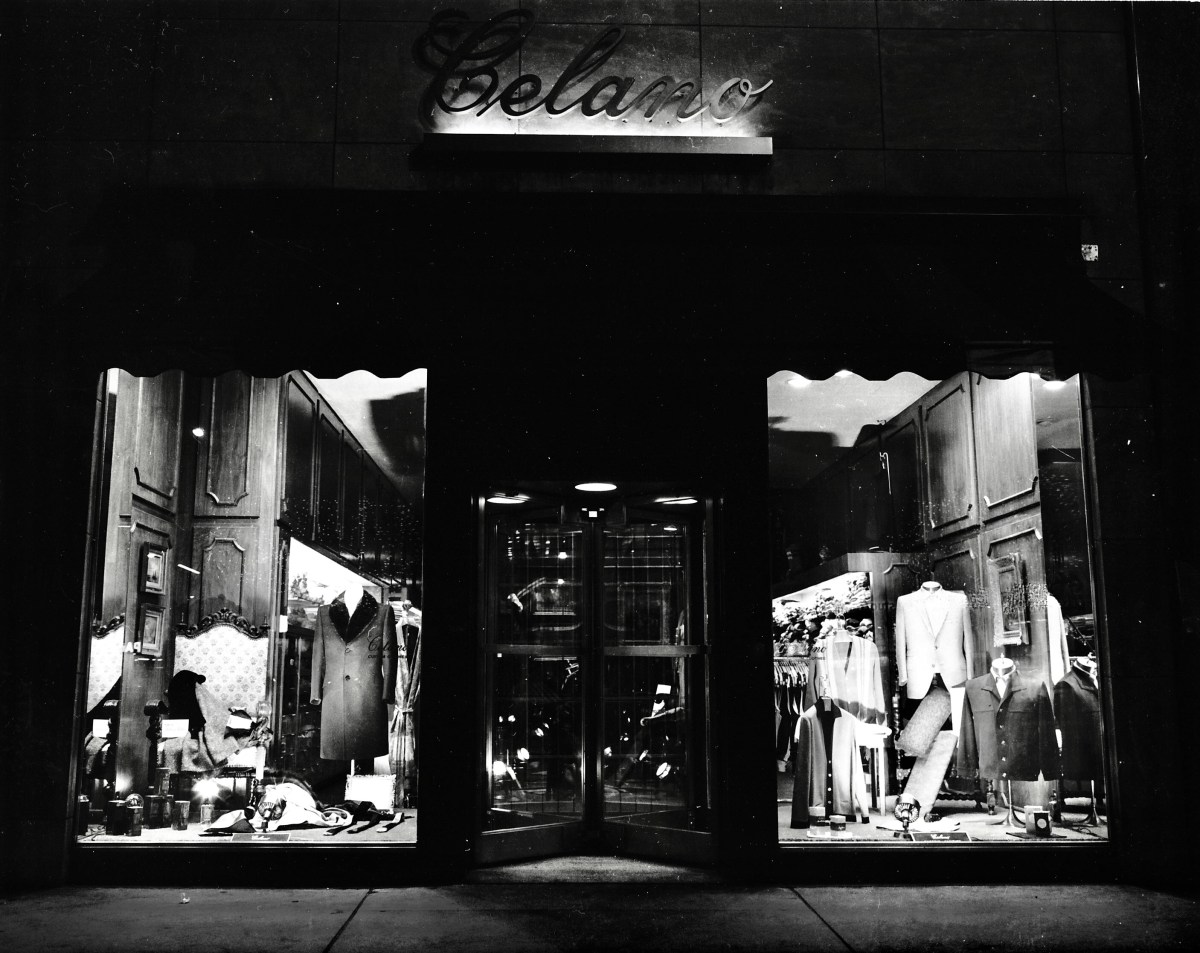
One block down and around the corner, to Michigan Avenue, I know to look for the red and gold awning (between the fancy shoe store and even fancier department store). 

As soon as I spot it, I pick up my pace until reaching the revolving door of Papa’s store, Celano Custom Tailors.

Squeezing my way into the pie-shaped divisions and forced to spin a circle and a half – by a sibling pushing the rotating door too fast – I stumble onto a sea of cardinal red carpet.

Impeccably clean. 

Incredibly lush.

At the end of the long, narrow showroom, past smartly dressed salesmen and bolts of rich fabric, stands Papa. 

Smiling quietly. 

Waiting to give his warm, well-pressed, fragrant hugs to each of his progeny.

After which, he gently, but hastily, scoots all five of us to the back of the store. Away from the immaculate glass cabinet displays of silk ties, colorful ascots and men’s colognes. 

Away from the meticulously stacked cashmere sweaters, and roll after roll of expensive Italian wools, French cottons and Irish linens. Keeping us well clear of the handsome, silk robes neatly hung on racks with red, wood hangers, custom-stamped in gold.

Most of all, we are whisked away from his well-to-do clientele in their very expensive, custom suits, custom shirts and spit shine shoes.

But my interest lies down a narrow set of stairs, in the windowless world below; where little men, with measuring tapes hung around their necks and giant scissors in their hands, bend over large, long work tables, spread with dark wools and shimmering silks.

They always stop and smile, exclaiming how much we’ve all grown, but my attention is on what’s behind the glass partition where Papa’s bookkeeper works, and in the bottom drawer, at the side of her desk, piled high with ledgers.

As soon as I reach her side, she bends toward the drawer with her piled-high hair.

Casting a shadow over her bookkeeping.

And from it she takes out a full box of Turtles – chocolate and caramel and pecans in a gooey, luscious mound. 

Papa’s favorite. 

And mine. 

In our silent ritual, I smile and thank the bee-hived bookkeeper and choose a turtle from the box, before being pushed by an impatient sibling next in line.

Permitted back upstairs only after all hands have been inspected, we’re led to Papa’s office where Jim plays boss with the many-buttoned telephone on the large, leather- topped desk. Until he dials the storefront and annoys the staff and Papa appears with playing cards and store stationary, and a gentle warning. 

Stop fidgeting. 

With Mom and Dad still shopping, we begin to take turns spying on the front of the store, watching the elegant dance of silent footsteps, hushed tones and controlled smiles in full-length mirrors. Making me feel as if I’m witnessing something sacred in the tending of well-to-do gentleman.

As if an ascension.

Until Jim discovers the stereo and starts pushing buttons. 

Shattering the sober storefront with an unexpected symphony. 

Instantly paroled from our conference room confinement, we race along the heavily padded, red carpeting, past the quiet clerks and perfect displays, and bolts and bolts, of dark, rich fabric.

Past Papa, who flinches when our many-footed exit shakes the cabinets.

And ruffles his clients. 

Michigan Avenue is an eruption of motion and commotion, which we’re swept up in, until we find ourselves among the tourists and the toilers at the base of the very new John Hancock Center.

Pressing my hands and body against its cool, black steel, I look skyward, trying to see the skyscraper’s top. Struggling to keeping my balance.

It makes me dizzy and suddenly anxious to see the red and gold awning. 

And the thick, red carpeting.

And Papa’s outstretched arms, for one last hug, before returning north. 

Past the giant girl in the yellow dress. 

Past the giant, neon lips, now lighting the early evening skies with its rosy red glow. 

Past the smokestack man disappearing in the dusk.

To the quiet woods. 

To the dark skies.

To home. 

Within Close Range: The Greenhouse

Defying the somber shades of dead in a Midwestern Winter,

when most everything surrounding the small, plexiglass world 

was limp and lifeless,

hidden beneath thick, mean layers of snow and ice.

green was something you could see, 

smell 

and touch 

in Mom’s greenhouse.

Stepping down into its steamy realm 

was like discovering a distant jungle.

Moist.

Pungent.

Earthy.

Exotic.

I’d sit on the cement stairs, 

arms hanging over the metal railing 

moist from the humidity.

Galoshes and socks dangling precariously.

Watching Mom dig her hands into a soily concoction.

Inhaling strange, sweet smells 

of bone meal and blood meal.

Manure and lime. 

And life.

Nurtured with the same intensity Mom tended her flock.  

Passionate and determined all should flourish. 

Cultivating her offspring with a unique and fertile mix 

of love and cynicism, 

melancholy, 

curiosity

and eccentricity.

Within Close Range: Summers on the Edge

I find solace in the familiar sounds of summer at Shoreacres.

The Northwestern train keeping to its schedule.

Bank Swallows calling to their colony as they swoop to and from nests pockmarking the sandy bluff wall.

The harbor’s baritone foghorn warning boats buried in Lake Michigan’s mist.

Even the sailors at the Great Lakes Naval Training Center to the north chime in, drilling up and down the parade grounds.

Marching.

Grunting.

Singing and rhyming.

Voices hovering in the air like ancient tribal chants.

Laying on the lawn overlooking the lake, I close my eyes and ease into the familiar sound of the sailors’ strong, low voices.

And the marching band practicing its spirited battle hymns.

Miles away, but strong and clear.

Carried to my ears by the lake winds cutting through the thick, moist air that smells of fresh cut lawn and freshwater fish.

Sun-filled days of climbing up and down the bluff where the path used to be before the lake rose and stole chunks of land, leaving little but swallow holes and sand – and killer cool ledges for daring leaps by reckless kids who take to the skies, then aim for the beach, landing in the soft, thick sand below – hot on the surface, but damp and cool just inches beneath.

Wriggling my toes further into the moist earth, I try to recapture the wind knocked out of me in the landing, until voices from above goad me into action and I’m forced forward again, down the soft, crumbling bluff, to a rugged line of boulders Dad had dropped on the beach in his failed fight against this infamously wicked lake.

Then one by one, into the water and waves we wade, trying to dislodge sand from our swimsuits and butt cracks. Feeling the lake’s strong, cold undertow at our feet and the strong, hot sun on our heads.

Watching our Lab, Heather, joyously and tirelessly swim after a stick bobbing on the waves. 

Silly dog.

Then up to the top we head to bound down again.

And again.

And again.

Long summer days invade the nights, inspiring late nights of Ghost in the Graveyard and Sardines and a world of hiding places scattered around our acres and outbuildings, where we squat amid the fireflies’ ambitious flickering and whisper above the crickets and cicadas charging the atmosphere with their measured, mesmerizing songs.

Reminding me that I am never really alone.

Standing at the edge of the bluff on the Fourth of July, with the comforts of home just steps away, we watch the fireworks displays from Chicago to Waukegan, “Ooohing” and “Ahhing”, mimicking the faraway crowds and slapping at mosquitoes determined to disturb our private celebration.

Mom unfreezes boxes of brats and burgers to feed a small army, which eventually arrives with empty stomachs and pockets full of bottle rockets, sparklers and Roman candles ample enough to light the skies and the lake, and disturb our quiet neighbors long after the distant festivities have ended.

But the best displays I witness from the brink are the summer thunderstorms rolling over the Great Lake, and the lightening exploding in sky-wide, silver-white bolts and bursts.

I feel fortunate.

And irrelevant.

On gentler nights when the moon is full and bright and we can see our way down the bluff to the beach, my siblings and I wade into the vast, still water. 

First, up to our knees. Then our bellies. Then our chests.

Eventually emboldened by the bright moonlight and calm, glassy water, I swim further from the shore and my companions.

Through strange patches of warm in the perpetually cold, inland water.

Scanning the dark stretch of water in front of me and turning to see the sparsely lit shoreline now well behind me, the calm in my mind begins to churn and I begin to worry about what lurks just below my feet – and in those warm patches – and start paddling madly toward the beach and the nearest sibling. 

Not stopping until I’m close enough to feel the sand below my feet, or see a smile in the moonlight.

Finding enormous comfort and calm in the motion of another’s treading water.

In their laughter.

In their teasing.

These are the endless days spent layered in sand and sun tan oil. 

Brown and blissful.

These are the days of sleeping well into the afternoon, or until the smell of breakfast cooking below wafts into my room… 

or my class schedule arrives in the mail all too soon.