Within Close Range: The Checkered Beacon

At the corner of Sheridan Road and Sheridan Place, right across from East Elementary and Lake Bluff Junior High School sits Artesian Park, two blocks of village green where every Fourth of July the grassy field turns to festival and carnival and fun and every winter, the sunken baseball diamond is flooded to make an ice-skating rink.

As soon as the temperature dips and the rink freezes solid, villagers swarm to the park, packing the small patch of ice with skaters of all ages, sizes and skills; with races of speed and games of Crack-the-Whip, hockey sticks slapping and half-hearted “Hamill Camels” spinning.

Huge smiles crowding pink cheeks.

The park’s field house is also opened, where a giant crackling fire in a giant stone hearth, hot drinks, long rubber mats and long, wooden benches, welcome skaters looking for secure footing and a temporary reprieve from the nippy wonders of winter.

Such happiness in hot cocoa and crackling fires.

In being a part of village life, instead of apart from it.

Layered, bundled, skated and packed into the station wagon, anxious to get to the rink and our friends, we watch Dad re-shovel the shoveled path by the garage. 

When Mom finally steps through the back door, all heads swivel toward the flash of candy apple red which has newly invaded the icy, grey scenery.

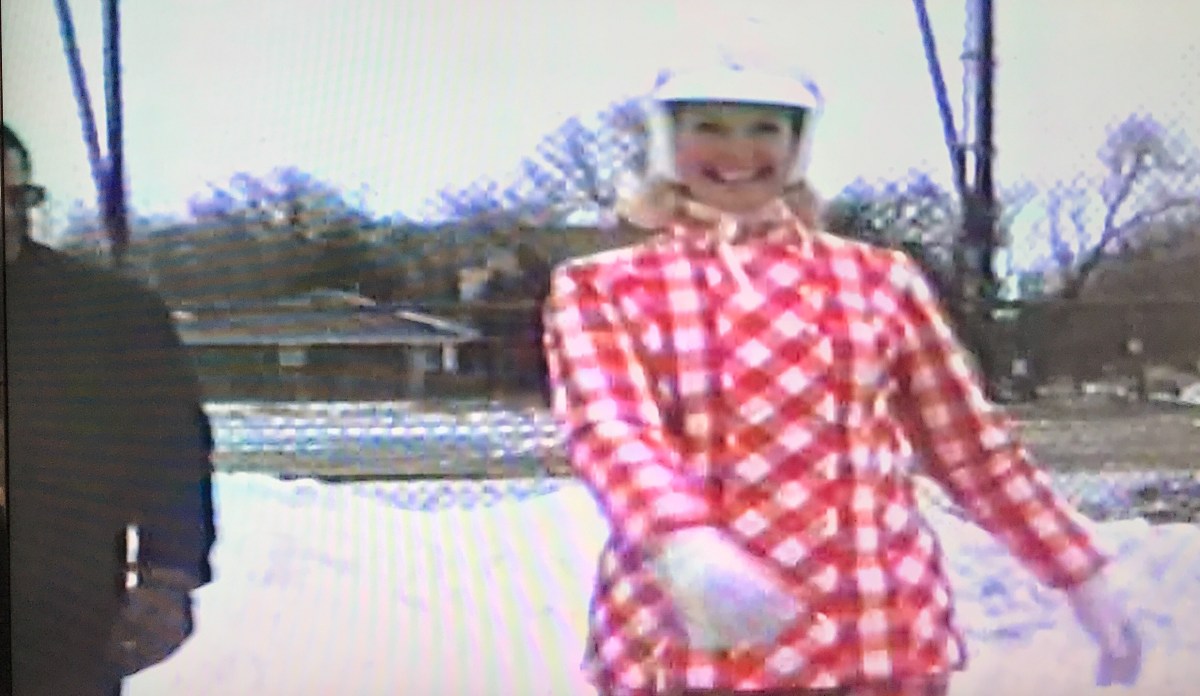
There stands Mom in an outfit the likes of which Lake Bluff villagers have never – nor will likely ever see again – a red and white checkered snow suit, with its belted jacket and matching knickers (Yes, that’s right, I said knickers.), red cable knit stockings, white knit gloves, and a matching, white knit, helmet-shaped cap with ear flaps and a large, snowball-sized pom-pom on top.

It’s something to be seen… and near impossible to miss.

She’s something to be seen. 

But that’s usually Mom: statuesque, blonde, beautiful, incomparable. 

Ever the model. 

Not afraid to be individual, and always, always fashionable.

Even when that fashion might be questionable…

… at least from the viewpoint of her five, young impressionables.

But Mom is glowing. 

Excited for the family outing. 

Eager to put her weatherproof, yet fashion savvy snow suit to the test.

But Mom is GLOWING

Like a giant, checkered barber pole.

And everyone from Dad (whose briefly raised eyebrows are a dead giveaway) to Mark (who strains his tiny, bundled body to turn and stare wide-eyed at the walking tablecloth) are stunned silent by the new outfit that speaks volumes.

As Dad winds the wagon toward town, whispers around the rear seats are exchanged. It’s agreed that the best course of action is evasive – a rapid, rear door exit will surely guarantee reaching the rink quickly and losing ourselves in the nameless, motherless crowd in moments.

As luck would have it, a parking space – one actually big enough to accommodate our Grand Safari station wagon – opens up right in front and above the bustling rink. There’s no more delaying the inevitable fashion statement that’s about to be thrust upon the unsuspecting citizens of Lake Bluff. 

As soon as Dad docks the wagon and shifts into park, Jim and Chris leap from the center seat and never look back. 

In the very rear of the wagon, however,  Mia and I are at the mercy of Dad who needs to open our escape hatch from the outside (a major miscalculation on our part), and who is leisurely lacing his own skates; while Mom struggles to wriggle a wiggly four-year-old into a pair of hand-me-down, oversized skates.

Dad finally releases us, and leaving Mia to fend for herself, I make fast, teetering tracks to the ice, losing myself in a swarm of bladed, unbounded activity. 

From the anonymity of the crowd below I watch, – mortified – as Mom’s checkered ensemble appears around the rear of our wagon, moving very, very slowly over ice and snow toward the rink. 

Giving everyone within a three mile radius ample time to take it all in.

Radiating red against the endless, ashen clouds.

Unembarrassed. 

Unaffected. 

Unbelievable.

Forcing me deeper into the throng of villagers, into the sea of somber, Midwestern winter gear. Commonsensical clothes in practical colors blending together like the dark waters of a deep, churning lake.

Unsteadying me. 

Disorienting me.

Drowning me in denim and down; in unfamiliar faces and forms, swirling and twirling and lawless.

I feel panic rise and tears swell and wish everyone would just… STOP!

Until a beautiful beacon appears.

A sudden flash of something dazzlingly bright shining through the drab-colored chaos. 

The most wonderful sight I’ve ever seen. 

Giving instant comfort. 

Guiding me home.

To the arms of Mom. 

To the warmth of her hug. 

Wrapped tight in all her red and white checkered glory.
Within Close Range: Bullies

Because our home’s so far away, 

I’m the first picked up by the bus each day

and the very first stop after school –

which makes every student on our route  

sit forty minutes more each afternoon

and me, an unwelcome sight.

Full of hormones and hate, 

those in last few rows of the long, yellow bus 

moan and groan 

as soon as I climb on,

making me nervously skitter to the nearest seat

where I crouch 

and hide 

and wait.

The hardcore insults come later

and louder

cloaked in the anonymity of the rumbling and motion 

of our rolling prison.

Deaf to what he hears, 

the bus driver just stares ahead

and goes where he’s told. 

United by the same neighborhood, 

in the opposite direction,

they snarl and nip at the back of my neck –

piercing my thin skin. 

It’s us versus them, 

in every nasty word. 

But the “them” they think I am 

is absolutely absurd.

When their rabid, backseat words 

have more than their usual bite, 

I step from the bus 

and race to the woods, 

searching for a way to shake the hurt 

in the thick, dim patches of unpeopled forest. 

I disappear among the ember-colored leaves 

which cap the many trees

before the heavy freeze 

steals the color from the land.

And there, I simply am.

Where I step to the sound of my breathing,

the movement of the clouds, 

and to the busy hush of forest life about, 

reminding me to go about my own;

and to heal my wounds

with the comforts of home.

Within Close Range: Dinner at the Celanos’

Dinner means waiting.

It means setting the table 

with placemats and napkins,

and neatly set silver, 

pitchers of water 

and plates for your salad; 

and waiting and waiting,

as smells from the kitchen, 

from sizzling pans and simmering pots, 

waft through the house 

like intoxicating fog.

Making it hard to concentrate 

on anything but the the clock,

and the driveway, 

where we turn our attentions 

every few minutes, 

hoping for headlights.

Stomachs gurgling.

Tempers shortening.

Dad finally showing 

and ever so slowly…

shedding his suit. 

Un-harried. 

Unhurried 

to get the meal going. 

Though children are moaning. 

Haven’t eaten in minutes. 

But dinner begins 

when Dad’s ready to sit.

And no sooner.

Within Close Range: Curfew

Every mile or so, 

I glance to the clock. 

Hoping time will stop.

Or that it’s not really five o’clock.

The final mile along the road, 

I roll down the windows to air out the smell. 

The woodland creatures are beginning to shift,

so once in the driveway, I turn the lights off

and roll slowly along, with the engine hushed.

Safe inside, it’s straight to the fridge.

Grabbing cold pasta, I start up to bed.

But a light from the den stops me instead.

And before I can step a tip to a toe,

Dad rumbles from the den, 

strong and low.

And I have nowhere else to go.

Perched on his favorite, swivel chair, 

he’s flanked by portraits of ungrateful heirs.

Grumbling at the empty driveway 

and disappearing night,

he’s been swiveling there for hours 

without a child in sight.

Staring at my bloodshot eyes, 

he asks if I know the hour,

and things aren’t looking good 

for this early morning flower.

“What could you be doing 

until five in the morning?”

All at once, the truth pours forth 

without a single warning.

I tell Dad how the day was spent 

cooking with some friends, 

then going to a drive-in 

for a zombie marathon;

about the beautiful night 

and the shoreline fire, 

the remarkable moonlight 

as we waded in the water.

Baffled by my sudden truths, 

Dad takes a moment to recompute.

“I’m just waiting for your sister.”

(as the final plot twister)

were the next 

and last 

words from his mouth.

Equally confounded, 

I leave the scene ungrounded.

Looking from an upstairs window, 

just above where Dad keeps vigil,

I see the dawn beginning to dance, 

and know, poor Mia, 

doesn’t stand 

chance.

Within Close Range: Clogs

Lake Forest High School’s West Campus

is a giant, brick and cinder block monstrosity, 

designed with all the charm and comforts 

of a state penitentiary. 

Sterile, 

uninviting, 

uninspiring, 

practically windowless, colorless, 

and completely humorless. 

Its warden roams the cinder block dungeons 

in his plaid polyester sports coat, 

smelling of cigarettes and body odor; 

wielding his insignificant power 

with more brawn than brain.

I’ve done everything I can to steer clear.

But best laid plans…

Still mocking an outdated documentary 

on health, hygiene, and the hazards of smoking;

featuring mildly graphic surgery footage, 

phony teens in dungarees, 

and from a hole cut in his larynx,

a smiling man blowing smoke rings,

I start down the stairs to my next class

but never see past the very first step

because the clog on my right foot has chosen to go ahead – 

getting only as far as the arch, instead –

landing my half-clogged foot on the step’s metal edge.

I plunge toward a staircase-ful of surprised friends

and new enemies, 

twisting and hurtling through the innocent 

and unsuspecting.

Coming down hard on my back.

With the grim, fluorescent lighting above 

and the cold, cement floor below,

I am returned to the moment 

by the moans of the stunned and wounded 

getting to their feet.

I attempt to do the same, 

but am gently pushed back to the cold concrete.

“You can’t move.”

“I’m fine,” I sigh in response, 

attempting to sit up again.

“No,” says our teacher,

as she pushes me back to the ground 

(a little more firmly this time).

“I mean, I can’t let you move until the principal gets here.”

“I’M FINE!” explodes off the cinder block walls. 

Faces grimace.

The class is soon sent on their way,

while like a one-shoed idiot, there I lay…

waiting…

imagining how the news of my nose dive

is already spreading.

Sprinting unnecessarily up the flight of stairs; 

a figure is soon looming over me on the landing –

an oppressive cloud of Aqua Velva and brown plaid.

And now I’m truly wishing I was dead.

Finally ensuring my captors 

there’ll be no need for an ambulance, 

to lawyer up,

or even help me up,

I hobble away,

bruised and humiliated.

Less than two weeks later,

fate becomes a hater – 

as I tumble down another set of steps.

People are beginning to wonder. 

Including the school nurse,

who meets me at the office door, 

shaking her head. 

Scrutinizing my footwear.

She hates clogs. 

Thinks they should all be put in a big pile 

and burned.

Just wait til she catches sight of my new Dr. Scholl’s.

Within Close Range: At the Edge of the Bluff

It’s an early spring day in the heartland.

Anemic, damp and miserable.

Clumps of stubborn snow and ice, 

grey and grimy, 

still dot the sidewalks and lawns.

Faces look pale and anxious for sun.

After the usual sermon of incense and absolution,

followed by stacks of pancakes and sausages, 

we know something is up 

when Dad drives past our neighborhood, 

further and further from home.

Passing unfamiliar faces and unfamiliar towns,

until backseat boredom is about to grow horns.

Passing another tiny town, 

and a solid white, storybook farm,

Dad finally slows and signals a turn.

“Shoreacres Country Club, Members Only”, 

reads the uninviting sign.

Swallowed by the dark of the woods,

the wide, low wagon drifts silently down the road, 

flanked by a small, trickling brook, 

winding past towering trees 

and long stretches of green. 

Everything is covered in a fine, frigid gloom, 

including another set of pretty, white buildings,  

silent and still on this dreary afternoon.

As we drive by a faded, old, green water tower, 

headless and frightening in the fog, 

our destination is finally divulged: 

a new home.  

I sink further into the wagon’s rear seat, 

where the unfriendly neighborhood disappears 

and I can see nothing but the thick, dark clouds. 

The silence is broken only by the sound of gravel 

crunching beneath the wheels of the wagon, 

now weighted with disappointment.

We twist down a long driveway and stop.

So inching my way back up, 

I survey the house. 

It’s dark and sullen.

Like the day. 

And my mood. 

Dad says, “We’ll just take a peek.”

But even I know what that means.

So, like prisoners into an exercise yard, 

we file from the car, 

and stand in an unhappy cluster in front of the house –

which isn’t yellow – 

like ours.

Which has no sign of neighbors, 

a school, 

the Good Humor Man,

or a new treehouse –

like ours.

We’re coaxed to a long row of windows 

which look through the cold, empty rooms, 

and beyond,

where lies a huge expanse of lawn.

And water, as far as the eye can see.

Racing to the rear of the house, 

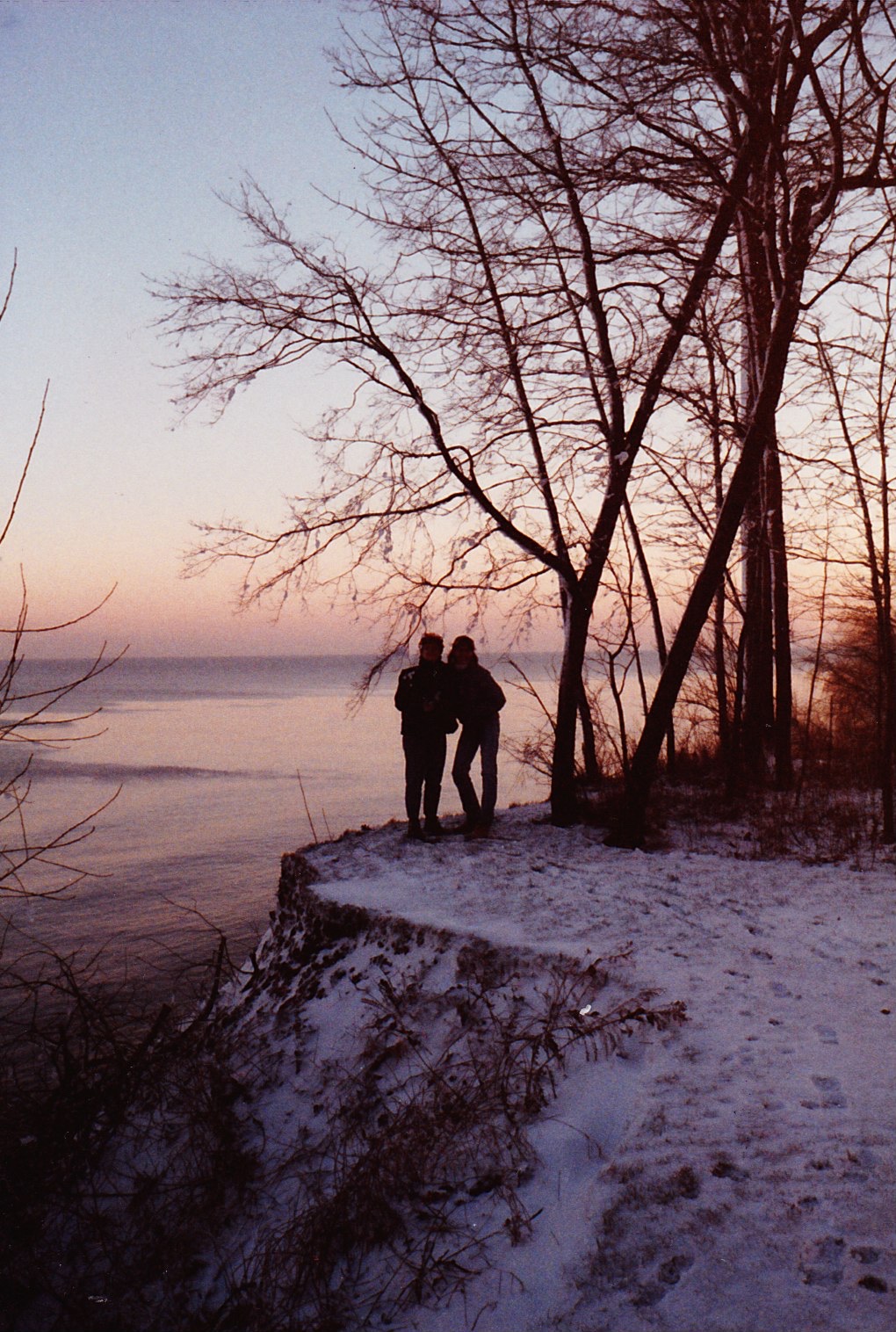
we stand the edge of the bluff, 

looking out over the grand, Great Lake

right there at our toes.

We can see the silhouette of Chicago, 40 miles south.

Excitement for this strange, new place now erupts.

This place will become significant for all of us:

A decades-long breeder of unsupervised fun.

First beers. 

First cigarettes

And, of course, first bongs.

Secret rendezvous for teenage loves.

Outbuildings will be havens for fainthearted runaways

who soon long for home just a few feet away.

Follies of youth.

Such glorious days.

Until this world begins to erode.

To implode.

And all begin to scatter.

But, oh, what fertile earth it was

living life in the woods 

at the edge of the bluff.

Within Close Range: Mutton Stew

I’m in the middle of the pine-paneled restaurant at Boyne Mountain Resort (somewhere at the top of Michigan’s mitt), sitting in a large, carved pine chair – twice as large as it needs to be. 

Looking around the big, round table, there are siblings to the left and siblings to the right, with Mom and Dad straight ahead; and everyone capable of reading the menu, is. 

Scanning mine for a third time, my eyes keep returning to the word “stew”, which conjures a mouthwatering picture in my head – big chunks of tender meat in a rich, dark gravy.

“How different could mutton be from beef?” a voice in my head insists – repeatedly – drowning out all inner arguments and already placed orders.

It’s my turn.

“I’ll have the Mutton Stew, please.”

The waitress looks up from her pad, hesitates, and then looks to Mom and Dad.

“Oh, Annie, you won’t like that,” Mom gently suggests. “It has a very strong flavor.”

But I protest.

“Anne Elizabeth.”

“Please, Dad,” I plead, revving the perpetually high-powered motor that drives most eight-year-olds.

Mom urges, once more, to reconsider, but I remain unflappable. The lady is waiting and “The Troops” are hungry and restless. Dad raises his eyebrows, then nods to the waitress.

“All right then, Mutton Stew for the young lady.”

Triumphant, I can already taste the dark, rich gravy. 

Minutes seem like hours. The baskets of crackers and breadsticks and the pats of butter on small mountains of ice in the center of the big, round, constantly spinning, Lazy Susan are rapidly disappearing.

Beyond the large, glass windows overlooking the resort’s ski hills, the slopes are ablaze with white and dotted with skiers still eager to slip and slide down the gentle, rolling, Midwestern hills. 

It’s a wonderful sight, but the hungry voice in my head has recently enlisted my stomach, now rumbling, low and loud. Until the waitress returns with her overburdened tray, all I can think about is stew.

Burgers and fries pass by my eyes. Mom has soup and Dad’s given pasta. It takes two hands to carry the large, shallow bowl heading my way. 

I’m so excited, I can hardly keep still in my seat. 

My eyes eagerly follow the large, round bowl to the place setting in front of me and I look down to see…

… a sea of grayish-brownish goo; its foul smell already invading my nostrils.

Pungent.

Powerful.

Horrible.

My hunger instantly retreats, but all eyes at the table are on me. Even the waitress is loitering nearby, which means I can’t possibly back down before the first bite and so, with reluctance, I grab the smallest spoon and in it goes.

Releasing more stink from the bowl of brown-gray gloom.

I scoop up a small, dark morsel; highly doubtful about this dubious-scented mouthful.

It’s instant repulsion. 

Unbridled revulsion. 

A funky chunk of grisly meat that my tongue and teeth want to reject and my throat wants to eject into the clean, white napkin in my lap. But it’s swallow it, or my pride. 

The mutton punishes me all the way down.

Without a word, Mom and Dad turn their attention to their own plates. All follow.

While I’m left alone to stew.

Within Close Range: Ms. O’Hara

She strides down the halls of Lake Bluff Junior High, with her shoulder length, ginger hair parting seventh and eight graders like the Red Sea. 

Always looking as if she’s ready to mount a spirited steed, wearing brown and beige tweed, and a steely, determined expression.

She tries to fill young minds with old tales of the rise and fall of nations and heroes, cultures and convictions; and her classroom walls, laden with maps and relics, attest to all she has invested in the cause.

Rarely standing still, the fiery, young teacher has a fiery will to make her students listen; marching up and down the crowded aisles, often wielding a rather persuasive attention-getting device, which comes down with a “CRACK!” on desktops of students attempting to nap.

NOT in Ms. O’Hara’s Social Studies class.

As she canters through the halls with her tousled, red hair, Ms. O’Hara seems fearless and confident and cool, loath to play any part the fool. No one dares question how tough she can be. 

But I can see.

I can see in those eyes often wild with frustration, an impish will and inclination, lurking in the quiet shadows of a stern reputation. And once in a while, a small, smirking smile, which she’s been hiding all the while, will arise; first in those eyes, then form upon her lips – hands on hips – and eventually she’ll soften, dissolving my inhibition to hang nearby and feed on her powerful presence.

Made even more formidable in her red, Camero convertible.  

She likes to rev its engine and make the boys grin, revealing the mischievous side within. Then hitting the gas when all signs of the school are past, she vanishes amid the village trees, in her brown and beige tweeds.

Into the reds and yellows and browns of autumn, and into my earliest images of a strong, modern woman.

Within Close Range: Mr. Hastings

I don’t like science. 

But I like Mr. Hastings, my 8th grade science teacher.

A tall, unlikely comrade with his horn-rimmed glasses, bow tie, and barely there, gray hair; with his starched, white, short-sleeved shirt – which never varies – but for the cardigan he wears when a chill is in the air.

Schooling restless, new teens hovering absent-mindedly over Bunsen burners and long braids, sharp scalpels, squeamish lab partners, and former frogs, must have its days. 

Especially with the likes of me, barely squeaking out an apathetic C.

Yet Mr. Hastings rarely raises his voice. Rocking the cinder block walls with his frustration only once. 

Maybe twice.

Still I keep myself invisible behind students and books and beakers. Slipping in and out of class. Answering questions only when asked. Until I see some things on the science teacher’s desk.

Sitting on an old newspaper, near little, brown bottles, some brushes, and neatly folded rags, sit several pieces of small-scale dollhouse furniture, which somehow this giant-of-a-man created with his two giant hands, and a crippled right arm due to Polio.

Even though my female peers are now more interested in boys than theirs, there is little else that I adore more than my dollhouse. 

Earned, gifted, and more than occasionally lifted from my Dad’s loose change box, I amass what cash I can to fill my two bedroom, one bath, pale yellow Colonial, with its newly shingled roof of hand-cut, balsa wood. (Jim’s community service for repeated dollhouse abuses.)

I inch my way closer to the old newspaper, longing to get a closer look at the tiny treasures which I normally have to view behind a locked, glass, display cabinet in a local store, guarded by a grumpy, old man, mistrustful of all youth.

Mr. Hastings notices. 

And there we begin – girl to man – sharing a common devotion.

Lifting a teeny-tiny chessboard into the palm of his illogically enormous hand, this towering 8th grade science-teacher-of-a-man describes with great care how he cut and varnished each itsy-bitsy square.

And I listen. 

Ignited by his dedication. 

Astonished by each delicate piece of miniature perfection.

I still don’t like science. 

But I’ll always like Mr. Hastings, with his perfect bow tie, his pressed short-sleeved shirt and barely there, gray hair, and his remarkably gifted hands.

Within Close Range: Mr. Dieden

I hate P.E. 

And the sight of green grass once again spreading across the corner of Artesian Park across from school each spring.

The southeast corner, to be exact, where I suffer through the tortures of Physical Education with activities such as catching a first softball… with my nose… and the annually humiliating 400 yard dash, a quarter mile of side cramps and red-faced misery.

Nauseous and breathless. 

Always one of the last to stumble over the finish line. 

Destined, in Mr. Dieden’s eyes, to be stuck at the bottom of life’s climbing rope forever.

“Walk it off!” he likes to holler unsympathetically to us stragglers, scattered and collapsing at the side of the coned-in track, circling the corner patch of park grass.

Mr. Dieden, with his crisp, white, short-sleeved shirt and shiny, bald head. 

Mr. Dieden, with an ever-present whistle around his neck and clipboard in hand.

Who makes me write: “I will never say ‘Shut Up’ in Mr. Dieden’s 6th period gym class again.” 

1,973 times. (One sentence for each year.)

Didn’t even get the “up” out before his voice echoes off the old gymnasium walls, “Miss Celano. I’ll see you after class.” 

Like he’s been waiting for it. 

Hoping for it.

Never a word to Jeff, on the other side of the net, about his “gold bricks and rich brats” remark.

Within Close Range: Papa’s Store

As buildings begin to replace trees along the Edens Expressway, I watch for familiar signs that we’re getting nearer Papa’s store.

Up ahead, on the right, stands Nickey (with a backward k), a giant, winking, smokestack of a man urging motorists to take the next exit for their very own, souped-up Chevrolet. 

The first downtown-bound sentry means twenty minutes more. 

Further along the constantly changing horizon, the magnificent, cherry red, neon lips of Magikist – 80 ft. high and puckering up for passersby for years – appears on the left, dazzling and hypnotic, garishly separating the suburbs from the city; the quiet and conventional, from the wonder and the chaos. 

Fifteen more minutes. 

At the very edge of the highway, around the next bend, looms the monster of a Morton Salt building and a great expanse of roof (almost level with the highway) painted with it’s iconic logo. I like to count how many seconds its takes to pass this massive, salt-filled warehouse.

And the girl in the yellow dress, with her big umbrella and box of Morton’s.

One-one-thousand, two-one-thousand, three-one-thousand…

… until it disappears from the smudged rear window.

Ten minutes more. 

Taking the next exit, we’re no longer speeding past the inner-city scenery, no longer isolated from the purposeful sprawl, but entering the industrial grime of Ohio Street’s massive warehouse district, desolate and dingy; where faded ads cling to crumbling brick walls and vast stretches of soot-stained windows lay dark and broken along shadowed streets, gray, cracked and worn from the Windy City’s daily grind.

I sink in my seat and cautiously scan the familiar but frightening streets for signs of trouble. My uneasiness arising from the barely discernible (except for the simultaneous “click”), but habitual practice Mom has of locking the doors before the first red light. 

Only after old brownstones and young professionals replace storehouses and seedy-looking characters, do I straighten up and welcome the city outside the window.

The constant beep of car horns trying to hurry along traffic below the tall buildings and shadowed streets. The constant movement of people of all types – not just well-off and white.

The dingy beads of water from the elevated tracks and platforms that plop, trickle and disappear down the window of the station wagon and tell me we’re very near.

Dressed in our Sunday best, fermenting with the pent up energy forty-five minutes in close quarters guarantees, our restless tribe is led in a disorderly row, through the perennially cold, dark, parking structure and onto the city streets. 

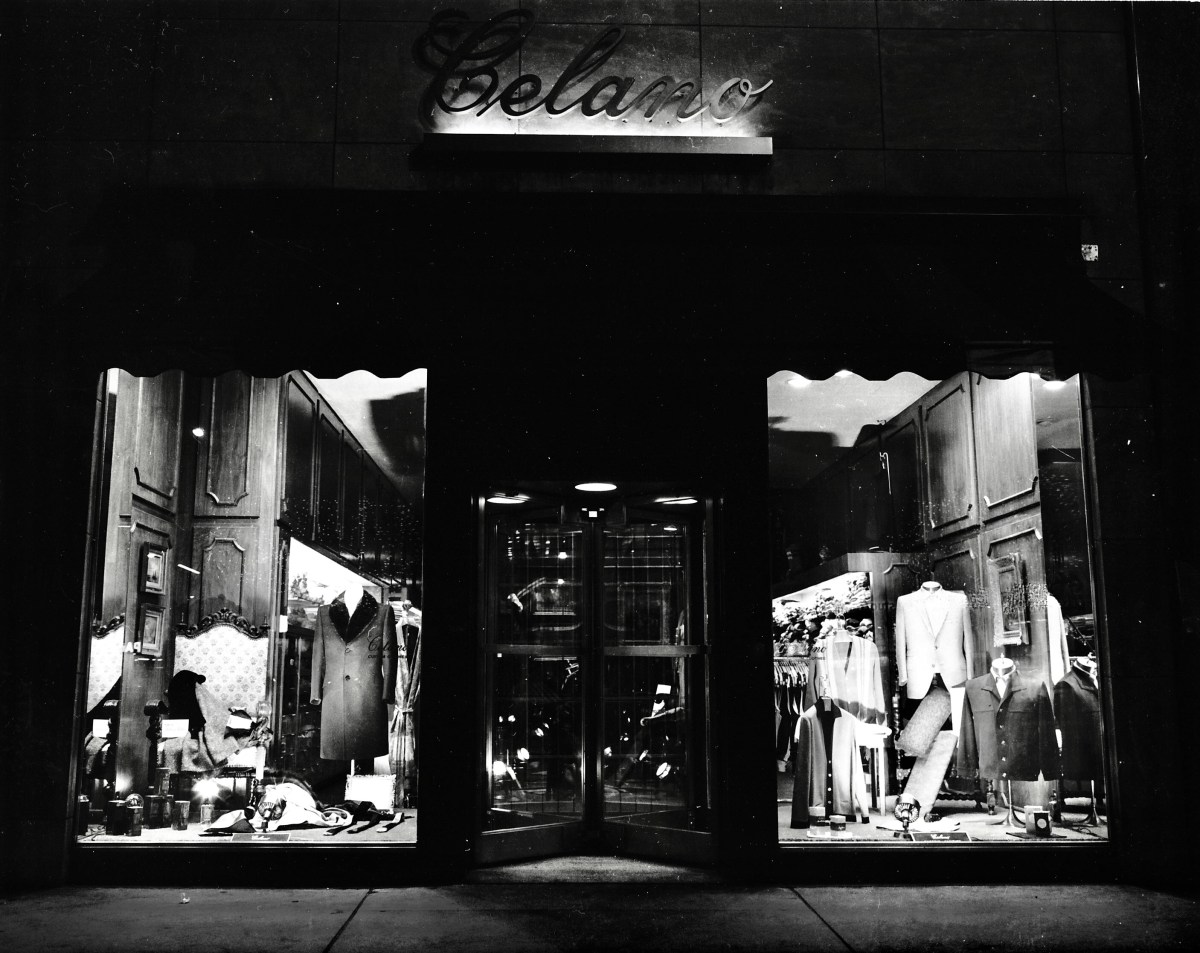
One block down and around the corner, to Michigan Avenue, I know to look for the red and gold awning (between the fancy shoe store and even fancier department store). 

As soon as I spot it, I pick up my pace until reaching the revolving door of Papa’s store, Celano Custom Tailors.

Squeezing my way into the pie-shaped divisions and forced to spin a circle and a half – by a sibling pushing the rotating door too fast – I stumble onto a sea of cardinal red carpet.

Impeccably clean. 

Incredibly lush.

At the end of the long, narrow showroom, past smartly dressed salesmen and bolts of rich fabric, stands Papa. 

Smiling quietly. 

Waiting to give his warm, well-pressed, fragrant hugs to each of his progeny.

After which, he gently, but hastily, scoots all five of us to the back of the store. Away from the immaculate glass cabinet displays of silk ties, colorful ascots and men’s colognes. 

Away from the meticulously stacked cashmere sweaters, and roll after roll of expensive Italian wools, French cottons and Irish linens. Keeping us well clear of the handsome, silk robes neatly hung on racks with red, wood hangers, custom-stamped in gold.

Most of all, we are whisked away from his well-to-do clientele in their very expensive, custom suits, custom shirts and spit shine shoes.

But my interest lies down a narrow set of stairs, in the windowless world below; where little men, with measuring tapes hung around their necks and giant scissors in their hands, bend over large, long work tables, spread with dark wools and shimmering silks.

They always stop and smile, exclaiming how much we’ve all grown, but my attention is on what’s behind the glass partition where Papa’s bookkeeper works, and in the bottom drawer, at the side of her desk, piled high with ledgers.

As soon as I reach her side, she bends toward the drawer with her piled-high hair.

Casting a shadow over her bookkeeping.

And from it she takes out a full box of Turtles – chocolate and caramel and pecans in a gooey, luscious mound. 

Papa’s favorite. 

And mine. 

In our silent ritual, I smile and thank the bee-hived bookkeeper and choose a turtle from the box, before being pushed by an impatient sibling next in line.

Permitted back upstairs only after all hands have been inspected, we’re led to Papa’s office where Jim plays boss with the many-buttoned telephone on the large, leather- topped desk. Until he dials the storefront and annoys the staff and Papa appears with playing cards and store stationary, and a gentle warning. 

Stop fidgeting. 

With Mom and Dad still shopping, we begin to take turns spying on the front of the store, watching the elegant dance of silent footsteps, hushed tones and controlled smiles in full-length mirrors. Making me feel as if I’m witnessing something sacred in the tending of well-to-do gentleman.

As if an ascension.

Until Jim discovers the stereo and starts pushing buttons. 

Shattering the sober storefront with an unexpected symphony. 

Instantly paroled from our conference room confinement, we race along the heavily padded, red carpeting, past the quiet clerks and perfect displays, and bolts and bolts, of dark, rich fabric.

Past Papa, who flinches when our many-footed exit shakes the cabinets.

And ruffles his clients. 

Michigan Avenue is an eruption of motion and commotion, which we’re swept up in, until we find ourselves among the tourists and the toilers at the base of the very new John Hancock Center.

Pressing my hands and body against its cool, black steel, I look skyward, trying to see the skyscraper’s top. Struggling to keeping my balance.

It makes me dizzy and suddenly anxious to see the red and gold awning. 

And the thick, red carpeting.

And Papa’s outstretched arms, for one last hug, before returning north. 

Past the giant girl in the yellow dress. 

Past the giant, neon lips, now lighting the early evening skies with its rosy red glow. 

Past the smokestack man disappearing in the dusk.

To the quiet woods. 

To the dark skies.

To home. 

Within Close Range: Summers on the Edge

I find solace in the familiar sounds of summer at Shoreacres.

The Northwestern train keeping to its schedule.

Bank Swallows calling to their colony as they swoop to and from nests pockmarking the sandy bluff wall.

The harbor’s baritone foghorn warning boats buried in Lake Michigan’s mist.

Even the sailors at the Great Lakes Naval Training Center to the north chime in, drilling up and down the parade grounds.

Marching.

Grunting.

Singing and rhyming.

Voices hovering in the air like ancient tribal chants.

Laying on the lawn overlooking the lake, I close my eyes and ease into the familiar sound of the sailors’ strong, low voices.

And the marching band practicing its spirited battle hymns.

Miles away, but strong and clear.

Carried to my ears by the lake winds cutting through the thick, moist air that smells of fresh cut lawn and freshwater fish.

Sun-filled days of climbing up and down the bluff where the path used to be before the lake rose and stole chunks of land, leaving little but swallow holes and sand – and killer cool ledges for daring leaps by reckless kids who take to the skies, then aim for the beach, landing in the soft, thick sand below – hot on the surface, but damp and cool just inches beneath.

Wriggling my toes further into the moist earth, I try to recapture the wind knocked out of me in the landing, until voices from above goad me into action and I’m forced forward again, down the soft, crumbling bluff, to a rugged line of boulders Dad had dropped on the beach in his failed fight against this infamously wicked lake.

Then one by one, into the water and waves we wade, trying to dislodge sand from our swimsuits and butt cracks. Feeling the lake’s strong, cold undertow at our feet and the strong, hot sun on our heads.

Watching our Lab, Heather, joyously and tirelessly swim after a stick bobbing on the waves. 

Silly dog.

Then up to the top we head to bound down again.

And again.

And again.

Long summer days invade the nights, inspiring late nights of Ghost in the Graveyard and Sardines and a world of hiding places scattered around our acres and outbuildings, where we squat amid the fireflies’ ambitious flickering and whisper above the crickets and cicadas charging the atmosphere with their measured, mesmerizing songs.

Reminding me that I am never really alone.

Standing at the edge of the bluff on the Fourth of July, with the comforts of home just steps away, we watch the fireworks displays from Chicago to Waukegan, “Ooohing” and “Ahhing”, mimicking the faraway crowds and slapping at mosquitoes determined to disturb our private celebration.

Mom unfreezes boxes of brats and burgers to feed a small army, which eventually arrives with empty stomachs and pockets full of bottle rockets, sparklers and Roman candles ample enough to light the skies and the lake, and disturb our quiet neighbors long after the distant festivities have ended.

But the best displays I witness from the brink are the summer thunderstorms rolling over the Great Lake, and the lightening exploding in sky-wide, silver-white bolts and bursts.

I feel fortunate.

And irrelevant.

On gentler nights when the moon is full and bright and we can see our way down the bluff to the beach, my siblings and I wade into the vast, still water. 

First, up to our knees. Then our bellies. Then our chests.

Eventually emboldened by the bright moonlight and calm, glassy water, I swim further from the shore and my companions.

Through strange patches of warm in the perpetually cold, inland water.

Scanning the dark stretch of water in front of me and turning to see the sparsely lit shoreline now well behind me, the calm in my mind begins to churn and I begin to worry about what lurks just below my feet – and in those warm patches – and start paddling madly toward the beach and the nearest sibling. 

Not stopping until I’m close enough to feel the sand below my feet, or see a smile in the moonlight.

Finding enormous comfort and calm in the motion of another’s treading water.

In their laughter.

In their teasing.

These are the endless days spent layered in sand and sun tan oil. 

Brown and blissful.

These are the days of sleeping well into the afternoon, or until the smell of breakfast cooking below wafts into my room… 

or my class schedule arrives in the mail all too soon.